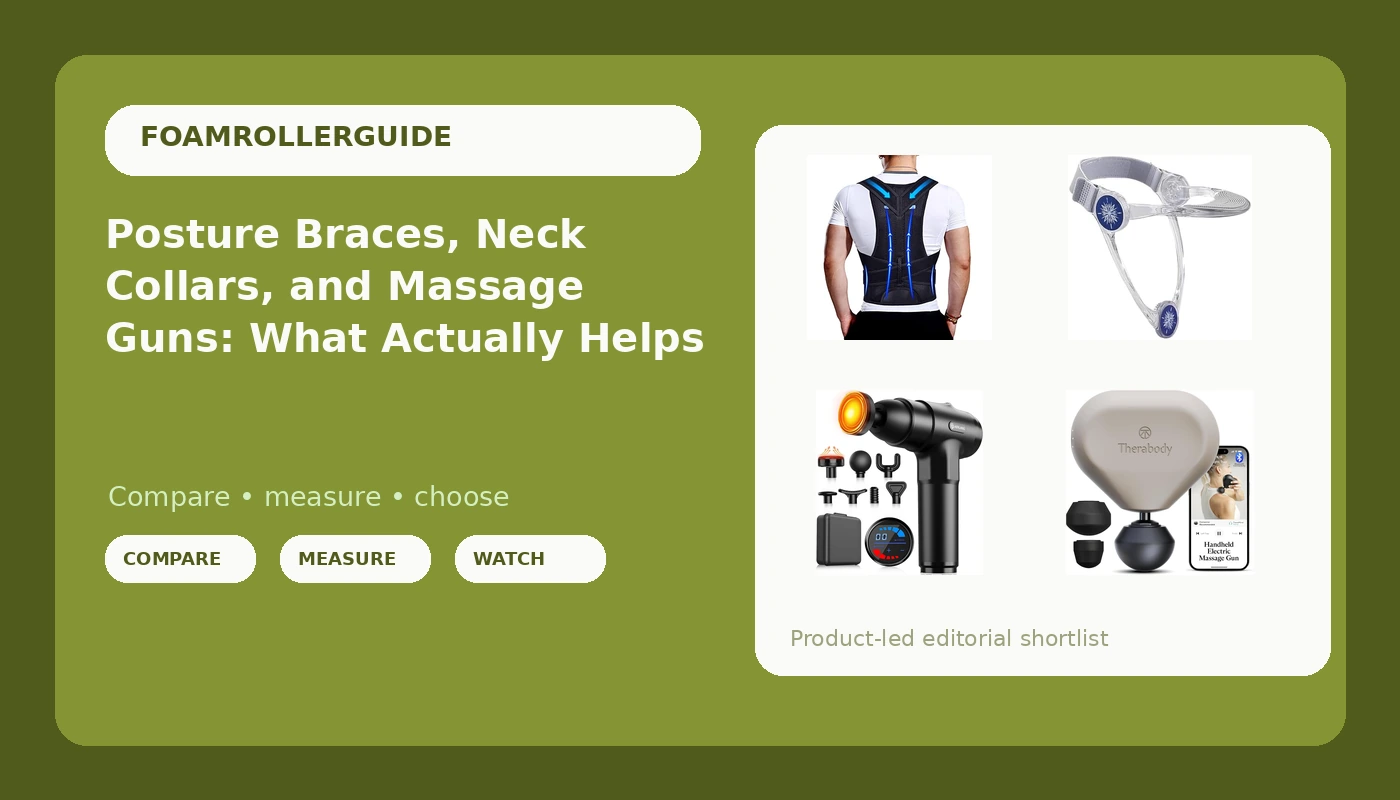
Most people who go looking for posture and recovery tools are not shopping for a hobby. They are trying to solve one specific complaint: a low back that starts grumbling by mid-afternoon, a neck that feels like it carried the laptop home, or shoulders that stay bunched up hours after the stressful email got answered. The four products below all live in that territory, but they do genuinely different jobs, and that is where most people go wrong. A brace, a collar, and a massage gun are not three versions of the same purchase. Buy the one that matches your symptom and your daily routine, or buy nothing and save the money.
Related: How to Foam Roll Your Quads Without Wrecking Your Knees →
Quick answer
No single tool here fixes posture, and any listing that promises that is overselling. These products split into three jobs: a back brace holds a position while you are in it, a cervical collar offloads and stretches the neck in short sessions, and a massage gun works on muscle tissue only. Match the tool to the tissue, keep the doses short, and keep percussion off bones, joints, and the spine. If your pain is sharp, radiating, or getting worse week over week, that is a conversation with a clinician, not a product page.
Four useful options
| Model | Best fit | What stands out |
|---|---|---|
| Upgraded Posture Corrector Back Brace for Men and Women, New Version Lumbar Support for Posture Improving and Pain Relief, Full Back Support for Neck, Shoulder, Waist Pain, L | All-day postural reminders while you sit, drive, or walk | Adjustable brace format sized for both men and women, with lumbar support and coverage described for the neck, shoulders, and waist |
| 360° Adjustable Neck Collar - Neck Support with Neck Stretcher | Cervical Collar Made of Plastic for Correcting Forward Head Posture and Relieving Neck Pain | Neck-focused complaints and forward head posture | A plastic cervical collar with a 360 degree adjustable fit and a built-in stretcher function |
| Massage Gun with Heat Massager Deep Tissue Muscle Massager Gifts for Men | Muscle tightness plus warmth in one pass | Percussion massage combined with a heat function in a single handheld unit |
| TheraGun Therabody Mini 3rd Gen Massage Gun | Travel Essential, Oat | Keeping recovery work in a gym bag or carry-on | A compact mini format from Therabody, listed as a travel essential |
The daytime support: Upgraded Posture Corrector Back Brace for Men and Women, New Version Lumbar Support for Posture Improving and Pain Relief, Full Back Support for Neck, Shoulder, Waist Pain, L
A brace is an external cue, not a muscle. It changes the position you hold while you are wearing it, and that is the entire mechanism. The trap is treating it like a cure: wear it for twelve hours a day and the muscles that are supposed to hold you upright get to stay lazy, which is the opposite of what you want long term. My rule for patients is blocks, not days. Put it on for the stretch of the afternoon when your posture historically falls apart, take it off for sleep and for any long period where you can get up and move instead. If you cannot function without it after a few weeks, that is information about your strength and your workstation, not about the brace.
The neck-specific tool: 360° Adjustable Neck Collar - Neck Support with Neck Stretcher | Cervical Collar Made of Plastic for Correcting Forward Head Posture and Relieving Neck Pain
This is the category I worry about most, because it is the one people leave on for an hour while they watch television. Anything that offloads or stretches the neck should be dosed in minutes, not in evenings, and it should never be a sleep aid or a driving accessory. The feedback loop matters too: if you feel tingling, numbness, dizziness, or pain running down an arm, take it off and get evaluated. A collar can be a useful short-term input for a neck that has been stuck forward for months, but it is not a substitute for the boring work of strengthening the deep neck flexors and the upper back.
The heat-equipped gun: Massage Gun with Heat Massager Deep Tissue Muscle Massager Gifts for Men
Heat makes tissue more pliable, which is why a warm muscle often moves better right after. That cuts both ways: warm tissue also reports less accurately, so it is easier to press harder than you should without noticing. Keep the head on the belly of the muscle, glutes, quads, calves, upper back, and give each area a couple of minutes rather than a couple of songs. The neck and spine are off limits for percussion, always, and so is anything bony or numb. That is not caution for its own sake. I have seen the injuries.
The travel gun: TheraGun Therabody Mini 3rd Gen Massage Gun | Travel Essential, Oat
The best recovery tool is the one that is within arm's reach when you actually have five minutes, and a gun that lives in a carry-on gets used far more often than one that lives on a shelf. The trade-off is real, though. If your main complaint is a stubborn quad or a glute that never lets go, a compact unit may feel like it is skating over the surface, and you will get more out of a firm roller or a full-size gun. Think of the mini as a complement to a roller you already own, not a replacement for it.
Prices and availability may change. Product images, names, and retailer links must be matched by verified ASIN. Do not state a current price, rating, stock status, or measured result without current evidence.
Why these three categories are not interchangeable
A brace, a collar, and a massage gun all touch the same general region of the body, which is why shoppers lump them together, but their mechanisms have almost nothing in common.
A posture brace changes position passively. While it is on, it reduces the demand on the muscles that hold your shoulders back and your ribcage stacked, which can make a long afternoon at a desk feel less punishing. What it does not do is build capacity. Take it off and you are back to your own strength and your own habits, which is why bracing works best as a reminder during a specific window rather than as a permanent fixture.
A cervical collar works on load and length. By supporting the head, it reduces the work the neck muscles do, and a stretcher function adds a gentle traction-like pull. Both effects are temporary and both are dose-sensitive. Longer is not better here. If you have ever spent an hour in a collar and felt looser for ten minutes and worse for the rest of the day, you already know the pattern.
A massage gun is a mechanical input to muscle. Percussion appears to reduce perceived soreness and give a short-term window of better movement, which is genuinely useful before or after training. It does nothing for a joint, a disc, or a nerve, and using it on those structures is how people turn a mild problem into a memorable one.
Foam rolling sits in the same family as the gun, and most people reading this already own a roller. A firm roller covers large areas like the quads, IT band region, and upper back with more surface contact than a gun head, and it costs less. If you are choosing between a roller and a gun, the honest answer is that a good firm roller gets you most of the way, and the gun is the convenience upgrade.
How to dose each tool
Dosing is the part nobody sells you, and it is the part that decides whether a tool helps. The principle is simple: enough input to change the tissue's behavior, not enough to irritate it. Two minutes per muscle group, pressure that is uncomfortable but not painful, and a clear end point before you start.
- Name the symptom and the tissue first. Muscle soreness points to a gun or a roller. A position you cannot hold points to a brace. A neck that clenches forward points to a collar, briefly.
- Set the clock before you begin. Two minutes per muscle group with percussion, short timed sessions in a collar, and brace use in work blocks rather than all day.
- Apply the pressure rule. Discomfort is acceptable, pain is not. If you are gritting your teeth or holding your breath, you are past the useful dose.
- Reassess after a week of consistency. If nothing has changed, the tool is not your answer, and more of it will not help.
- Stop for red flags. Numbness, tingling, weakness, dizziness, or pain that travels down a limb means put the device down and get it looked at.
How to use these tools without making things worse
- Wear the brace for the hours you actually need it, and take it off for sleep and for any stretch of sitting you can break up with movement instead.
- Use the collar in short, timed sessions, never as a pillow, and never while driving.
- Keep percussion on muscle bellies only: glutes, quads, calves, upper back. Off the neck, the spine, and every joint.
- Pair heat with movement. Warm tissue that then moves beats warm tissue that stays on the couch.
- Buy for the routine you already have, not the one you are planning. A compact gun in your bag beats a full-size one on the shelf.
Which option should you choose?
Choose the Upgraded Posture Corrector Back Brace for Men and Women, New Version Lumbar Support for Posture Improving and Pain Relief, Full Back Support for Neck, Shoulder, Waist Pain, L when your complaint shows up as a position problem during the day and you want a wearable reminder to sit and stand taller while you work or drive.
Choose the 360° Adjustable Neck Collar - Neck Support with Neck Stretcher | Cervical Collar Made of Plastic for Correcting Forward Head Posture and Relieving Neck Pain when the problem is specifically your neck and forward head posture, and you are willing to use it in short, supervised-feeling sessions rather than all evening.
Choose the Massage Gun with Heat Massager Deep Tissue Muscle Massager Gifts for Men when your tightness is muscular and you want warmth and percussion in the same pass, especially before movement or after a long day.
Choose the TheraGun Therabody Mini 3rd Gen Massage Gun | Travel Essential, Oat when portability is the deciding factor and you want something that fits in a bag you actually carry.
None of these tools replaces load management, strength work, and sleep, and the evidence for posture braces and collars is far thinner than the marketing suggests. They are adjuncts. If your symptoms are persistent, worsening, or accompanied by neurological signs, the right next purchase is an appointment, not a device.
The bottom line
Posture and recovery tools work when they are matched to a specific job and used in honest doses. A brace is a reminder you wear for part of the day. A collar is a short, careful input for the neck. A massage gun is for muscle tissue, and only muscle tissue, with heat as a comfort bonus and portability as a real but limited advantage. Pick the one that fits the symptom you actually have and the routine you actually keep, use it in small consistent amounts, and judge it after a week rather than after a single session. If it is not helping, that is a real result, and it is worth more than another gadget.