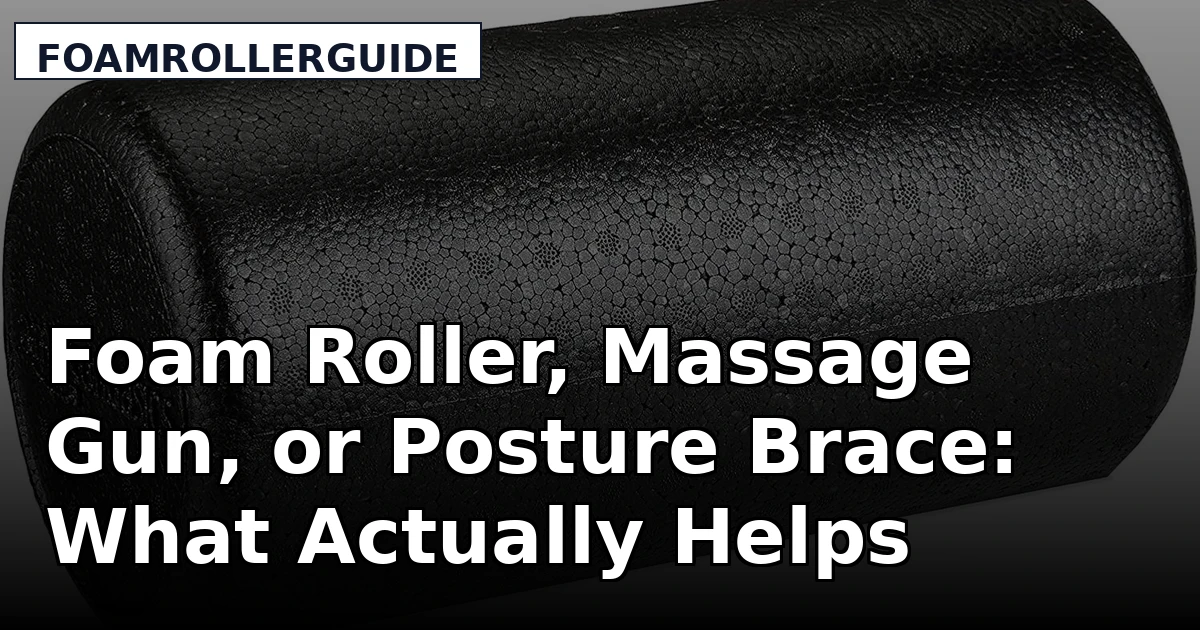
Most people shopping for recovery gear are really asking one question: which of these things will actually make me feel better? That question gets harder because a foam roller and posture corrector are sold side by side as if they do the same job. They do not. A roller is a pressure tool you move your own body against. A posture brace is a wearable that changes how you hold yourself while you work, drive, and stand in line. A handheld massager sits in the middle, applying force to muscle tissue without asking you to get on the floor.
The confusion costs money. Someone with a stiff mid-back buys a brace because wearing it is easier than rolling. Someone whose shoulders round forward buys a roller because it is cheaper than the brace a friend recommended. Neither tool is wrong. Each is aimed at a different problem, and the buying decision gets much simpler once you separate tissue work from posture support.
This explainer covers four common, low-drama options: a budget high-density foam roller, a handheld percussion massager, and two posture correctors with very different amounts of coverage. It explains what each one is for, where each one falls short, and how to decide which single purchase makes sense for your body right now.
Related: How to Roll Your Quads Without Bruising Yourself →
Quick answer
If the tightness lives in muscle tissue and you can comfortably get on the floor, start with a foam roller. If you want pressure on muscle without floor work, or you need to cover a large area like the quads or calves quickly, a handheld percussion massager is the tool built for that. If the problem is that you collapse into a slump by mid-afternoon and your upper back aches because of it, a posture brace is the category aimed at that problem, and it works best as a reminder that supports strength work rather than as a permanent crutch. Two of the options here are braces, and the practical difference between them is how much of your torso they touch.
A note on what a brace can and cannot do: posture supports are reminders. They cue you to bring your shoulders back, and lasting change comes from the muscles you train while wearing one. Anyone with ongoing pain, numbness, tingling, or a diagnosed spine condition should get clearance from a clinician before adding a brace to the daily routine.
Four useful options
| Model | Best fit | What stands out |
|---|---|---|
| Amazon Basics High Density Foam | A first roller and a low-commitment start | High-density foam in a plain cylindrical format |
| Hyperice Hypervolt 2 Pro Handheld Percussion Massage Gun Deep Muscle Tissue | Muscle work without floor space | Handheld percussion design aimed at deep muscle tissue |
| Posture Corrector for Men/Women, Full Back Brace, Lumbar Support | Broader torso coverage and lumbar support | Full back brace design that includes lumbar support |
| FlexGuard Posture Corrector for Women and Men, X-Large | A lighter daily reminder | Adjustable shoulder and back support, listed in X-Large |
The budget roller: Amazon Basics High Density Foam
A high-density foam roller is the least glamorous purchase in this article and often the most useful. Density is the spec that matters. A soft roller compresses under your weight and spreads force across a wide area, which is appropriate for a ribcage or a tender calf and close to useless for a hamstring that needs real pressure. High-density foam is the opposite trade: less give, more focused pressure, and a firmer feel that some people dislike for the first week.
The catch with any foam roller is that it demands effort. You supply the force by lifting and lowering your body weight over the roller, and the pressure you feel is a direct result of how much weight you put on it. That is a feature, not a flaw, because it lets you dial the dose down to almost nothing when a muscle is irritated. It also means a roller that stays in the closet helps nobody. Buy the inexpensive one if you are unsure you will use it, and upgrade later once you know you will.
The percussion tool: Hyperice Hypervolt 2 Pro Handheld Percussion Massage Gun Deep Muscle Tissue
Percussion devices do something a roller cannot: they deliver force to muscle tissue without requiring you to support your body weight over anything. For someone who cannot comfortably get down on the floor, or who wants to work a single dense area like a calf or a quad without a full rolling session, that convenience is the entire point.
The trade-offs are real. A percussion device applies a rapid, repeated impulse to a small contact area, which is excellent on muscle bellies and inappropriate on bone, joints, the front of the neck, and the spine. It also invites overuse, because it feels good and takes no effort. Two minutes per muscle group is a dose. Fifteen minutes because the battery is charged is not recovery, it is a hobby. And no percussion device replaces the strength work that keeps a shoulder from rolling forward in the first place.
The full-coverage brace: Posture Corrector for Men/Women, Full Back Brace, Lumbar Support
The word "full" in the product name is the important part. A brace that covers the back and the lumbar region touches more of your torso than a strap-based corrector, which changes both how it feels and how it fits under clothing. More coverage usually means more material against your skin, more warmth, and a silhouette that is harder to hide under a t-shirt.
Full coverage is not automatically better. It is a different job. Someone whose main complaint is a mid-back that fatigues by three in the afternoon may want that broader support. Someone who wants a light reminder they can wear under a work shirt will find a full brace bulky and hot. That is not a failure of the product. It is a question of which problem you are actually solving.
The light reminder: FlexGuard Posture Corrector for Women and Men, X-Large
This is the strap-and-shoulder style most people picture when they hear posture corrector. The listing describes adjustable support for the shoulders and back, and it comes in X-Large, which matters because a corrector that is too small pulls the shoulders back too aggressively and gets taken off within an hour.
Strap-style correctors are best understood as reminders with a fit problem to solve. If the straps dig into the armpit or the front of the shoulder, the size or the adjustment is wrong, and no amount of willpower fixes that. The honest limitation is that a brace can hold a position, but it cannot build the endurance to hold that position yourself. That comes from rows, rear delt work, and the unglamorous habit of sitting up straight when nobody is watching.
Prices and availability may change. Product images, names, and retailer links must be matched by verified ASIN. Do not state a current price, rating, stock status, or measured result without current evidence.
Tissue work and posture support are different jobs
Rolling and percussion belong to the same family: they apply mechanical pressure to muscle and the surrounding connective tissue. The popular story is that they "break up knots" and "release scar tissue." That story is not supported, and repeating it does not help anyone buy better gear. What pressure actually appears to do is change how the tissue and nervous system respond in the short term: blood flow increases, the local tissue feels less guarded, and a range of motion that felt blocked often opens up for a while. That window is useful. It is not permanent remodeling, and it is not a substitute for strength.
The nervous system part matters more than people expect. Much of what we call tightness is a muscle doing its job of protecting something it thinks is unstable. Pressure can calm that response temporarily, which is why rolling before training feels different from rolling after. Before a session, light pressure and movement prep the tissue for work. After a session, slower pressure at a tolerable intensity helps settle things down. They are not interchangeable, and doing the wrong one at the wrong time is a common reason people conclude that rolling "does not work for them."
Posture braces work on a completely different principle. They do not change tissue. They change position, and they do it passively, which is exactly why they need a plan around them. A brace holds your shoulders where you cannot hold them yourself yet. The muscles that eventually do that job, the mid-back and rear shoulder muscles, only get stronger if you use them, and they only get used if you spend part of the day out of the brace. Worn all day, every day, a brace can become the thing your posture depends on rather than the thing that helps you rebuild it.
How to match the tool to the target
- Name the problem in one sentence. "My calves feel locked after runs" points to tissue work. "My upper back aches by the end of the workday" points toward posture support. "I cannot get on the floor without pain" points to a handheld device or a different plan entirely.
- Identify the tissue or the position you are targeting. Quads, calves, glutes, and mid-back respond to pressure tools. Shoulder position and thoracic posture respond to strength work first, with a brace as a temporary reminder.
- Pick the category before the brand. A firmer roller is the right call for large, dense muscle groups and the wrong call for a ribcage. A percussion device suits someone who will not do floor work. A brace suits someone who has a strength routine and needs a cue during the hours they cannot train.
- Set the dose before you buy. Two minutes per muscle group at a pressure that is uncomfortable but not painful is a working protocol. A brace worn for a set number of hours per day with a specific purpose is a plan. Neither one is "whenever I remember."
- Decide whether you will actually do it. The best tool in this article is the one that fits your routine. A roller you never unroll, a massager that lives in a drawer, and a brace that stays in its box all cost the same amount of nothing.
Practical guidance
- Roll or use percussion on muscle bellies only. Bones, joints, the front of the neck, and the spine are off limits, and that is not a conservative preference, it is a line worth holding.
- Back off when the sensation turns sharp, burning, or shooting. Pressure that is uncomfortable but steady is a different signal than pain, and pain means stop rather than push through.
- Keep sessions short and repeatable. Two minutes per area, most days, beats a heroic twenty-minute session once a week that leaves you sore and unwilling to repeat it.
- Treat a brace as a training partner, not a treatment. Wear it for defined blocks, do the strength work that makes it unnecessary, and build time out of it deliberately.
- Reassess after a month. If the roller is doing its job, the same pressure should feel more tolerable. If a brace is doing its job, you should need it less, not more.
- Check sizing before you commit, especially on a strap-style corrector. A posture brace that does not fit will be uncomfortable no matter how well it is made.
Which option should you choose?
Choose the Amazon Basics High Density Foam when you want the cheapest sensible way to start rolling and you are willing to do the floor work that makes a roller useful. Choose the Hyperice Hypervolt 2 Pro Handheld Percussion Massage Gun Deep Muscle Tissue when you want pressure on muscle tissue without getting on the floor, or when you need to cover dense areas like calves and quads quickly and consistently. Choose the Posture Corrector for Men/Women, Full Back Brace, Lumbar Support when your complaint is a whole back that fatigues during the day and you want broader coverage plus lumbar support in one piece. Choose the FlexGuard Posture Corrector for Women and Men, X-Large when you want a lighter, adjustable reminder you can wear under clothing and you need a larger size.
One caveat worth repeating: none of these tools treats a medical problem. Posture braces are support garments, and the evidence behind them is mostly about short-term posture cues rather than long-term correction. Rolling and percussion are comfort and movement tools, not cures for an injury. If pain is persistent, radiating, or getting worse, the right purchase is an appointment, not a product.
The bottom line
Tissue work and posture support solve different problems, and buying across those categories is how people end up with a closet full of gear that never gets used. If your muscles feel tight and you will do the floor work, the budget high-density roller is the simplest place to start. If floor work is not realistic or you want targeted pressure in less time, a handheld percussion massager covers that gap. If the problem is how you hold yourself through a workday, a brace is the right category, and the choice between a full-coverage brace and a lighter adjustable one comes down to how much of your torso you want covered and how discreet you need it to be. Pick one, use it consistently for a month, and judge it on whether you are still reaching for it in week five.