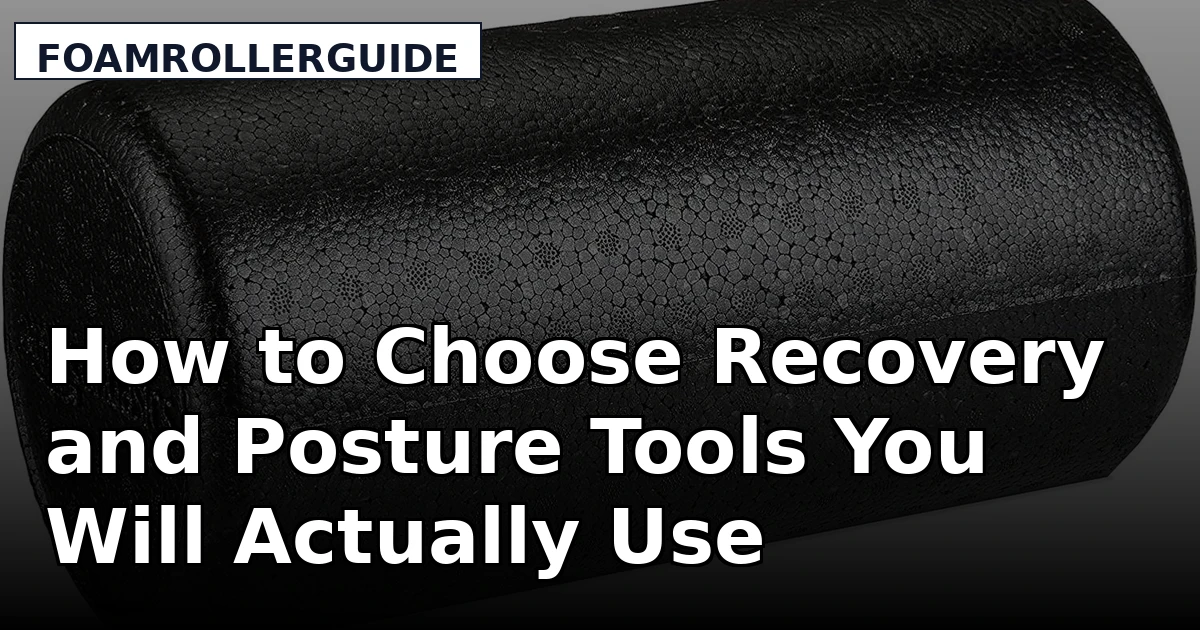
Most people who buy recovery gear are trying to solve one of two problems: something feels tight, or something aches after a long day at a desk. The trouble is that the shelf of recovery and posture tools has grown faster than most of us can keep up with. A high-density foam roller, a foot roller, an acupressure mat, and a posture brace all promise relief, and not one of them does the same job as the others. Buy the wrong one and it lives in the closet. Buy the right one and it becomes the fifteen minutes of your day that keeps your calves and shoulders from tightening back up.
Related: How to Roll Your Quads Without Wincing →
Quick answer
No single tool covers every job. A high-density foam roller handles large muscle groups like quads, calves, and hamstrings. A foot-specific roller is for arches and plantar tissue, which a full-size roller cannot reach well. An acupressure mat is a lying-down, low-effort tool for upper back tension and winding down. A posture brace is a reminder device for people who slump, not a strength program. Match the tool to the tissue you are targeting, then be honest about whether you will actually use it.
Four useful options
| Model | Best fit | What stands out |
|---|---|---|
| Amazon Basics High Density Foam | Large muscle groups and first-time rollers | A plain high-density foam cylinder with no hardware to maintain |
| TRIGGERPOINT Performance Nano LTE Foot Roller Massage Roller for Deep Tissue Massage | Feet, arches, and plantar tissue | Built specifically for foot and arch work rather than whole-body rolling |
| ShaktiMat Acupressure Mat for Tension Release & Relaxation, Level 1 Black | Upper back tension and nervous system wind-down | Acupressure points across a mat you lie on rather than roll over |
| Posture Corrector for Women and Men, Adjustable Full Back Brace Support | Desk-posture reminders | Adjustable straps and full back brace support across the upper back |
The everyday roller: Amazon Basics High Density Foam
Density is the whole conversation with a roller, and it is where most buyers get misled. A soft roller is not a beginner version of a firm roller; it is a different tool for a different target. Soft foam belongs under a ribcage, a sensitive low back, or someone who has never rolled before and needs to learn the movement without wincing. Firm foam belongs under a calf, a quad, or a hamstring, where the tissue is thick enough to take real pressure. When a listing prints "deep tissue" on a roller that squashes flat under one hand, that is marketing, not engineering. The trade-off with a simple cylinder is that you control the pressure entirely with your own body weight, which is exactly what makes it a good first purchase and a slightly limited tool once you get strong.
The foot specialist: TRIGGERPOINT Performance Nano LTE Foot Roller Massage Roller for Deep Tissue Massage
The plantar fascia is a thick band that runs along the sole of the foot, and it is one of the few structures where a dedicated tool genuinely beats a general one. Rolling a foot on a large foam cylinder is awkward at best, because the roller is wider than the arch and your ankle ends up doing the work. A foot roller lets you sit down, load the arch with your body weight, and move slowly from heel to ball. The trade-off is obvious: this tool does one thing. If your tightness lives in your calves and quads, this is not the purchase. If your first three steps out of bed in the morning are the worst part of your day, it is worth the shelf space. Keep the pressure honest. A foot roller that makes you hold your breath is a foot roller you will stop using by week two.
The wind-down option: ShaktiMat Acupressure Mat for Tension Release & Relaxation, Level 1 Black
Here is the honest version of how an acupressure mat fits into recovery. It does not replace rolling, and it is not a stretching tool. What it does well is give you a reason to lie still on your back for ten or fifteen minutes with your shoulders supported, and the point contact gives your nervous system something to pay attention to while you do it. That matters for the desk worker whose upper back never gets to unclench, and for anyone who finds it easier to lie down than to roll. The trade-off is sensation. The first few minutes are sharp, and that is normal, but it should settle into something warm rather than something you are enduring. Start with a shirt on, keep the session short, and add time only when the sensation stays comfortable.
The posture reminder: Posture Corrector for Women and Men, Adjustable Full Back Brace Support
Be careful with this category. A brace does not build the muscles that hold your shoulders back, and wearing one all day can let those muscles get lazy. What it can do is interrupt a habit. If you sit at a desk for eight hours and only notice your posture when your neck starts aching, a brace gives you a physical cue in the moment, which is information you cannot get from a reminder app you ignore. The trade-off is dependence. Use it for blocks of time, take it off for movement and training, and pair it with actual strengthening for the upper back. If you wear it from morning to night, you have traded one problem for another.
Prices and availability may change. Product images, names, and retailer links must be matched by verified ASIN. Do not state a current price, rating, stock status, or measured result without current evidence.
Density, contact area, and why the same roller feels different on two people
Two people can use the same roller and report completely different experiences, and it usually comes down to two variables: how firm the tool is and how much of your body weight you put on it. Density describes how much the material resists compression. A high-density foam roller stays round under a full body load; a soft one flattens, which spreads your weight over a wider area and reduces the pressure at any single point. That is not automatically worse. It is simply a different dose.
Contact area matters just as much. A wide cylinder under a quad spreads force across a large muscle belly, which most people find manageable. The same cylinder under an arch is useless, because the surface is too broad and the shape is wrong. A small, firm tool concentrates force into a narrow area, which is exactly what you want for a foot and exactly what you do not want under a ribcage or a low back.
Put those two variables together and the marketing language starts to sort itself out. "Deep tissue" should mean firm material and focused contact, not a soft roller with aggressive-looking texture. "Gentle" should mean a tool for sensitive or bony areas, not a cheap one. When you evaluate a new piece of gear, ask what tissue it is shaped for and how firm it actually is under your weight. Those two answers tell you more than any label on the box.
Matching the tool to the target tissue
This is the order I use when someone asks what to buy, and it works whether you are shopping or just trying to use what you already own.
- Name the tissue first. A muscle belly, the arch of the foot, the upper back between the shoulder blades, or your whole nervous system. Each one points to a different tool.
- Pick the contact area to match. Wide and flat for large muscle groups, small and firm for feet and hands, broad and passive for lying down.
- Decide how much effort you will realistically give. Rolling is active and takes attention. A mat is passive. A brace is passive all day. The one you will use is the one that fits your energy level on a bad day, not a good one.
- Set a dose before you start. Two minutes per muscle group, pressure that is uncomfortable but never sharp. On a mat, start with a few minutes. On a brace, use blocks of time rather than the whole day.
- Re-check in two weeks. If nothing has changed, change the tool or the dose. Do not simply push harder. More pain is not better data.
Building a routine you will actually keep
- Store the tool where the problem happens. A foot roller by the desk gets used; a foot roller in a gym bag does not.
- Roll after training for recovery and before training only to prepare. They are different jobs with different pressure.
- Keep hard tools off joints, bones, and the spine itself. Muscle tissue tolerates pressure that a joint does not.
- If a session leaves bruising or soreness that lasts more than a day, you went too hard. Back off the pressure, not the frequency.
- Consistency beats intensity every time. Five short sessions a week will do more than one heroic session you dread repeating.
Which option should you choose?
Choose the Amazon Basics High Density Foam when you want one simple tool for quads, calves, and hamstrings, or when you are new to rolling and need to learn the movement. Choose the TRIGGERPOINT Performance Nano LTE Foot Roller Massage Roller for Deep Tissue Massage when your tightness is concentrated in the arches and plantar tissue and a full-size roller cannot reach it. Choose the ShaktiMat Acupressure Mat for Tension Release & Relaxation, Level 1 Black when the tension is in your upper back and shoulders and you want a tool that works while you lie still. Choose the Posture Corrector for Women and Men, Adjustable Full Back Brace Support when you need an in-the-moment cue for desk posture and you are willing to pair it with actual strengthening.
One caveat worth repeating: none of these tools treats a medical problem. Sharp pain, numbness, tingling, or pain that wakes you at night is a reason to see a clinician, not a reason to buy a firmer roller. Recovery gear helps with the ordinary tightness that comes from training, sitting, and standing. It does not diagnose anything.
The bottom line
The right recovery tool is the one that matches the tissue you are actually trying to help and the routine you actually have. A high-density foam roller covers the most ground for the least money and the least maintenance. A foot roller is worth adding only if your feet are the problem. An acupressure mat is a low-effort way to spend fifteen minutes on your back, which many people need more than another exercise. A posture brace is a reminder, not a cure, and it works best in short doses alongside strengthening. Buy for the problem in front of you, dose it sensibly, and give it two weeks before you decide whether it earned its place.