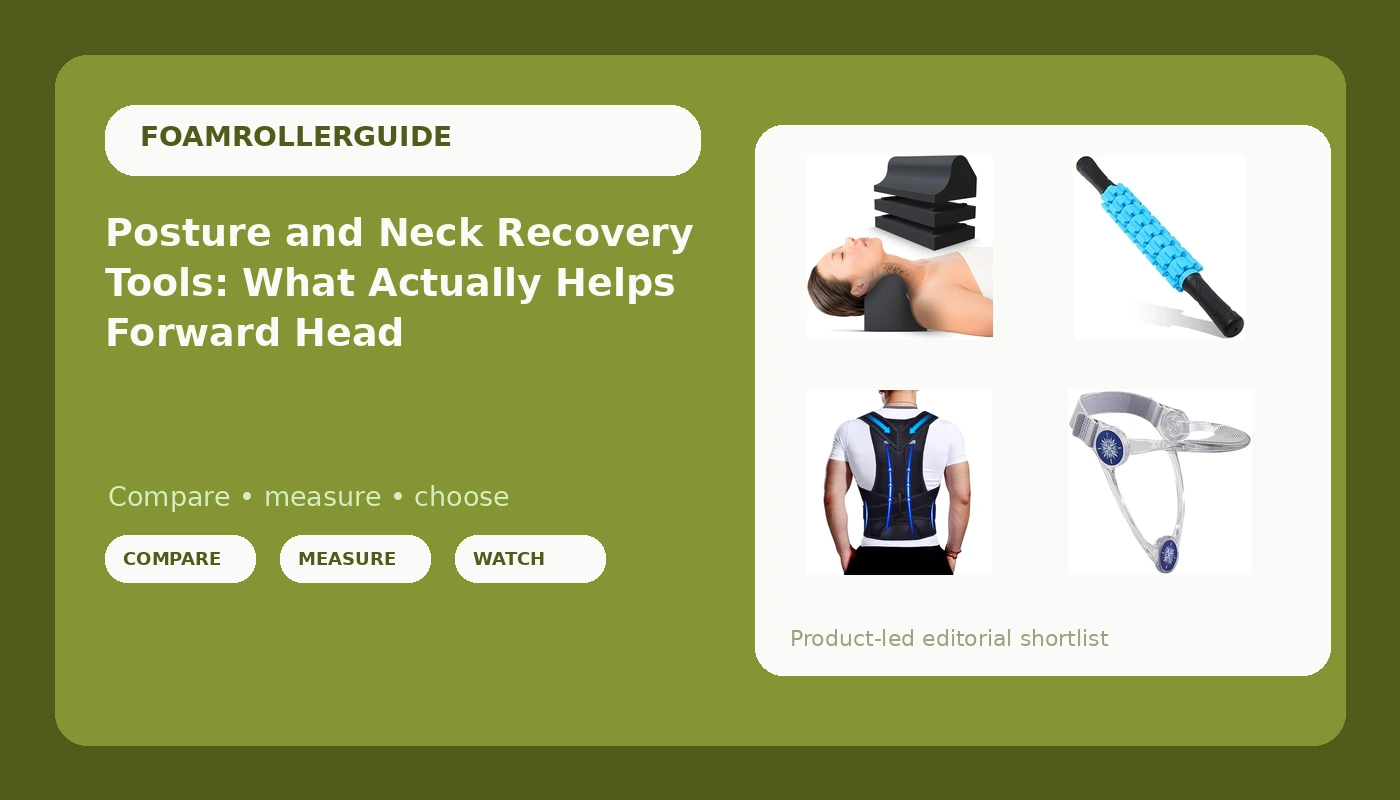
Forward head posture, a stiff mid-back, calves that stay tight no matter how much you stretch: these complaints get lumped together under one vague label, and then people buy a single tool expecting it to fix all of them. It will not. Neck and posture recovery tools work on specific tissue in specific positions, and a roller stick that helps a tight calf has nothing to say to a cervical spine that spends nine hours a day craned toward a monitor. The useful question is not which tool is strongest or most expensive. It is which tool matches the tissue you are actually trying to change, and whether you will use it consistently enough to matter. This explainer covers four options, what each one is designed to do, and where each one stops being the right answer.
Related: Foam Rolling Your Quads Without Bruising Yourself →
Quick answer
Match the tool to the target. A roller stick addresses muscle bellies in the legs, calves, and thighs. A cervical traction device works on the neck in a controlled, supported position. An adjustable neck collar supports the head during the day. A posture brace wraps the upper back and shoulders and encourages a different resting position. None of these replace daily movement, and none should be used aggressively enough to cause pain. Start with the smallest intervention that addresses your actual complaint, use it at a dose you can repeat tomorrow, and add complexity only when the simple version stops helping.
Four useful options
| Model | Best fit | What stands out |
|---|---|---|
| ZanLLW Massage Roller, Muscle Roller Stick | Legs, calves, and thighs | Handheld rolling pin format aimed at trigger points and sore muscle recovery |
| Cervical Traction Orthotic Neck Alignment Device | Neck traction and forward head posture work | Traction-style design listed for spinal curve tension and stretching |
| 360° Adjustable Neck Collar with Neck Stretcher | Daytime neck support | Adjustable 360° collar that pairs support with a stretcher function |
| Upgraded Posture Corrector Back Brace (XXL) | Upper back and shoulder posture | Full back support listed for neck, shoulder, and waist, offered in an XXL size |
The lower-body roller: ZanLLW Massage Roller, Muscle Roller Stick
A stick and a mat roller are not the same tool with different shapes. A stick gives you leverage and precision: you can sit on the edge of a chair and work a calf or a shin without getting on the floor, and you can dial pressure by how hard you pull. That control is the point, and it is also the trap. Because you are pulling with your arms, it is easy to press far harder than you would with your body weight on a roller. The listing's "deep tissue" language is marketing, not a measurement; density is what actually determines how much pressure reaches the tissue, and a stick is only as aggressive as the hands holding it. Use it for narrow, accessible areas. Do not expect it to cover a whole quad the way a wide roller does.
The traction option: Cervical Traction Orthotic Neck Alignment Device
Traction is passive work. You position yourself, you let the device hold the position, and you wait. That makes it appealing for anyone whose neck feels better when someone gently pulls the head away from the shoulders, and it makes it easy to overdo, because lying still feels harmless. It is not. The neck is the one region where I tell people to be conservative: if you feel tingling, numbness, dizziness, or anything shooting into an arm, stop and get it looked at rather than pushing through. Traction is also a positional intervention, not a strengthening one. It can change how the neck feels for a while. It will not build the deep neck flexors or the mid-back muscles that hold your head where it belongs, and that is the part that lasts.
The daytime support: 360° Adjustable Neck Collar with Neck Stretcher
A collar is a support, not a correction. It holds your head in a position you cannot hold comfortably on your own for a stretch of time, which is genuinely useful during a long drive, a flight, or a day of desk work that flares the neck up. What it will not do is retrain anything. Wear a collar too often and you are borrowing support from muscles that need to do the work themselves, which is why I treat them as task-specific tools rather than all-day wear. The adjustable fit matters here, since a collar that is too tall pushes the chin up and one that is too short does nothing. Keep sessions short, use it when the alternative is a painful hour, and take it off when the hour is over.
The full-torso option: Upgraded Posture Corrector Back Brace
Think of a posture brace as a reminder with a strap, not a muscle builder. It pulls the shoulders back and gives you a reference for what neutral feels like, which some people find genuinely helpful for the first couple of weeks. The evidence for lasting postural change from bracing alone is thin, and I say that plainly. What changes posture over months is the capacity of the muscles that hold you there, plus a workspace that does not force your head forward. A brace can buy you awareness while you build that. It should never be tight enough to restrict breathing, and it is not a substitute for the strengthening work that actually moves the needle.
Prices and availability may change. Product images, names, and retailer links are matched to verified listings. No current price, rating, stock status, or measured result is stated here without current evidence.
Why the target body part decides the tool
Recovery tools get sold as if they all do one thing called "release." They do not, because the tissues they touch are not the same kind of tissue. Muscle responds to pressure, movement, and blood flow. Joints and the cervical spine respond to position and load. A nervous system that has been guarding a region for months responds to gentle, repeated, non-threatening input, which is why a session that leaves you gasping is counterproductive. When you press a roller into a calf, you are not breaking up adhesions or scar tissue; that is not what rolling does. You are creating pressure and movement that the nervous system reads as safe input, which can reduce the sensation of tightness and improve how the tissue tolerates load afterward.
That distinction matters when you shop. A device that changes position, like a collar, a traction unit, or a brace, works while you wear it and stops working when you take it off. A device that works on muscle, like a roller stick, depends entirely on how you use it and how often. Neither category is superior. They just answer different questions, and buying the wrong category is the most common mistake I see. Someone with a stiff upper back buys a collar. Someone with a tight calf buys a brace. Both end up frustrated, and both conclude that recovery tools do not work, when the actual problem was a mismatch between the tool and the target.
How to dose a session
Dose is where most people go wrong, and it is the easiest thing to fix. Pain during rolling is a signal to back off, not a badge of honor. If you are crying, you are not recovering.
- Identify the target before you pick up anything. Name the body part and the complaint out loud: right calf, tight after runs; or neck, stiff by 3 p.m. at the desk.
- Choose the smallest intervention that addresses it. A roller stick for a calf. A short traction session for a neck that feels compressed. A collar for a long drive. A brace for a workday reminder.
- Start shorter than you think you need. Roughly a minute or two per area is a reasonable first session, not ten.
- Rate the pressure on a scale where 10 is pain. Stay in the uncomfortable-but-conversational range, and never chase a number above that.
- Reassess the next day. If you are sorer, you overdosed. If you feel the same or better and moved more easily, repeat the same dose before adding anything.
Practical rules that keep recovery tools useful
- Use tools as a supplement to movement, never as the movement itself. Ten minutes of walking beats an hour of rolling for most backs.
- Keep the tool where you will actually see it. A roller you keep in the closet is a paperweight, and a brace in a drawer is a strap.
- Separate before-workout and after-workout use. One preps tissue for load, one helps you wind down. They are not interchangeable.
- Never use a rigid collar or traction device as an all-day solution. Support is a loan, and you have to pay it back with strength work.
- Stop and get evaluated if you have numbness, tingling, weakness, or pain that travels into an arm or leg. No tool on this page fixes a nerve problem.
Which option should you choose?
Choose the ZanLLW Massage Roller, Muscle Roller Stick when your tightness lives in the legs, calves, or thighs and you want something you can use sitting down without floor space. Choose the Cervical Traction Orthotic Neck Alignment Device when a clinician has cleared you for cervical traction and your neck responds well to a supported, stretched-out position. Choose the 360° Adjustable Neck Collar when you need supported head position for a specific block of time, such as a long commute or a flare-up day at the desk. Choose the Upgraded Posture Corrector Back Brace when you want a physical reminder to bring your shoulders back while you build the strength and workspace habits that hold the change.
One caveat applies to all four: none of these tools has been shown to reverse forward head posture on its own, and posture itself is far less predictive of pain than most people assume. What these devices can do is make a painful day more manageable and make movement more comfortable. If your neck pain comes with headaches, dizziness, or arm symptoms, the right next step is an evaluation, not a purchase.
The bottom line
There is no single tool that fixes a neck, a back, and a pair of tight calves, and any listing that claims otherwise is selling you a category error. Pick the tool that matches the tissue you are trying to change, dose it low, use it consistently for a few weeks, and judge it on whether you move better and hurt less rather than on how much it hurts in the moment. Support tools like collars and braces buy you time and awareness. Muscle tools like the roller stick buy you circulation and a nervous system that feels safer under load. Use them that way, alongside actual movement, and they earn their place in the corner of the room instead of the back of a closet.