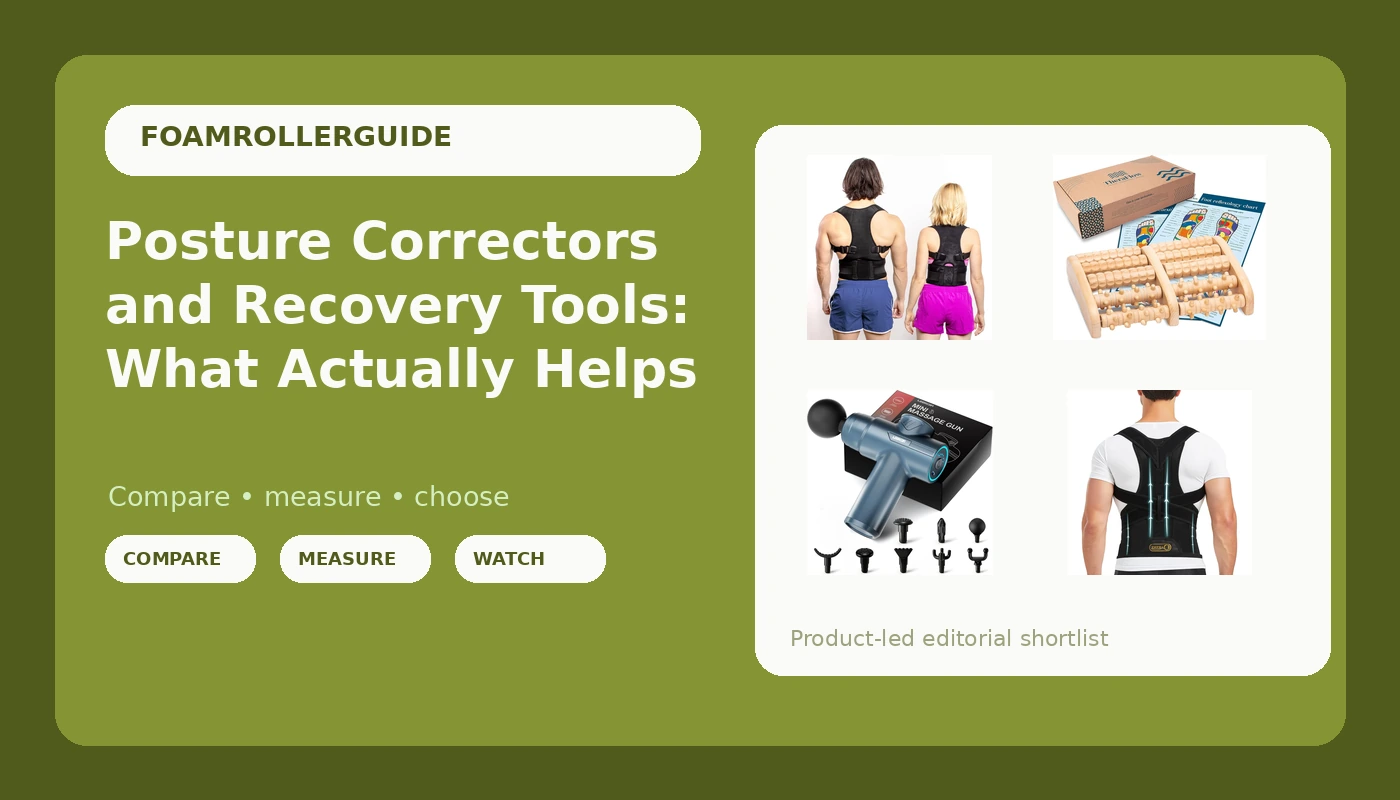
Most people shopping for a posture corrector and recovery tools are not chasing a personal record. They are dealing with a back that aches by 3 p.m., a foot that stings on the first step out of bed, or shoulders that creep forward after a long week at a desk. The category sells hope, and it is crowded with straps that promise correction, realignment, and pain relief in one piece of webbing. Some of it genuinely helps. Some of it ends up in a drawer by February. This guide walks through four tools worth understanding, what each one is actually for, and how to decide whether you need a brace, a percussion massager, a foot roller, or none of the above.
Related: Foam Rolling for Lower Back Pain: A Physical Therapist's Protocol →
Quick answer
If your main complaint is postural fatigue and a nagging upper or lower back ache during desk work, an adjustable back brace is the most direct tool here. If your problem is muscle tightness after training, a handheld percussion massager addresses large muscle groups. If your feet hurt in the morning, a wooden foot roller is the least expensive useful thing you can own. A brace does not strengthen anything, and a massager does not fix a spine. These tools are reminders and circulation aids, not cures, and the ones that help are the ones you actually use.
4 useful options
| Model | Best fit | What stands out |
|---|---|---|
| Back Brace and Posture Corrector (adjustable) | Upper and lower back support during long desk days | One-piece strap design with adjustable webbing, marketed for scoliosis and hunchback correction |
| LEERCON Massage Gun Deep Tissue | Muscle tightness in large groups like calves, quads, and glutes | Handheld percussion device with a padded head, marketed for deep tissue work and pain relief |
| FlexGuard Posture Corrector, X-Large | First-time brace buyers with a broader frame | X-Large sizing with adjustable shoulder straps for men and women |
| TheraFlow Foot Massager | Morning arch and heel pain | Wooden roller with deep tissue and reflexology nubs, sold with a reflexology chart |
Adjustable back brace: Back Brace and Posture Corrector for Men and Women
Here is the honest version of what a brace does. It changes the sensory input around your shoulders and trunk, which reminds you to stop slumping, and it can take some load off tired postural muscles during a long meeting or a long drive. What it does not do is strengthen the muscles that hold you upright, and it does not change the shape of a spine. In practice, I treat braces as a timer rather than a treatment: 20 to 30 minutes during a specific task, then off. Worn all day every day, a brace becomes the thing your muscles lean on instead of the thing that teaches them.
Percussion: LEERCON Massage Gun Deep Tissue Handheld Muscle Massager for Pain Relief
Percussion is easy to overdo because it feels like progress while you are doing it. The protocol I give people is boring on purpose: one to two minutes per muscle group, low to medium speed, moving slowly across the belly of the muscle, never parked on one tender spot for minutes at a time. If an area feels bruised the next day, you went too long. The boundary is absolute: no percussion on the neck, on the spine, or over a joint. I have met more than one person who hammered their own cervical spine and came in with a headache and a story about it.
Budget posture corrector: FlexGuard Posture Corrector for Women and Men, X-Large
Sizing is the number one reason posture braces fail, and it has nothing to do with how much you spent. Measure your chest circumference and compare it against the manufacturer's chart before you order, and if you land between two sizes, think hard about which direction to go. A brace that fits gets worn. A brace that digs into your ribs does not, no matter how good the design is. This one makes sense for someone who wants to find out whether bracing changes their day before committing more money to the idea.
Foot roller: TheraFlow Foot Massager for Plantar Fasciitis Relief
Plantar fasciitis responds to load management, calf flexibility, and time, not to any single tool. A foot roller earns its place in the minutes before you stand up, when the tissue is stiff and the first steps hurt most. Two minutes per foot, seated, slow, at a pressure that is uncomfortable but not sharp. If rolling makes the morning pain worse rather than better, you are pressing too hard or going too long. Think of the roller as an add-on to calf work and a graded loading program, not a replacement for either.
Prices and availability may change. Product images, names, and retailer links must be matched by verified ASIN. Do not state a current price, rating, stock status, or measured result without current evidence.
What a posture corrector can and cannot do
Braces are the most misunderstood products in this category, so it helps to be blunt about the mechanism. A posture corrector applies a gentle pull across the shoulders and trunk. That pull creates constant sensory feedback, and sensory feedback is what reminds your nervous system to hold a different position. It can also reduce the effort your postural muscles have to produce during a long static task, which is why some people feel less tired at the end of a desk day.
What a brace cannot do is strengthen the muscles that hold you upright. Strength comes from resistance and time under load, and a strap provides neither. A brace also does not change the structure of a spine. Scoliosis and hunchback language appears on a lot of packaging, and that language describes a medical condition that needs an assessment, imaging where appropriate, and a plan from a clinician, not a $30 strap from a marketplace listing.
The practical rule is this: a brace is a tool for a specific window. Twenty to thirty minutes during a task that reliably wrecks your posture, or a stretch of a long drive. Then it comes off, and you do the work that actually builds capacity, which means rows, carries, and whatever upper back and trunk training fits your week. If you cannot imagine taking the brace off, that is a sign to talk to a professional rather than to buy a second one.
How to choose between bracing, percussion, and rolling
These three tools solve different problems, and the mistake is buying the one that sounds most impressive rather than the one that matches your complaint. A brace addresses position and postural fatigue. A percussion device addresses muscle tightness and the feeling of a knot in a large muscle group. A foot roller addresses the sole of the foot and the morning stiffness that comes with it. None of them fixes a training program that has no recovery in it, and none of them replaces sleep, food, and a sensible ramp in volume.
- Write your complaint in one sentence before you shop. "My upper back aches by 3 p.m." and "my calves are locked after long runs" lead to completely different purchases.
- Match the tool to the tissue. Muscle gets percussion. A position habit gets a brace. The plantar surface of the foot gets a roller. Mixing these up is how people end up hammering a joint.
- Check fit and sizing before features. Chest circumference for a brace, foot length for a roller, and reach for a massager you plan to use on your own back.
- Set the dose before the product arrives. Two minutes per foot, one to two minutes per muscle group, 20 to 30 minutes of bracing per session. A tool without a dose is a toy.
- Give it two weeks and a pass or fail test. If the morning pain, the afternoon ache, or the post-training tightness has not changed at all in 14 days of consistent use, the tool is not the answer and you should change the plan, not the brand.
Practical guidance for a real week
- Brace during the task that causes the slump, not from wake-up to bedtime. A brace worn all day trains your muscles to depend on it.
- Keep percussion off the neck, the spine, and every joint. Muscle bellies only, and back off any spot that feels bruised the next morning.
- Roll your feet seated, not standing, so you control the pressure instead of your body weight controlling it.
- Pair any tool with one strength habit. A brace plus two sets of rows beats a brace alone every single time.
- Store the tool where you will see it. Recovery gear that lives in a closet gets used roughly never.
Which option should you choose?
Choose the Back Brace and Posture Corrector for Men and Women when your ache spans the upper and lower back and shows up during long desk or driving sessions. Choose the LEERCON Massage Gun Deep Tissue Handheld Muscle Massager for Pain Relief when the problem is tight, knotted muscle in large groups like calves, quads, and glutes after training. Choose the FlexGuard Posture Corrector for Women and Men, X-Large when you have a broader frame and want to test whether bracing helps before spending more. Choose the TheraFlow Foot Massager for Plantar Fasciitis Relief when the pain is concentrated in the arch and heel, especially on the first steps of the morning.
One caveat worth repeating: none of these is a treatment for a diagnosed spinal condition, a stress fracture, or nerve pain that travels down a leg. If your symptoms include numbness, tingling, weakness, or pain that wakes you at night, the right next step is an assessment, not a purchase.
The bottom line
Recovery tools work when they match a specific complaint and come with a dose. An adjustable back brace is a reminder and a fatigue reducer for postural work, not a strengthening device. A handheld percussion massager is useful on large muscle groups and off limits on the neck and spine. A wooden foot roller is a cheap, sensible two minutes before you stand up in the morning. Pick the one that matches the sentence you wrote about your own problem, use it consistently for two weeks, and judge it on whether your day actually changed. If it did not, the tool is not the missing piece, and no amount of upgrading will make it one.