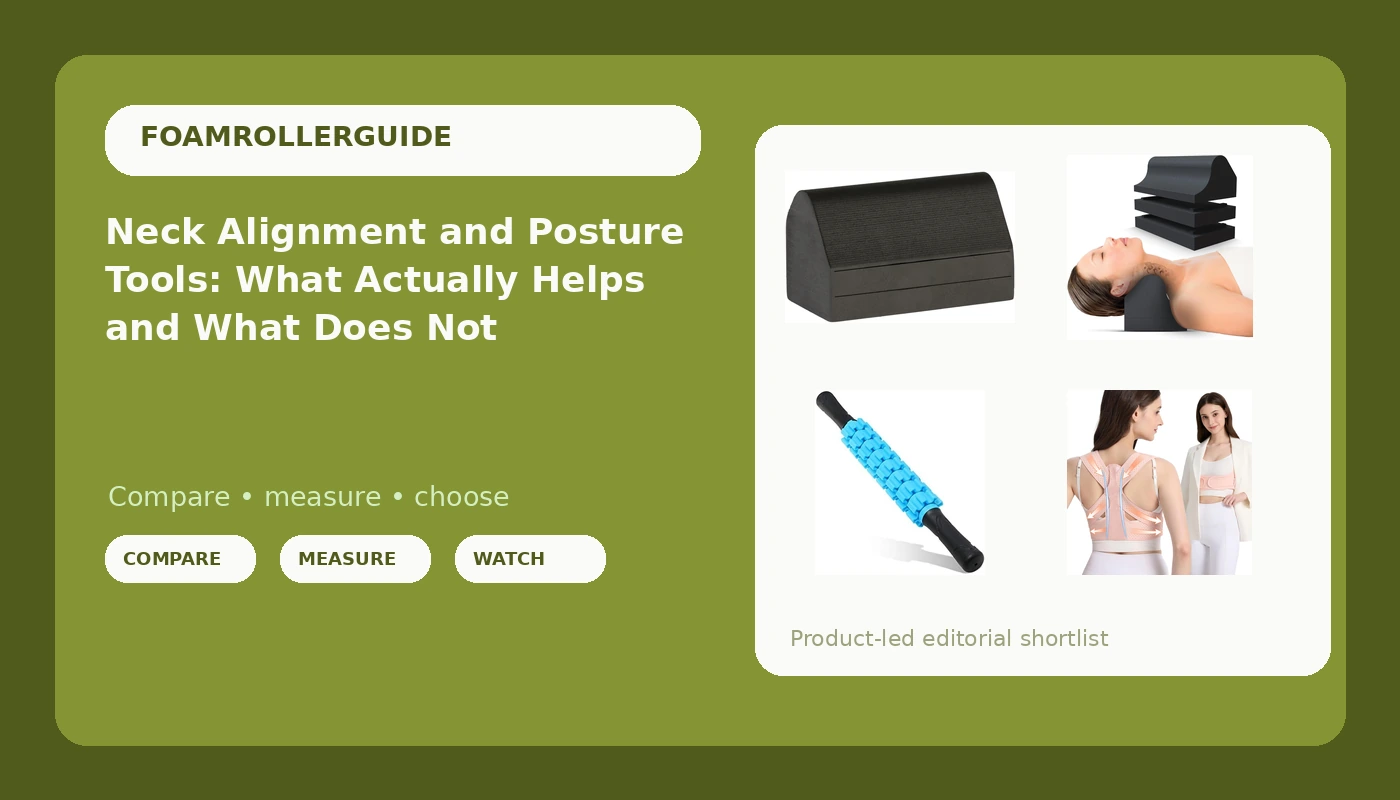
Neck and shoulder complaints rarely arrive from one dramatic moment. They build from long hours at a laptop, a phone held below chin height, a pillow that lets the cervical curve collapse overnight, and a training week with no recovery slot in it. That combination is why cervical posture support tools sell so well, and also why so many of them end up in a drawer next to a resistance band. The four products below are not interchangeable. Two work while you lie down, one works as a wearable cue during your day, and one is a stick roller for the muscle tissue in your legs that a floor roller cannot reach. Choosing between them starts with naming your actual target instead of your actual symptom.
Related: How to Roll Your Upper Back Without Irritating Your Neck →
Quick answer
These four products answer four different questions. If you want firm, shaped support under the neck while you rest, the Core Apex cervical orthosis is built for that job. If you want a traction-style stretch aimed at forward head posture, the cervical traction orthotic is the option in this group positioned for it. If you want a reminder to stop rounding your shoulders during desk work, the posture corrector is a wearable cue rather than a treatment. If your calves, thighs, or quads are the tight part, the ZanLLW roller stick reaches tissue a floor roller misses. None of them replaces an assessment of why the neck hurts in the first place.
Four useful options
| Model | Best fit | What stands out |
|---|---|---|
| Core Apex Cervical Orthosis for Neck Alignment & Posture Support, Firm | Lying-down neck alignment work at home | Firm density stated in the name, shaped for the cervical region |
| Cervical Traction Orthotic Chiropractic Neck Alignment Device (Black) | Home traction-style stretching for forward head posture | Traction-style design listed for spinal curve tension and physical therapy routines |
| Posture Corrector for Women Back Brace Shoulder Straightener Pink, S/M | A daytime reminder cue during desk and phone work | Wearable shoulder-straightening brace in a women's S/M fit |
| ZanLLW Massage Roller, Muscle Roller Stick | Calves, thighs, and trigger point work | Stick format that reaches limb tissue a floor roller cannot |
Firm cervical support: Core Apex Cervical Orthosis for Neck Alignment & Posture Support, Firm
A firm cervical orthosis is a lying-down tool. You use it for a few minutes at a time, on the floor or in bed, and the goal is to let the neck settle into a supported position you can then try to reproduce without it. Firmness matters here. A soft support under the neck lets the head drop back into extension, which is the opposite of what a forward-head posture needs. What this kind of tool will not do is hold your head up once you stand. If your posture collapses the second you leave the floor, that is a strength and habit problem, and no orthosis solves it.
Traction-style neck device: Cervical Traction Orthotic Chiropractic Neck Alignment Device for Spinal Curve Tension Stretching Forward Head Posture Pain Relief and Physical Therapy (Black)
Traction is a real clinical technique and a real home tool, but it is also the category where enthusiasm causes injuries. The idea is a sustained, gentle stretch through the cervical spine while you lie down, and the dose is minutes, not an hour. Anyone with a disc issue, a recent whiplash, or numbness and tingling running into an arm should have the neck assessed before adding traction at home. The rule I give patients is simple: if the stretch turns into a sharp pull, a headache, or tingling, stop, and get it looked at. Discomfort that eases while you breathe is one thing. A nerve complaining is another.
Wearable posture cue: Posture Corrector for Women Back Brace Shoulder Straightener Pink, S/M
Here is the honest version of how posture correctors work. They do not strengthen anything, and they do not fix a forward head. What they can do is make you notice the moment your shoulders roll forward, which is useful mainly as a teaching cue. Wear one in short blocks during desk work, then take it off and check whether you can hold the position on your own. If you need the brace to feel straight all day long, the brace has become the posture and the muscles underneath it are still doing nothing. That is the trap, and it is a common one.
Muscle roller stick: ZanLLW Massage Roller, Muscle Roller Stick, Therapy Roller Stick for Legs, Calf, Thigh, Lipo Roller for Relief Muscles, Deep Tissue Massage Rolling Pin for Trigger Points, Help Sore Muscle Recovery
Stick rollers solve a geometry problem. A foam roller on the floor is excellent for your back and quads, but it is clumsy on calves and nearly useless on the inner thigh, because you cannot get your body into a controlled position over the tissue. A stick lets you apply pressure with your arms and work one limb at a time, standing or seated. The trade-off is that you are the pressure gauge, which means you can also overdo it. Two minutes per area, pressure that is uncomfortable but not sharp, and nothing directly over a bone, a joint, or a nerve that is already sending signals down the leg.
Prices and availability may change. Product images, names, and retailer links are matched to verified listings. No current price, rating, stock status, or measured result is stated here without current evidence.
What these tools can and cannot do
The cervical spine has a natural forward curve, and the deep muscles at the front of the neck are supposed to help hold your head over your shoulders. Long hours looking down change the demand on those muscles. Some get short and overworked, others get lazy. A firm support under the neck gives the tired structures a few minutes in a supported position, which can feel genuinely good and can make it easier to find neutral again afterward. Traction adds a sustained stretch. A wearable cue reminds you where your shoulders are. A stick roller improves blood flow and calms down a grumpy area of muscle.
What none of them do is change tissue length in a permanent way, and none of them "break up" anything. Rolling and stretching work through blood flow, temperature, and the nervous system's tolerance for tension, not through physically dissolving knots. That distinction matters because it tells you what a realistic session looks like. It is short, it is repeatable, and it is not supposed to hurt. If you are grimacing through it, you are not recovering, you are just adding another stressor to a body that already has plenty.
It also matters that these four products target different regions. Two address the neck while you are lying down. One addresses shoulder position while you are upright. One addresses leg tissue entirely. Buying the wrong category is the most common mistake I see, and it is why so many of these devices sit unused.
Density, dose, and duration: the three variables that decide results
Density is about the target, not the price. A soft surface belongs under a ribcage or a sensitive neck. A firm surface belongs under a hamstring or a calf that has been asking for real pressure for weeks. When a product name says firm, believe it, and do not start there if you have never done this kind of work before. Start gentler, learn what your tissue tolerates, and only then decide whether you need more density.
Dose and duration are where most people go wrong in the other direction. More time is not better. A few minutes per area, once or twice a day, beats a heroic twenty-minute session that leaves you sore for two days and unwilling to repeat it. Consistency is the entire mechanism. A tool you use for three minutes every evening will outperform a better tool you use twice a month.
- Name the target first: neck position, shoulder position, or leg tissue. They are three separate problems.
- Screen yourself for red flags before buying anything for the neck, including numbness, tingling, or pain that shoots into an arm.
- Start with the shortest, gentlest dose the tool allows, and add time before you add pressure.
- Use the tool at the same time each day so it becomes a habit rather than a project.
- Reassess after two weeks. If nothing has changed, the tool is not the missing piece.
Practical guidance for a home routine
- Keep the neck work to a few minutes at a time, and stop at the first sign of tingling, headache, or a sharp pull.
- Pair any lying-down neck work with a minute of chin nods and shoulder blade squeezes, so the muscles that hold the position get some practice.
- Wear a posture corrector in short blocks during desk work, then remove it and try to hold the position unassisted.
- Use the stick roller on calves and thighs after training, not before, and keep the pressure short of sharp.
- Put the tool where you will see it. A roller that lives in a closet is a paperweight with a nice handle.
Which option should you choose?
Choose the Core Apex Cervical Orthosis for Neck Alignment & Posture Support, Firm when you want firm, shaped support under the neck for short lying-down sessions and you already know you tolerate firm pressure. Choose the Cervical Traction Orthotic Chiropractic Neck Alignment Device for Spinal Curve Tension Stretching Forward Head Posture Pain Relief and Physical Therapy (Black) when your goal is a traction-style stretch for forward head posture and a clinician has cleared your neck for it. Choose the Posture Corrector for Women Back Brace Shoulder Straightener Pink, S/M when you want a wearable reminder during desk and phone work and you are willing to use it as a cue rather than a crutch. Choose the ZanLLW Massage Roller, Muscle Roller Stick when the tight tissue is in your calves, thighs, or quads and a floor roller keeps sliding out of position.
The caveat that applies to all four: none of these devices addresses why the tissue got tight or why the head drifted forward in the first place. That answer usually lives in your daily positions, your training load, and your strength work, and it takes longer to change than any product takes to arrive. Devices support a plan. They are not the plan.
The bottom line
These four products are not competitors, and treating them as one category is how people end up with the wrong tool. Firm cervical support and traction-style stretching work on the neck while you lie down. A wearable corrector works as a daytime reminder cue. A stick roller works the limb tissue your floor roller cannot reach. Buy the one that matches your actual target, use it in short and repeatable doses, and be honest with yourself about whether the neck symptoms you are treating deserve a professional assessment before you add load to them. That order of operations is what separates recovery from a drawer full of good intentions.