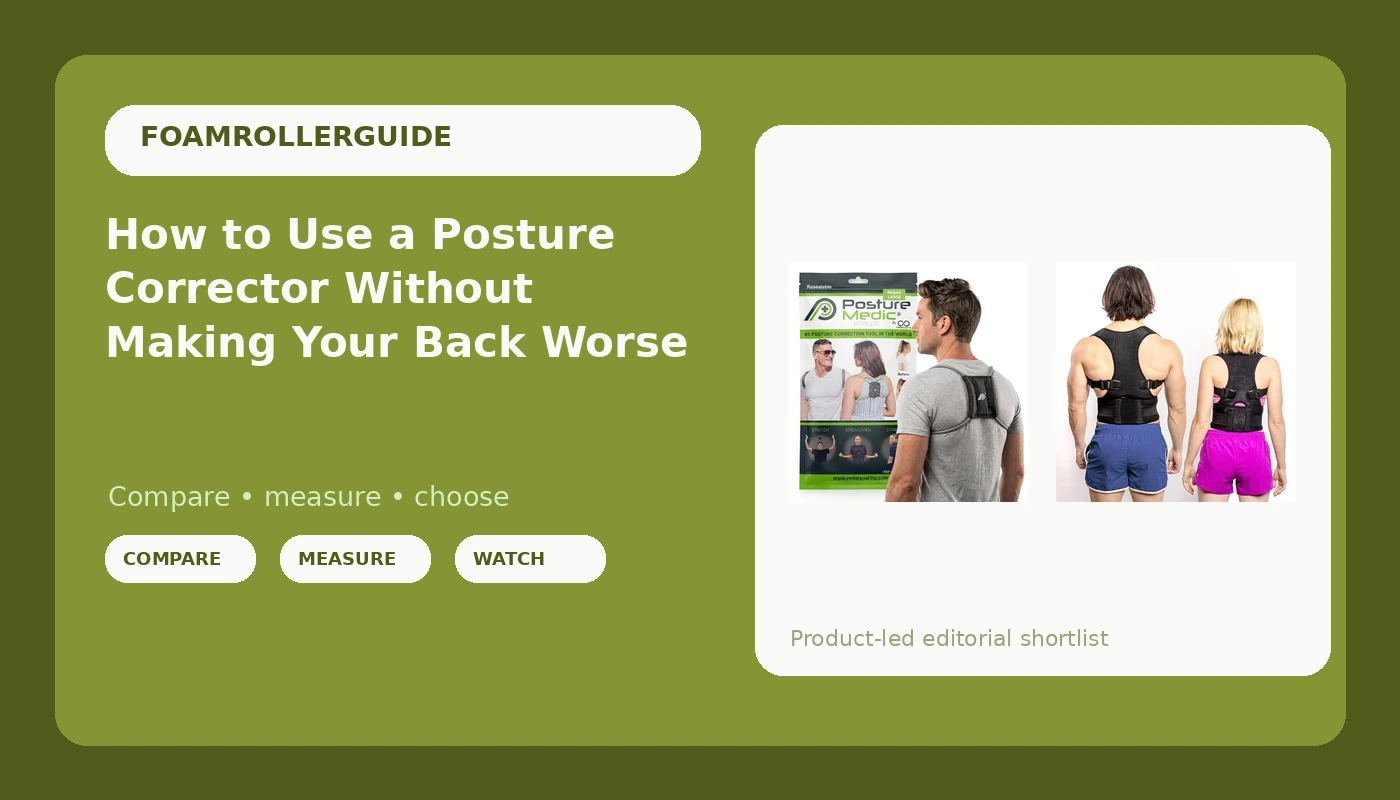
Most people who buy a posture corrector wear it wrong. They crank the straps until their shoulders ache, leave it on through a four-hour work block, and then wonder why their upper back feels worse by Friday. I have fitted these braces on patients in a Minneapolis clinic for twelve years, and the difference between a corrector that helps and one that becomes a crutch is almost never the brand. It is the dose.
This guide is about how to use a posture corrector properly: how tight to set it, how long to wear it, when to take it off, and how to pair it with the rolling and mobility work that actually changes tissue tolerance over time. If you want the short version, it is this. The brace reminds, the movement changes, and anything you wear for eight hours stops being a reminder and starts being a replacement.
Why you should trust me
I am a physical therapist in Minneapolis, twelve years in, and about half of that spent in a clinic where the referral notes said things like "back pain, no cause found." I spent those years watching what actually changed people's posture and what just made them feel like they were doing something about it. I prescribe foam rolling the way I prescribe anything else: a target, a duration, and a reason. I keep a pressure gauge in my treatment room for the "it hurts so it's working" crowd, and I have sent more people home without a brace than with one. Pain during rolling or during bracing is a sign to back off, not a badge of honor.
What a posture corrector actually does
A posture corrector does not strengthen your back. It reminds you where your shoulders belong, and it gives your upper back a break from the position you have been holding all day. That is the entire mechanism.
The strength part is your job. The brace creates a window where you can do the work: rows, band pull-aparts, face pulls, and thoracic extension over a roller. Wear a brace for eight hours and do nothing else, and you have trained your body to lean on a strap.
Two things follow from that, and they shape everything below.
- The corrector should feel like a light reminder, not a load. If you have to fight it to breathe or to reach forward for your coffee, it is too tight.
- The corrector comes off for anything loaded. You do not lift in a posture brace and you do not sleep in one.
How I picked the two braces below
I looked at three things, in this order.
First, adjustability. A corrector with one fixed setting is a corrector you cannot dose, and the difference between "reminder" and "restraint" is about two fingers of tension. You want closures that let you set the pull in small increments.
Second, what the pull does to the shoulder. Good designs bring the shoulders back and slightly down, which is where the shoulder blade actually sits. Bad designs pull them straight back and up, which shrugs you into a worse position than the one you started in.
Third, whether you will keep it on. A brace you peel off after ten minutes because it itches or digs under the arm is a brace that does nothing. Breathable fabric and a shape that does not ride up matter more than any phrase on the package about professional grade anything.
The two braces below cover the two realistic entry points: a low-cost basic option, and a higher-resistance training system for someone who wants to load the position rather than just remember it.
The two correctors worth starting with
Budget pick: FlexGuard Posture Corrector for Women and Men (Large (Pack of 1))
 Visit on Amazon →
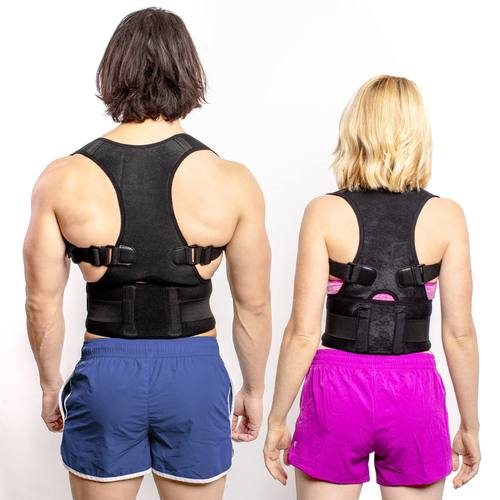
The FlexGuard is the simple version of this tool, and for most people starting out, simple is correct. It is a single brace in a large size, sold as one pack, so you are not paying for a system. You are paying for a reminder that goes over your shoulders and tells you when you have drifted forward again.
This is the one I would suggest to someone whose posture problem shows up at hour six of a desk day, not during a deadlift. Wear it for a focused block, do the mobility work, take it off. That rhythm is what makes a basic strap effective, because the value is in the interruption, not the duration.
Flaws but not dealbreakers: A basic brace like this gives you one job, which is position. It will not load your upper back the way a resistance-based trainer does, so if you want progressive resistance you are shopping in the wrong tier. Check the sizing chart before you order, because a large that gaps at the strap will not hold a setting.
Anyone who wants a low-cost way to break a slouching habit at a desk should start here.
Upgrade pick: PostureMedic Plus Strength Dynamic Posture Corrector for Athletes, High Resistance Training System for Performance & Recovery, Professional Grade Posture Trainer for Men & Women - Size L (Silver)
 Visit on Amazon →
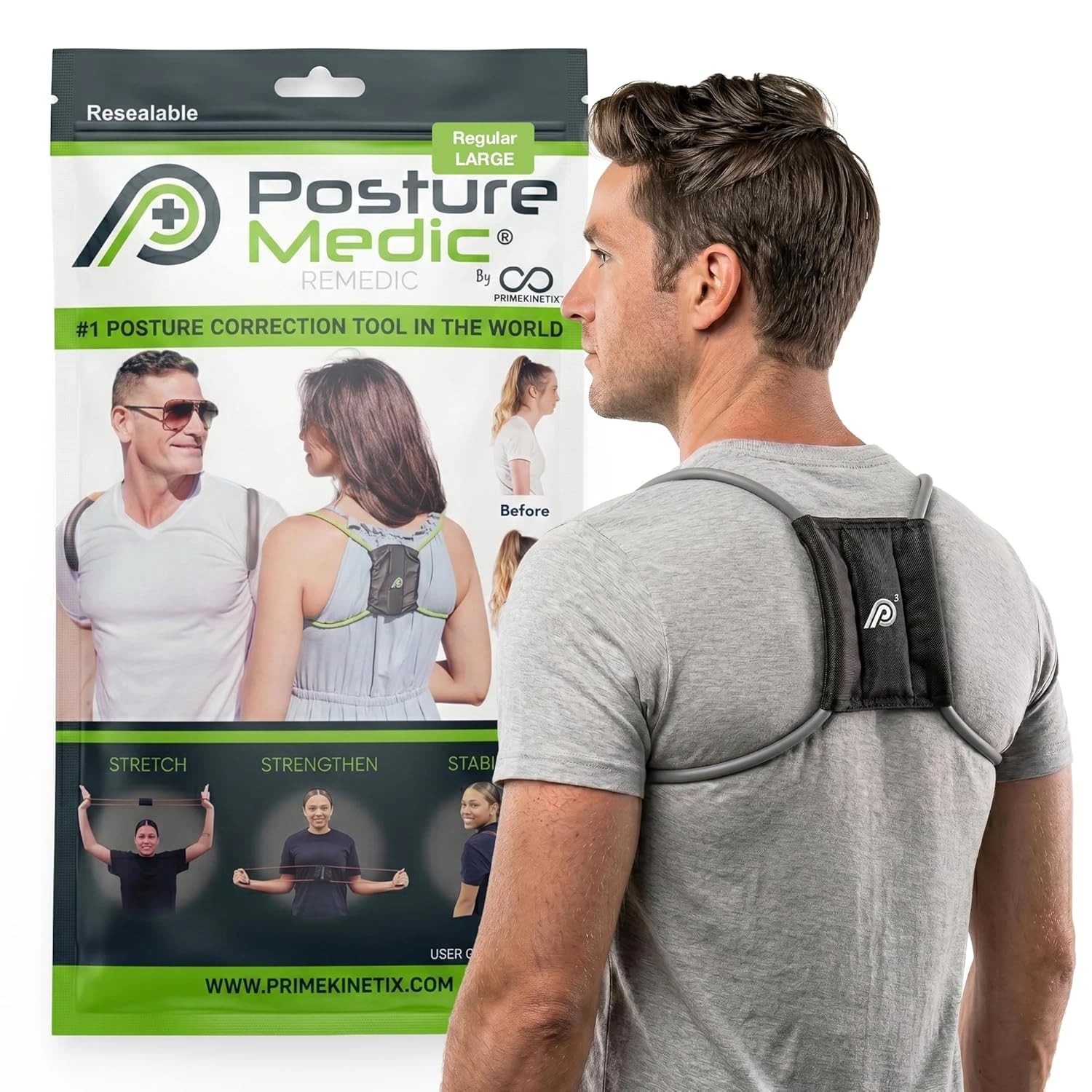
The PostureMedic Plus sits at the other end of the category. The listing frames it as a high-resistance training system rather than a passive reminder, and that distinction matters. This is a brace you wear in short, deliberate sets to resist the forward pull, which turns "sit up straight" from a scolding into an actual load on the muscles that hold your shoulders back.
That is a real training stimulus, and it is also exactly why this brace is not a leave-it-on-all-day item. High resistance plus long duration equals a tired, overworked upper back and a neck that starts compensating for it. Fifteen focused minutes beats two hours of passive wear, every time.
Flaws but not dealbreakers: The higher resistance is the point and also the risk. If you cannot get through a short set without shrugging your shoulders toward your ears, back the tension off or step down to the FlexGuard until you can. This listing is the size large silver model, so verify the size before ordering.
Athletes and lifters who want to train the position instead of just remembering it will get more out of this one.
How to use a posture corrector: the protocol
Now the part that decides whether this works.
Step one: Set the tension standing tall. Do not adjust straps while you are hunched over a laptop. Stand up, roll your shoulders back and down once, then set the closure so it holds that position with light contact. The test is simple: you should be able to slide two fingers under the strap at your shoulder. If you cannot, it is too tight.
Step two: Start at 15 to 20 minutes. One block, once a day, for the first week. That is a dose, not a challenge. If your upper back feels worked the next morning, hold at that duration. If it feels pinched, cut the time and loosen the strap.
Step three: Build to 30 to 45 minutes total per day, split into blocks. Two blocks of 20 minutes beat one block of 40, because what you are buying is the reminder, and a reminder loses its edge once you stop noticing it.
Step four: Pair every wear block with movement. This one is not optional. Five minutes of thoracic extension over a roller, then band pull-aparts or rows. The brace reminds, the movement changes. A brace without movement is a costume.
Step five: Take it off for anything loaded. No wearing it under a barbell, no running in it, no sleeping in it. A brace holding your shoulders while you ask your body to produce force is a brace teaching your stabilizers to switch off.
Step six: Reassess at two weeks. If you can hold the position for an hour after the brace comes off, you are winning. If you slump the second the strap is gone, you have been leaning on it. Either add movement work or reduce brace time. Do not add more strap.
The mistakes I see most
Wearing it too tight is the big one. People equate discomfort with correction, and a strap digging into the front of the shoulder is not correcting anything, it is restricting. Pain during wear is a signal to back off.
Wearing it all day is the second. A brace is a training window, not a posture. If it is on from breakfast to dinner, you have replaced your postural muscles with nylon.
Skipping the rolling is the third. Rolling works best as the warm-up for the muscles the brace is trying to wake up, so ten minutes of thoracic extension and lat work before you strap in makes the brace time worth more, not less.
The red flags that mean stop
Stop wearing a corrector and get evaluated if you get numbness or tingling into the arm or hand, a pinched sensation at the front of the shoulder, headaches that start during wear, or a neck ache after every session. Those are not adjustment symptoms. A brace should never be the reason something new hurts.
Skip the whole category, at least until you have clearance, if you are pregnant, if you have had recent shoulder or spine surgery, or if you have a rib or collarbone issue. Ask the person who knows your case.
Pairing a corrector with foam rolling
The brace and the roller do two different jobs, and you want both.
The roller is for the tissue holding you forward: the pecs, the lats, and the thoracic spine. Two minutes of extension over a firm roller, then a slow pass through the lats on each side. The brace is for the pattern that keeps sending you back there. Roll first, brace second, strengthen third. That order matters more than the brand of anything in the sequence.
If you have never rolled before, start with a medium-density roller and keep the pressure in the uncomfortable but conversational range. Firmness is about the target, not the price. A soft roller on a ribcage is correct. A soft roller on a tight lat is ten minutes you will not get back.
What this costs
The FlexGuard sits at the low end of the category, and the PostureMedic Plus costs more because it is built as a resistance trainer rather than a passive strap. Check current Amazon price on both before you decide, since sizing and stock move around.
Neither is expensive next to a single clinic visit, and the cost per use drops fast. Worn 20 minutes a day, five days a week, either brace works out to a few cents per session over a year. The money is not the hard part. The dose is, and the dose is free.
The short version
Buy the brace that matches the job. Wear it in short, deliberate blocks. Roll and strengthen in between. Take it off the moment it stops being a reminder and starts being a crutch. Do that and you will get more out of a basic strap than most people get out of a brace they never take off.