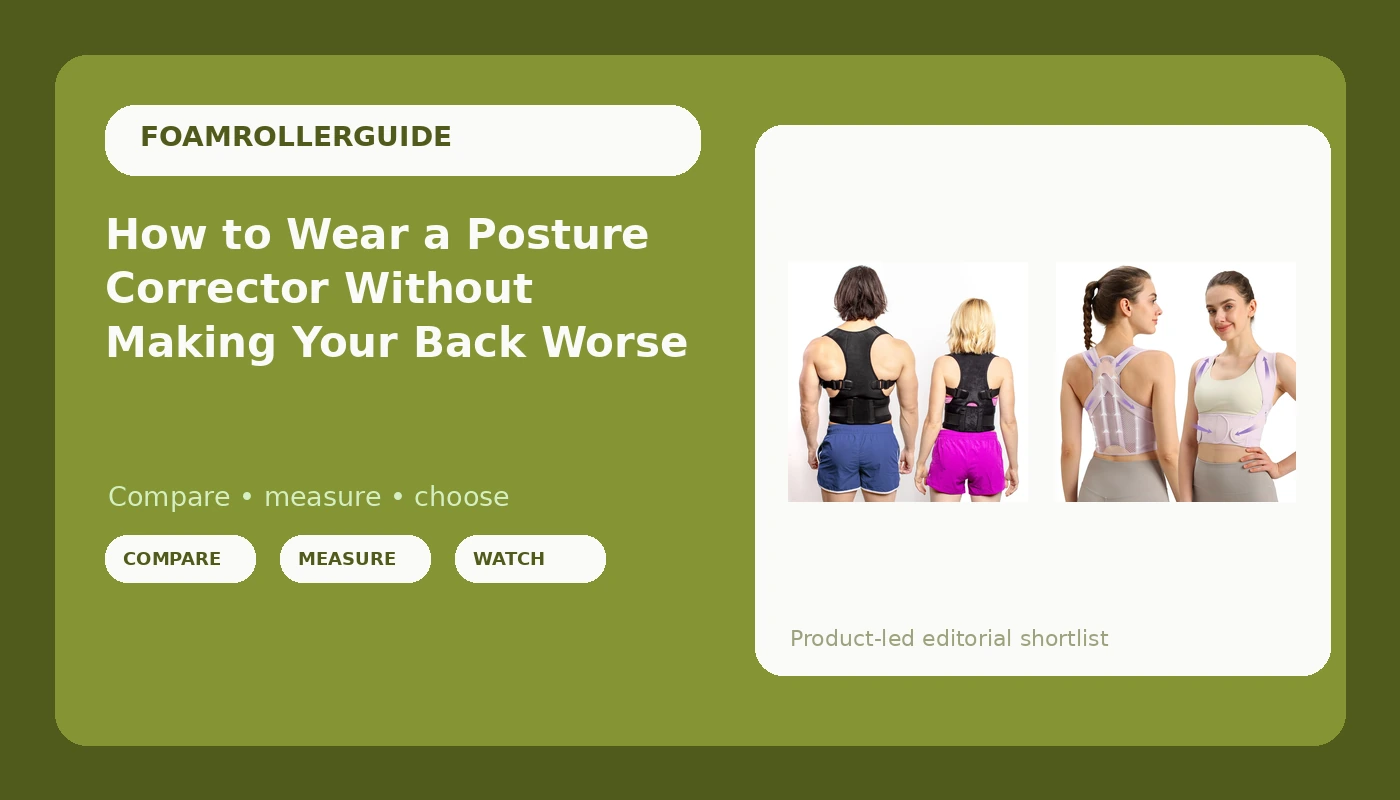
Most people strap on a posture corrector for back pain with the same energy they bring to a new foam roller: high hope, no plan, and a vague sense that discomfort means it is working. That is backwards. A brace is a reminder, not a repair. It holds your shoulders where they belong for twenty minutes so your nervous system remembers the position, and then you take it off and do the actual work.
I have spent twelve years as a physical therapist, half of that in a clinic treating backs that "just hurt" and shoulders that rounded forward sometime around 2014 and never came back. The patients who improve are the ones who treat a brace like a coach in their closet, not a wheelchair they wear to the office. This guide covers how to size one, how to dose it, how to roll around it, and how to tell when it is hurting more than helping.
Why you should trust me
I prescribe rolling and posture work the way doctors prescribe medicine: specific, dosed, and with a stated reason. I keep a pressure gauge in my treatment room for the "it hurts so it is working" crowd, because that crowd is usually the one that quits in three weeks with a bruise and a story.
I do not sell braces. Nobody pays me when you buy one. What I care about is that the thing you order does not turn into a twenty dollar paperweight or, worse, a crutch that lets your upper back muscles go on permanent vacation. The criteria below are the same ones I run through when a patient pulls a brace out of a shopping bag and asks me whether it is any good.
What a posture corrector can and cannot do
A brace does one thing well: it gives your body an external cue. Physical therapists call that proprioceptive feedback, which is a fancy way of saying your brain gets a clear signal about where your shoulders are. When you round forward for ten hours a day, that signal goes quiet. A brace turns the volume back up for a while.
What it cannot do is strengthen anything. Straps do not build muscle, and a brace you wear for eight hours a day does not train endurance, it replaces it. In my clinic, the patients who rely on a brace all day are the ones who feel worse the moment they take it off, because their deep postural muscles have been coasting for months.
That is why the wear schedule matters more than the brace. Short, deliberate blocks while you sit at a desk or stand at a counter. Off for lifting, off for running, off for sleeping. If you cannot tolerate being without it, you are using it wrong.
What to look for before you buy
Five things, in order of how often they cause returns.
Adjustability over rigidity. A brace with two independent shoulder straps lets you set tension left and right. Most bodies are not symmetrical, and a one-piece pull-back design will always be too tight on one side.
Padding under the armpits. The strap crosses your armpit, and that is where skin irritation happens. A wider, softer strap there is worth more than a fancy closure system.
Breathable material. You are going to sweat. A brace that traps heat gets worn twice and then lives in a drawer.
Sizing by chest circumference, not shirt size. Measure around the fullest part of your chest, under your arms, and follow the maker's chart. A brace that is too small pulls your shoulders into a shrug, which is a different problem than the one you are trying to solve.
A shape you can hide under a shirt. If you will not wear it because it shows through your blouse, it does not matter how good the straps are. Buy the one you will actually put on.
The two braces I would hand a patient
Neither of these is a medical device in the way a walking boot is. Both are reminders. Here is who each one fits.
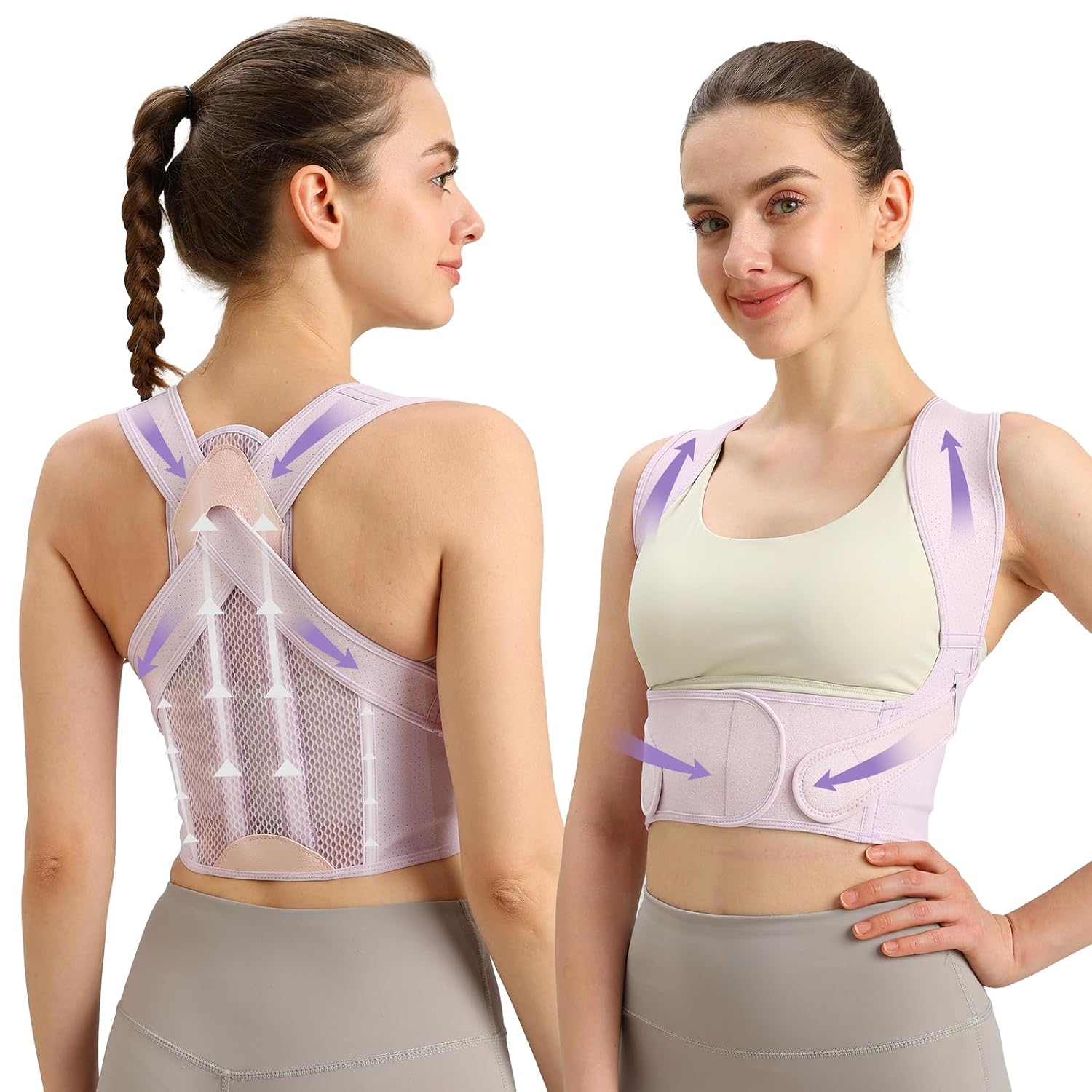
Best for all-day desk wear under clothes: NLNYCT Posture Corrector for Women, Back Brace Posture Corrector, Purple M
 Visit on Amazon →
This is the one I would suggest first to someone who works at a desk and wants the cue without announcing it to a conference room. It is a slim design that sits close to the body, which means it disappears under a looser shirt or a sweater, and the straps are narrow enough that you are not fighting a backpack harness all afternoon.
The sizing runs to a medium in this colorway, so measure your chest before you order rather than guessing from your usual top size. Check current Amazon price before you commit, and read the sizing notes in the listing carefully, because the most common complaint on slim braces is that people order by shirt size and end up with a band that digs.
Flaws but not dealbreakers: Slim braces trade coverage for discretion. If you want something that feels like a firm hand between your shoulder blades, this is not that. It is a light cue for a desk job, not a support garment for heavy lifting.
Anyone who wants a low-profile reminder they can wear for a focused work block and forget about after will get the most out of it.
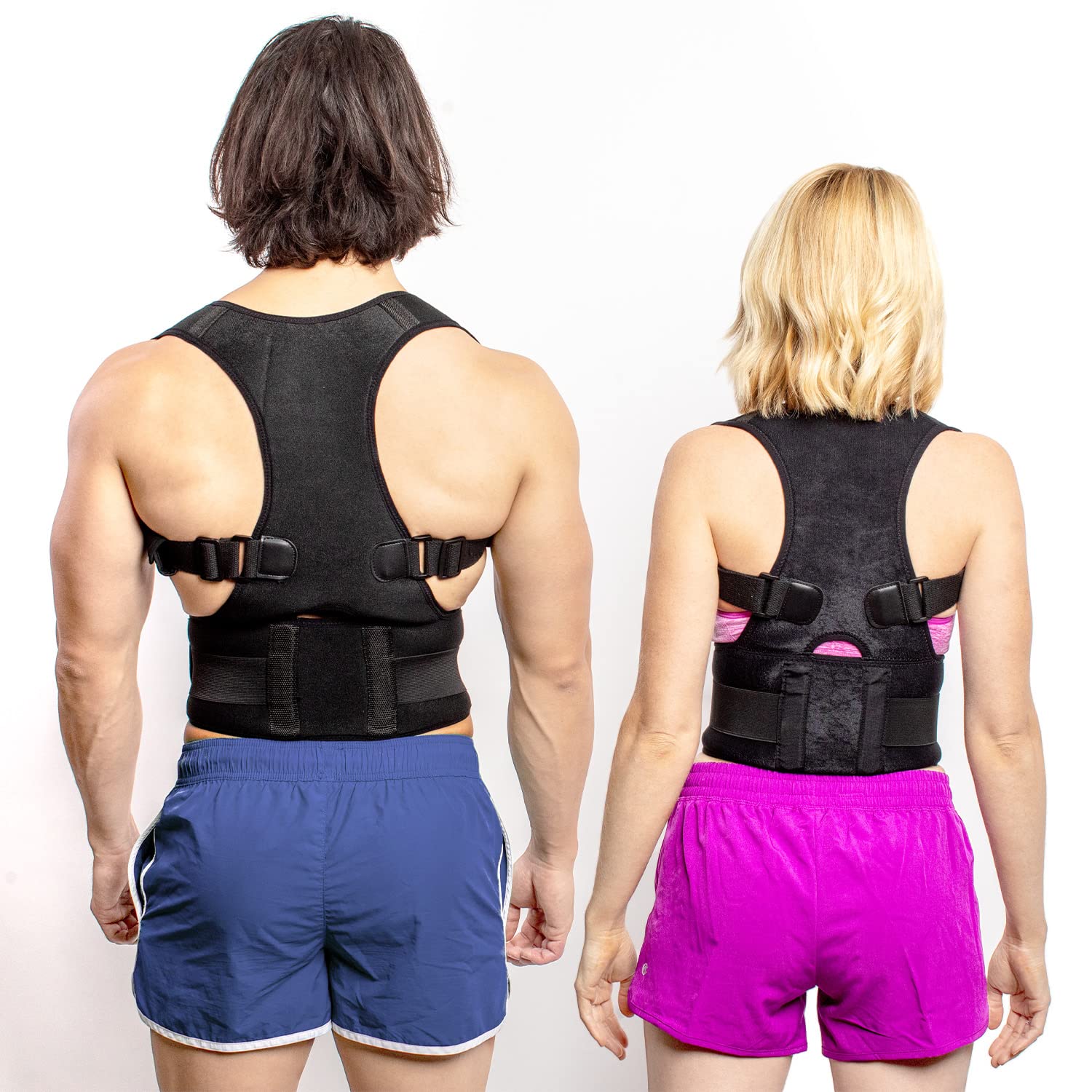
Best budget pick with room to grow: FlexGuard Posture Corrector for Women and Men - Back Brace for Posture, Adjustable Back Support Straightener Shoulder Posture Support for Pain Relief, Body Correction, X-Large
 Visit on Amazon →
This is the brace I point people toward when they want to try the whole idea before spending real money on it. It is an adjustable, unisex design, and the straps run long, which means it fits a wider range of bodies than a sized women's brace does. If you are between sizes or you are shopping for two people in one house, the adjustability is the feature that matters.
The X-Large sizing covers a broader chest, so if you have ever returned a brace because the band would not close, start here. Check current Amazon price, and expect a break-in period while you figure out where the straps want to sit on your shoulders. Every adjustable brace takes two or three sessions to dial in.
Flaws but not dealbreakers: More adjustment means more places to get it wrong. Over-tighten this one and you will feel it in your armpits within ten minutes, which is your signal to back the straps off rather than tough it out. The material is functional rather than plush, so wear it over a t-shirt at first.
Anyone who wants to test whether a brace helps their posture at all before investing more, or who needs one size to fit a range of adults, should start with this.
How to put it on properly, step by step
Step one: loosen everything first. Fully slack the straps before you put it on. Most people crank a brace down while putting it on and then never adjust it again.
Step two: put it on like a backpack. Shoulder straps over the shoulders, band across the upper back, closure at the front or side depending on the model. Do not twist it to get it on. If you have to fight it, it is too tight.
Step three: set the band first, then the shoulders. Get the band snug around your ribcage, then bring the shoulder straps down to tension. The band is the anchor. Shoulder straps alone will just pull your shoulders into a shrug.
Step four: check the two-finger rule. You should be able to slide two fingers under every strap, including the one crossing your armpit. If you cannot, loosen it. This is not a tourniquet.
Step five: sit down and check again. A brace that feels fine standing can feel like a vise when you sit. Sit at your desk, type for two minutes, and adjust before you forget about it.
Step six: set a timer. Fifteen to twenty minutes for the first week. When the timer goes off, take it off. The point is a reminder, not a marathon.
How long to wear it, week by week
Week one: one block of 15 to 20 minutes a day, ideally during your most slouched hour. Late afternoon for most desk workers.
Week two: two blocks a day, 20 minutes each. Take at least an hour between them.
Week three and beyond: build toward two or three blocks of 30 to 45 minutes. That is the ceiling for most people. You are not trying to live in this thing.
Always off for: sleeping, exercise, driving long distances, and any activity where you are lifting or reaching overhead. A brace that restricts your shoulder blade while you press something overhead is a shoulder injury waiting to happen.
If you feel worse on the days you wear it, cut the time in half. If you feel worse on the days you do not wear it, that is the sign you need to spend more time on the work below, not less.
What to do with the other 23 hours
The brace is the smallest part of this. The rest is the work.
Roll your thoracic spine. Lie on a medium-density roller with it across your mid-back, support your head with your hands, and extend gently over it. Two minutes. This is the one place where a soft roller is genuinely useful, because your ribcage does not want a firm cylinder jammed into it.
Stretch the front of your shoulders. Doorway pec stretch, 30 seconds per side, twice. If your chest is tight, no strap on earth will hold your shoulders back for long.
Train the muscles that hold you up. Rows, band pull-aparts, and chin tucks. Two sets, three times a week. This is the part that makes the brace unnecessary eventually.
Roll before you train, not after. Rolling before a workout preps tissue and wakes up your nervous system. Rolling after is for recovery. They are not interchangeable, and a brace does neither.
Move every 30 minutes. The best posture correction ever invented is standing up. Set a timer and walk to the kitchen. A brace cannot outwork ten hours of stillness.
Red flags: when to stop wearing it
Take it off and call a clinician if you get numbness or tingling into your hands, a headache that builds while you wear it, sharp pain under your ribs, or skin that stays red and irritated after you remove it.
Also stop if you find yourself reaching for it first thing every morning out of anxiety rather than intention. That is the crutch phase, and it is the hardest one to walk back. A brace should make you more aware of your posture, not less.
Common questions
How long should I wear a posture corrector each day? Start with 15 to 20 minutes once a day and build to two or three short blocks. The brace is a reminder, not a splint, so a few focused blocks beat all-day wear every time.
Should I sleep in a posture corrector? No. Sleep is when your tissue recovers. Eight hours in a brace does nothing for your posture and plenty for your ribs and armpits.
Can a brace fix my posture on its own? No. It is a cue. The strength work and the rolling are what change the baseline. The brace just reminds you where the baseline is.
The bottom line
Pick the brace that fits your body and your routine, not the one with the most aggressive marketing copy. Wear it in short, deliberate blocks. Take it off for anything athletic and anything horizontal. Spend the rest of your day rolling your mid-back, opening your chest, and training the muscles that hold your shoulders where you want them.
Both of the braces here cost less than a single copay, which makes them a cheap experiment and an expensive habit if you never take them off. Check current Amazon price, measure your chest, set a timer, and treat the thing like what it is: a twenty minute reminder that your posture is something you practice, not something you buy.