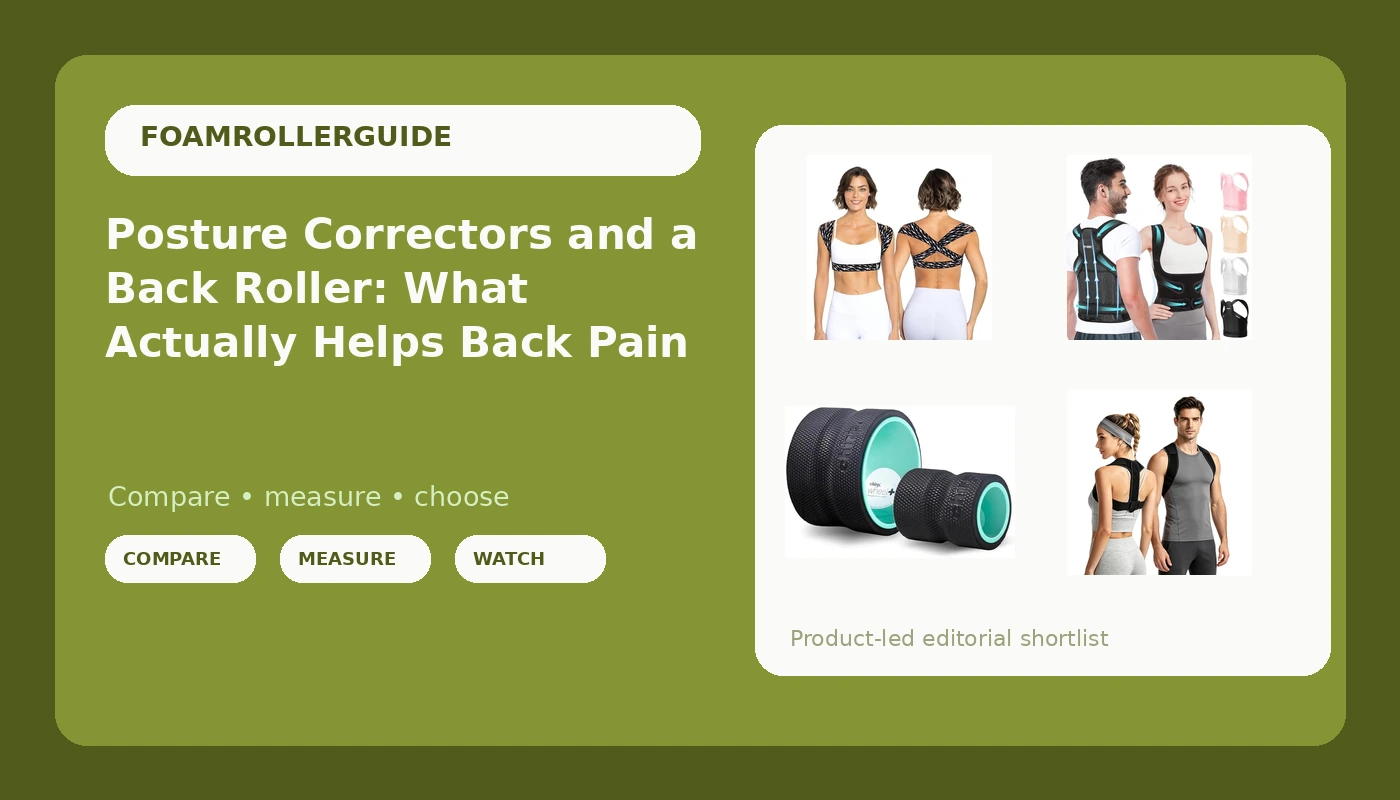
If you are shopping for a posture corrector for back pain, the first thing worth sorting out is what the device can and cannot do. A brace does not fix posture. It reminds you where your shoulders belong, and it buys you a window in which the muscles that hold that position can actually do some work. A back roller does something different: it gives you a way to load and move the tissue along your upper back and between your shoulder blades, which is usually where the stiffness that feeds the slouch lives.
That distinction matters, because these two categories get sold as if they were interchangeable. They are not. One is a cue. One is a tool. Most people with a mild, posture-related ache need a plan that uses both, in the right dose, at the right time of day.
Related: Foam Rolling the Upper Back: A Dosing Guide for Stiff Thoracic Spines →
Quick answer
A posture corrector for back pain is a short-term cue, not a treatment. Wear one for 15 to 30 minutes at a time while you are doing something that pulls you into a slouch, and use it to notice the position rather than to hold you up all day. A back roller is the tool that works on the tissue: a minute or two of slow rolling along the upper back, breathing the whole time. If you only buy one thing, buy the roller. If you sit at a desk for eight hours and genuinely cannot feel where your shoulders are, add a brace.
4 useful options
| Model | Best fit | What stands out |
|---|---|---|
| Chirp Wheel+ Foam Roller for Back Pain Relief, 4 and 6 Inch Set | Stiffness that sits in the upper back | Two wheel sizes in one set, built for back work |
| BackEmbrace Posture Corrector, Lightning Bolt M/L | Desk workers who want a slim brace under a shirt | Made in the USA, slim and adjustable, sized M/L |
| Fit Geno Posture Corrector for Women & Men | People who want one unisex shoulder support brace | Sold for both women and men, back and shoulder support |
| Posture Corrector for Women and Men, Adjustable Upper Back Brace | Anyone who wants an adjustable upper-back brace | Adjustable fit, upper back focus, unisex sizing |
The mobility tool: Chirp Wheel+ Foam Roller for Back Pain Relief, 4 and 6 Inch Set
The trade-off with any rolling tool is that it only works when you use it. A wheel set takes floor space and asks you to get down on the ground, which is the real barrier for most people, not the price. If your stiffness lives in the upper back and between the shoulder blades, this is the category that addresses it. Work the muscles beside the spine and around the shoulder blades rather than driving pressure straight into the bones. If your pain is sharp, one-sided, or travels down a leg, rolling is not the answer and neither is a brace.
The slim, made-in-USA option: BackEmbrace Posture Corrector for Women and Men, Lightning Bolt M/L
The slim profile is the selling point and also the thing to think hardest about. A brace you can hide under a shirt is one you will actually wear at your desk, which is where it does its job. But the same slimness means the cue is gentle, and a gentle cue is easy to ignore once you stop paying attention. Check the size range against your own measurements before ordering, and remember that the M/L sizing will not suit every body.
The unisex support brace: Fit Geno Posture Corrector for Women & Men, Back Shoulder Support Brace
The trade-off with a self-tensioned brace is that you are the calibration. Pull it tight enough that you feel a gentle reminder to bring the shoulders back, and no tighter. If the straps dig into your armpits or you find yourself taking shallow breaths, it is too tight, and a brace that changes how you breathe is working against you. Unisex sizing also means the fit is a compromise by design, so expect to spend a few minutes adjusting before you decide whether it stays.
The adjustable upper-back option: Posture Corrector for Women and Men, Adjustable Upper Back Brace
Adjustability is the whole argument for a brace in this style, and it is also where people get it wrong. The goal is the lightest tension that still gives you a useful reminder, not the tightest setting that stays put. If you have to fight the brace to move your arms, loosen it. And treat any of these braces as a temporary cue: the point is to teach your body a position it can eventually hold without help.
Prices and availability may change. Product images, names, and retailer links must be matched by verified ASIN. Do not state a current price, rating, stock status, or measured result without current evidence.
What a posture corrector actually does
A posture corrector is a proprioceptive cue. That is the clinical way of saying it makes you aware of where your shoulders and upper back are, which is information most desk workers lose somewhere around hour three of sitting. The straps pull your shoulders into a slightly retracted position, and while they are there, you notice the difference between that and your default.
What it does not do is strengthen anything. The muscles that hold your shoulder blades back do not get trained by being held in place by webbing. They get trained when you take the brace off and use them, which is why the correct wearing schedule is short blocks of time rather than all day. Fifteen to thirty minutes, a couple of times a day, while you are doing something that reliably pulls you into a slouch, is the pattern I would give a patient.
The other thing to keep straight is the relationship between posture and pain. It is real, but it is looser than the marketing suggests. Plenty of people with textbook posture hurt, and plenty of people with a forward head and rounded shoulders do not. A brace is worth trying when you can feel that your position is feeding the ache. It is not a fix for pain that has another source.
Where a back roller fits
Rolling does not break up scar tissue or scrape adhesions off your muscles. That claim needs to go away. What rolling does is load tissue, move fluid, and give your nervous system a strong, controlled input, and the useful window afterward is a few minutes of easier movement. If you roll your upper back and then reach overhead more comfortably, that is the effect working as intended.
Density and dose are the two decisions. Density is about the target: a firmer wheel for a thick, stubborn upper back, a gentler one when you are working near the ribs or the neck. Dose is about time: roughly one to two minutes per area, at a pressure that is uncomfortable but not painful. If you are holding your breath or bracing against it, you have gone too far, and the session stops being recovery and starts being a stress test.
Timing matters too, and it is the part people blur. Rolling before a workout is preparation: short, brisk, aimed at the areas you are about to use. Rolling after is recovery: slower, longer, and deliberately easy. They are not the same session and they should not feel the same.
- Find out where the problem actually is. Upper back stiffness and a slouch point to rolling plus a cue; sharp or one-sided pain points to a clinician.
- Decide whether you need a tool or a reminder. If you can feel your position and just cannot hold it, you need the roller. If you cannot feel it at all, add a brace.
- Match the brace to your clothing and your day. A slim design worn under a shirt gets used; a bulky one lives in a drawer.
- Set the dose before you buy. Two minutes per area with the roller, 15 to 30 minutes with the brace, twice a day at most.
- Reassess after two weeks. If nothing has changed, the tool is not the missing piece and the plan needs a different approach.
Practical guidance
- Wear the brace in short blocks, not from morning to night. It is a reminder, and reminders lose their edge when they never come off.
- Take it off before you do your strengthening work. That is the part that makes the change stick.
- Keep rolling pressure below the level where you tense up. Discomfort is fine, pain is a signal to back off.
- Breathe through every pass of the roller. If your breath is stuck, your nervous system is not in recovery mode.
- Leave the roller where you will see it. A tool in a closet is a tool you do not use, which is the most common reason this whole plan fails.
- Check in with a clinician if the pain is constant, wakes you at night, or comes with numbness or weakness in an arm or leg. None of the gear here is for that.
Which option should you choose?
Choose the Chirp Wheel+ Foam Roller for Back Pain Relief, 4 and 6 Inch Set when your stiffness sits in the upper back and you are willing to spend two minutes a day on the floor. Choose the BackEmbrace Posture Corrector for Women and Men, Lightning Bolt M/L when you want a slim, adjustable, made-in-USA brace that disappears under a work shirt, and you fall in its M/L size range. Choose the Fit Geno Posture Corrector for Women & Men, Back Shoulder Support Brace when you want one unisex brace with back and shoulder support and you are comfortable setting your own tension. Choose the Posture Corrector for Women and Men, Adjustable Upper Back Brace when adjustability is the priority and you want an upper-back brace you can dial in.
Whichever you pick, understand the ceiling. A brace is a cue and a roller is a tool, and neither one strengthens the muscles that hold you upright. That work happens in the minutes after you take the brace off and in the days between rolling sessions. If your pain is severe, persistent, or comes with neurological symptoms, gear is not the answer and a clinician is.
The bottom line
A posture corrector for back pain is worth owning if you treat it as a short, repeated reminder rather than a permanent support, and a back roller is worth owning if you will actually get on the floor and use it. The two do different jobs: the brace tells you where your shoulders should be, and the roller makes the tissue around your upper back easier to move. Buy the one that fits the routine you already have, use it in doses you can repeat, and give it two weeks before you decide whether it earned its place.