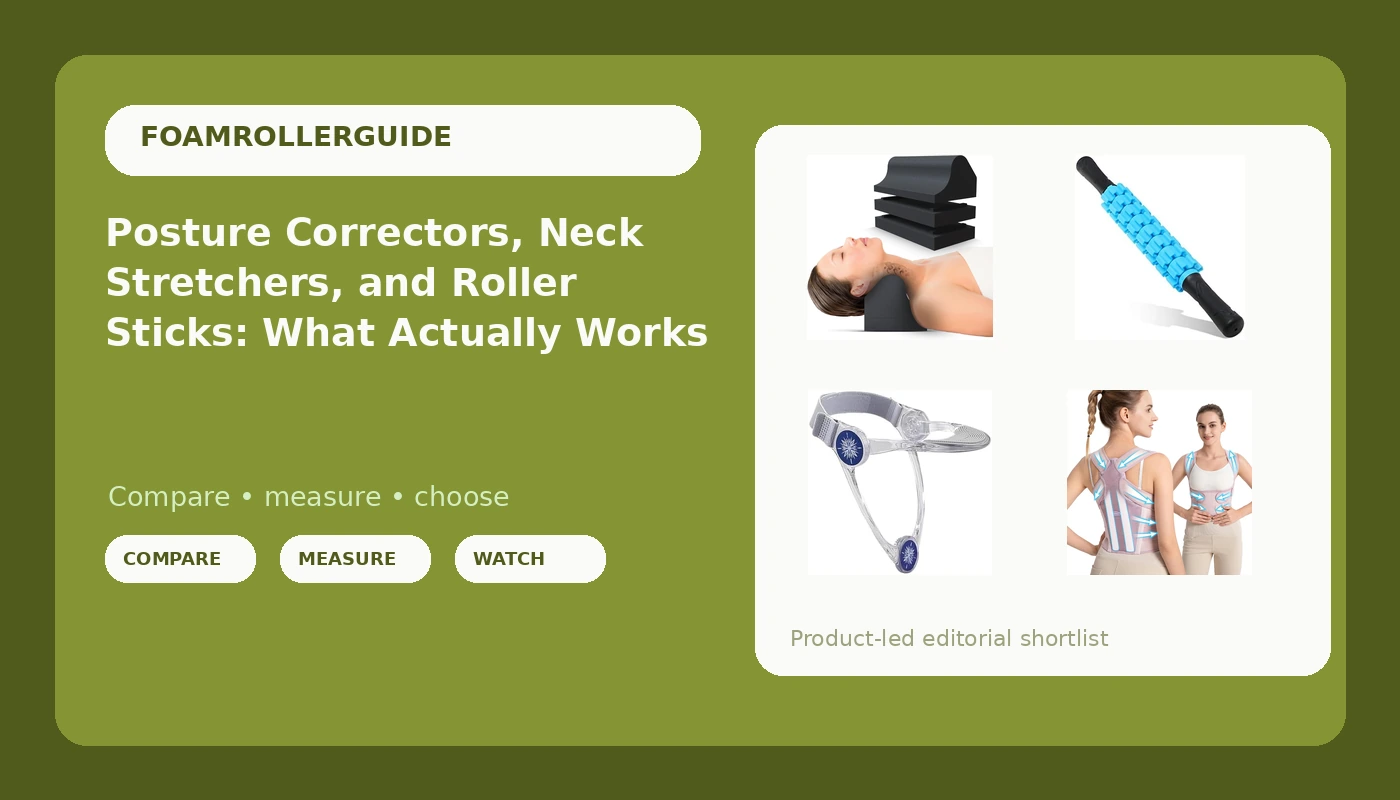
If you spend your workday at a screen, you have probably felt the pattern: the chin drifts forward, the upper back rounds, and by evening the neck and shoulders feel like they are being pulled in two directions. That drift is usually called forward head posture, and the market's answer is a pile of straps, collars, stretchers, and rollers. The useful question is not which device is strongest, it is which device matches the job you actually need done. This article covers four tools in the posture corrector and cervical traction category, what each one is built for, and where each one stops helping.
Related: How to Foam Roll Your Quads Without Bruising Yourself →
Quick answer
There is no single device that fixes posture, because posture is a behavior rather than a shape you can strap yourself into. The most useful setup for most people combines three things: a roller or roller stick for tight muscles, a brace or collar used briefly as a reminder during specific tasks, and short, controlled traction or stretching for the neck. None of these replaces daily movement, and none should be used to the point of pain. Match the tool to the target. Muscles respond to rolling, the neck responds to gentle support and traction, and the mid-back responds to strengthening.
4 useful options
| Model | Best fit | What stands out |
|---|---|---|
| NLNYCT Posture Corrector for Women, 2-in-1 Back Brace with Shoulder Support (S/M) | Short-term posture reminder during desk work | 2-in-1 brace with shoulder straps, adjustable, listed in S/M sizing |
| Cervical Traction Orthotic Chiropractic Neck Alignment Device (Black) | Gentle neck traction and stretching | Single-piece traction orthotic listed for forward head posture and physical therapy |
| 360° Adjustable Neck Collar with Neck Stretcher | Adjustable neck support with a stretching function | 360° adjustable plastic collar that combines support with a stretcher |
| ZanLLW Massage Roller, Muscle Roller Stick | Handheld rolling for legs, calves, and thighs | Stick design listed for trigger points and sore muscle recovery |
Everyday posture support: NLNYCT Posture Corrector for Women
Here is the honest framing: a brace is an external cue. It can pull the shoulders back and make a long desk session feel less tiring, and that is a real benefit for some people. What it cannot do is strengthen the muscles that hold you upright, because those muscles are doing less work while the brace does it for you. Worn all day, it teaches your postural muscles to lean on it. The more useful pattern is short, task-specific wear, such as through one block of focused computer work, paired with movement and strengthening the rest of the day. The listing's mention of scoliosis deserves its own note: scoliosis is a medical diagnosis, and a marketplace brace is not a treatment plan for it. That conversation belongs with your clinician.
Traction and stretching: Cervical Traction Orthotic Chiropractic Neck Alignment Device
Traction is a passive stretch for the neck, and it is one of the few tools where the evidence is genuinely mixed. Some people get short-term relief from the unloading sensation, especially after a long day of screen work, and some get nothing from it at all. What matters is how you use it: brief sessions, gentle pressure, and a firm stop rule. If you feel tingling, numbness, dizziness, or pain that travels into the arm, stop and have the symptom looked at rather than pushing through. Traction is also not appropriate for everyone, including people with certain disc problems, spinal instability, or a recent injury. Clear it with your clinician before you start.
Adjustable support: 360° Adjustable Neck Collar with Neck Stretcher
Collars sit in a similar place to braces: useful for short-term support, counterproductive as a permanent fixture. The neck is built to move, and a collar that holds it still for hours lets the deep neck muscles do less work than they should. A reasonable approach is to use it during a flare-up or during the specific activity that reliably aggravates your symptoms, then wean off it as things settle. Treat the phrase "correcting forward head posture" as marketing language rather than a mechanical promise. A collar supports and reminds. It does not remodel a spine.
Muscle rolling: ZanLLW Massage Roller, Muscle Roller Stick
A stick has one clear advantage over a foam roller: you apply pressure with your arms instead of your body weight, so you control the dose precisely. That makes it a good fit for people who find floor rolling too intense, who have trouble getting down to the floor, or who want to work a calf while sitting at a desk. It has a matching limitation, in that you cannot easily generate the same load on a large muscle like a quad that a firm foam roller can. On the lipo roller marketing: if you have had a procedure, follow your surgeon's instructions about timing and pressure, not a product listing.
Prices and availability may change. Product images, names, and retailer links are matched to verified listings. No current price, rating, stock status, or measured result is stated here without current evidence.
Why posture responds to movement, not straps
Forward head posture is not a sudden event. It is the accumulation of thousands of hours in the same position, and the body adapts to whatever position it spends the most time in. That is why a device that holds you in a better shape for twenty minutes has a hard time competing with the eight hours you spend in the shape you habitually choose.
It also helps to drop the idea that there is one correct posture. There is no single angle that a spine must hold, and trying to freeze yourself into one tends to create as much tension as it resolves. What the neck and mid-back need is variety and capacity: frequent changes of position, some strength in the muscles that pull the shoulder blades back and down, and some endurance in the deep muscles at the front of the neck that hold the head steady.
Rolling fits into that picture as a comfort tool, not a repair tool. It changes the input going into your nervous system and increases blood flow to the area, which is why a tight calf or a heavy quad often feels looser afterward. It does not break up scar tissue, and the knots people describe are better understood as areas of muscle that are guarding. That is also why pressure that makes you clench defeats the purpose: you are adding guarding, not removing it.
Finally, expect a timeline measured in weeks. Tissue and habit change slowly, and a single session of stretching or rolling does not undo a decade of desk work. The people who get the most out of these tools are the ones who use them consistently and mildly, rather than intensely and occasionally.
Matching the tool to the job
The mistake to avoid is buying a device before you have named the problem. Work through these steps in order.
- Name the symptom and the target area. Neck, mid-back, or legs. A tool that does not match the target will not help no matter how well it is made.
- Decide whether you need a movement tool or a support tool. Rolling and stretching change tissue and input. Braces and collars provide external support and a reminder. They do different jobs.
- Check the fit for your body and your space. Sizing, adjustability, and whether you can actually use it where you live matter more than features you will never touch.
- Set a dose before you start. A few minutes per muscle group, pressure that is uncomfortable but conversational, and a stop rule you will honor.
- Set a review date. If a tool has not changed anything in a few weeks of consistent use, change the plan rather than the intensity.
Using these tools without making things worse
- Keep pressure in the uncomfortable but conversational range. If you are holding your breath or bracing against the roller, ease off.
- Two minutes per muscle group is a reasonable starting dose. More time and more pressure are not automatically better.
- Roll muscles, not bones, joints, or the front of the neck. Bony areas and the throat are not rolling surfaces.
- Use support devices for tasks, not for whole days, and take them off when the task ends.
- Stop and seek advice for tingling, numbness, dizziness, or pain that travels down an arm or a leg.
Which option should you choose?
Choose the NLNYCT Posture Corrector for Women when you want a wearable reminder during focused desk work and you are prepared to use it for short blocks rather than all day. Choose the Cervical Traction Orthotic Chiropractic Neck Alignment Device when you want a passive stretch for the neck and your clinician has confirmed that traction is appropriate for you. Choose the 360° Adjustable Neck Collar with Neck Stretcher when you want adjustable support during a flare-up or a specific aggravating activity. Choose the ZanLLW Massage Roller, Muscle Roller Stick when your tightness is in the legs, calves, or thighs and you want pressure you control with your arms.
None of these four tools is a treatment for a diagnosed spinal condition, and none of them substitutes for strength work and daily movement. The claims on the listings are the seller's claims, not clinical findings, and the evidence for traction and for long-term collar use is mixed. If you have radiating pain, numbness, weakness, or a history of spine surgery, get guidance from a clinician before adding any of them.
The bottom line
The most useful purchase is usually the least dramatic one. A roller stick for tight legs, a brace or collar used briefly as a reminder, and a traction device used gently and briefly if it suits your neck will do more for most people than any single device used aggressively. Match the tool to the target area, dose it mildly, and give it a few weeks before you judge it. If a device is sitting in a closet because using it hurts, that is not a sign to push harder. It is a sign the tool, the dose, or the target was wrong.