Most people who show up with "bad posture" are not short on willpower. They are short on a routine that fits the fifteen minutes they actually have between work and dinner. A good posture recovery routine is not a brace you wear from breakfast until bedtime, and it is not twenty minutes of suffering on the hardest roller in the gym. It is a short, repeatable set of moves aimed at the tissues that pull you forward, plus a way to remind yourself what neutral actually feels like.
I am a physical therapist in Minneapolis. Twelve years in, half of them in a clinic where the schedule ran back to back and half the charts said the same sentence: it hurts and it will not loosen up. What follows is how I would set up a posture recovery routine at home, the order I would do it in, and the two tools I would actually keep in the room.
Why you should trust me
I have spent twelve years treating backs and shoulders, and a good chunk of that time has been spent talking people out of things rather than into them. Out of rolling until they cry. Out of wearing a brace for twelve hours a day. Out of buying a fourth massage gun instead of learning two exercises.
I keep a pressure gauge in my treatment room because the "it hurts so it must be working" crowd needs a number, not a lecture. Pain during rolling is a signal to back off. If you are gritting your teeth, you are not recovering, you are rehearsing tension.
What I will not do here is pretend a piece of equipment fixes posture. Posture is a habit and a strength problem. Tools help you get there faster and help you stay there, but they do not do the work for you.
How I judge a recovery tool
I do not care what the box says. I care about four things, in this order.
Does the intensity match the target? A soft surface belongs against a ribcage or a healing area. A firm surface belongs against a quad or an upper back. The mistake I see most often is someone buying one tool for every job and then wondering why their ribs hurt.
Can a normal person use it without hurting themselves? If the tool requires a tutorial and a spotter, it will not survive contact with a Tuesday night.
Will it still work in six months? Inflatable anything is a no. A roller that flattens into a pillow after three months is a no. A tool that lives in the closet is a forty dollar paperweight, and that is the real failure mode.
Would I prescribe it to a patient? This is the last filter and it kills most products. A gadget can be clever and still not belong in a recovery routine.
That is the test I applied to the two items below. Neither one is exotic. Both answer a specific question that comes up in almost every posture conversation I have.
The two tools I would start with
Everything in this section is about supporting the routine, not replacing it. If you only have fifteen minutes, spend twelve of them moving and three of them on equipment.
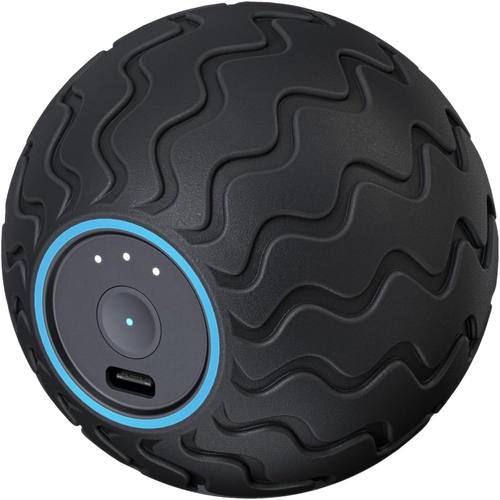
Upper back and lat work: Therabody WaveSolo - Handheld Bluetooth Enabled Massage Device, Ultra Portable Vibration Therapy Ball w/QuietRoll Technology & 3 Customizable Vibration Frequencies
 Visit on Amazon →
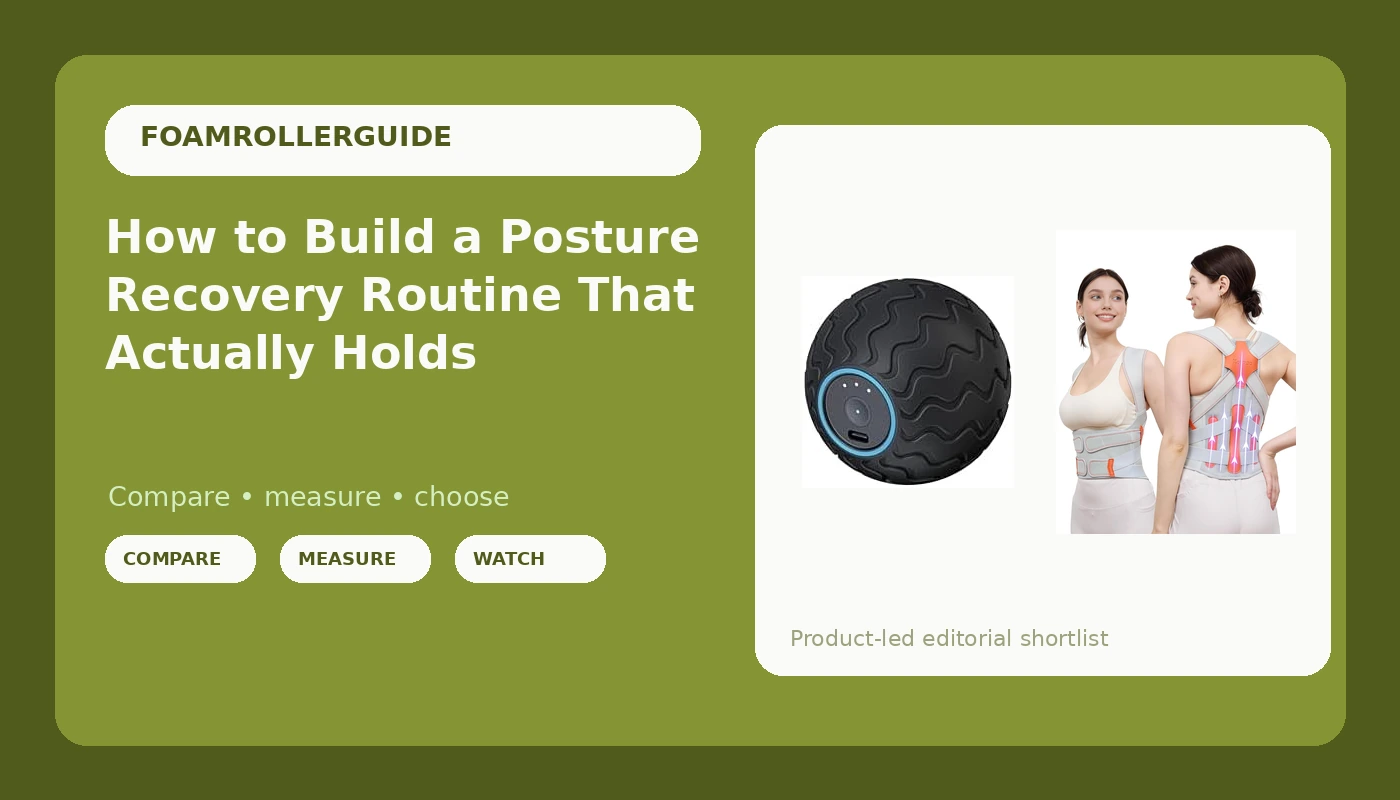
This is the tool I reach for when someone's upper back is locked in a forward curve and a flat roller cannot get into the space beside the shoulder blades. It is a handheld vibration therapy ball with three customizable vibration frequencies and a Bluetooth connection to the app, and the shape is the entire point. A round surface can sit next to the spine and work the muscles that run along it without pressing on the bones in the middle.
Vibration helps here for a boring reason: it gives the nervous system something to listen to besides the stretch, which lets people relax into a position instead of fighting it. That is why I use it for thoracic extension, for lats, and for pecs, all of which pull the shoulders forward. QuietRoll Technology matters more than it sounds. A tool that rattles gets used once.
Where I would not use it: on the neck, on the low back directly over the spine, or anywhere boney. Vibration belongs on muscle. That rule does not bend.
Check current Amazon price before you buy, and note that this is a tool for someone who already moves a little. If you have never done a single mobility drill, start with the routine below and add the ball in week two.
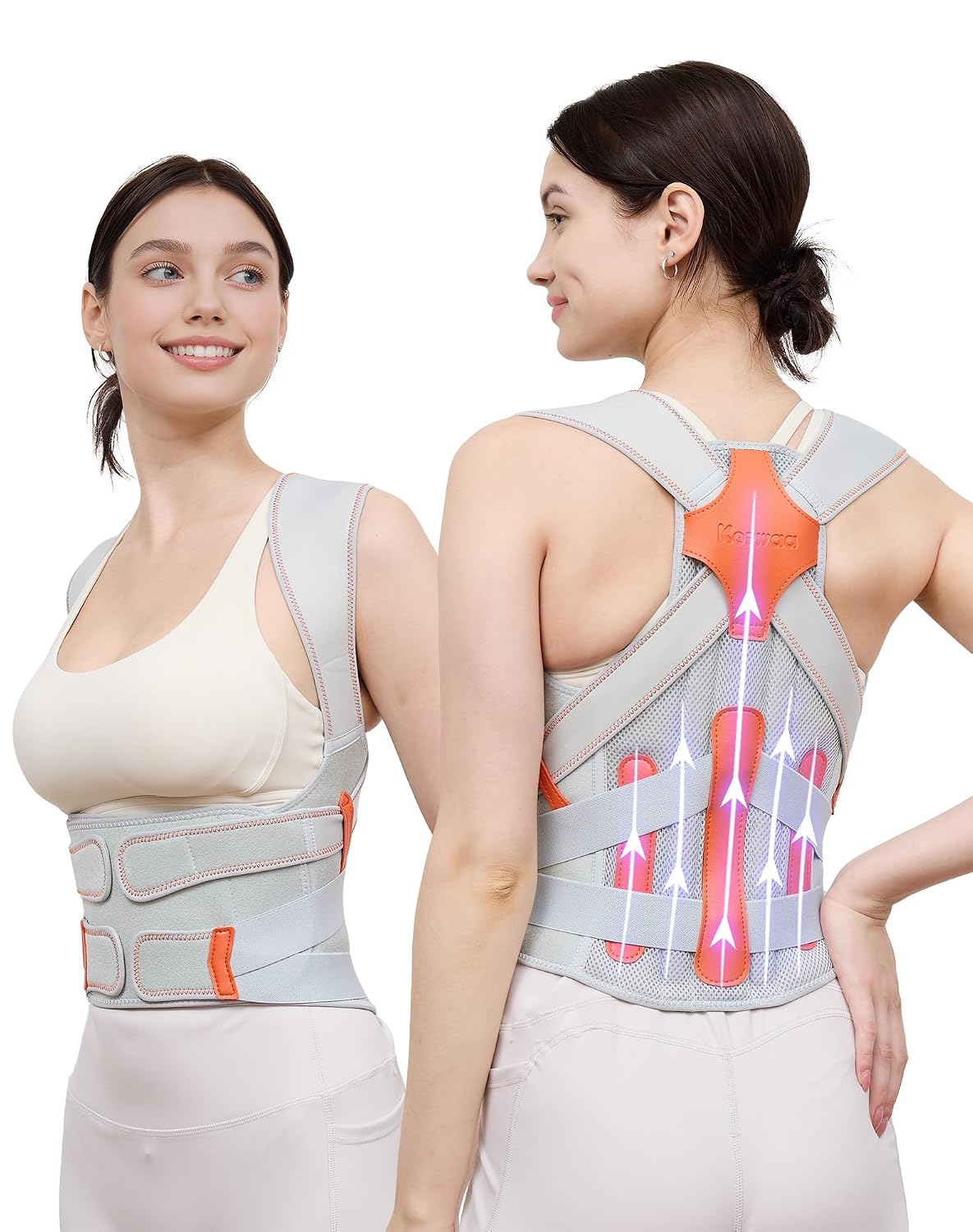
Posture cue: Posture Corrector for Women and Men, Full Back Support Brace, Gray, Large
 Visit on Amazon →
I prescribe braces the way I prescribe a timer. They are for teaching a position, not for holding one all day. This one is a full back support brace in gray, sized large, and it does what a brace should do: it pulls the shoulders back far enough that you can feel what neutral is, then it gets out of the way.
Here is the dosing I give patients. Twenty to thirty minutes at a time, during a task where you know you collapse, which for most people is desk work or driving. Not overnight. Not for a full workday. The brace is a reminder that your shoulder blades have a place to sit, and once you can find that place without it, you should need it less, not more.
Two practical notes. Measure your chest before you order, because a brace that is too small is a rib injury waiting to happen and one that is too big does nothing. And do not treat it as a substitute for rowing, pulling, or any of the strength work in the routine below. A brace that replaces training is a slower way to stay weak.
Check current Amazon price on the listing, since sizing and stock move around.
The routine itself
Fifteen minutes, four or five days a week. Do it in this order.
Step one: pick two targets, not ten. Most people cannot name the area that actually limits them. If your shoulders round forward, the targets are the pecs, the lats, and the upper back. If your low back aches after sitting, add the glutes and hip flexors. Two areas done well beats eight areas done badly.
Step two: warm the tissue for 60 to 90 seconds per area. Slow passes, pressure that is uncomfortable but not painful. If you cannot breathe normally, you are too deep, and the muscle will guard instead of release. Two minutes per muscle group is a protocol. Ten minutes of grinding is a punishment.
Step three: use the ball for the upper back, not the roller. Lie on your back with the ball under one side of the upper back, just off the spine. Support your head with your hands. Let your chest open and breathe out. Move the ball a couple of inches and repeat. Three or four positions per side is plenty. This is where the vibration ball earns its place, because it lets you stay in a position long enough for something to change.
Step four: roll the lats and pecs. Side lying for the lats, face down or against a wall for the pecs. Same dose. Slow. These are the tissues that win the tug of war with your shoulder blades, and they are usually the ones nobody touches.
Step five: glutes and hips if you sit all day. Ball or roller, either works. Sixty to ninety seconds per side. This is also where people discover that their "tight hamstrings" are actually a hip that has not moved in eight hours.
Step six: put the brace on for the task you struggle with. Desk work, driving, the hour of email. Twenty to thirty minutes. Then take it off and do the strength work while you can still feel where your shoulder blades are.
Step seven: strength, three exercises. A row variation, a wall slide or band pull apart, and a chin tuck. Two sets of ten, slow. This is the part that makes posture stick. Rolling and vibration buy you a window of mobility. Strength keeps the window open.
Step eight: know the difference between before and after. Before a workout, keep mobility work short and range of motion focused, and skip the long grinding. After a workout, slow it down and give each area its full 60 to 90 seconds. One preps. One recovers. Treating them as the same thing is how people end up sore in the wrong places.
What I would skip
Inflatable rollers. They pop mid session, and when they do not pop they are too soft to do anything for a leg.
Anything labeled deep tissue that you can squeeze with one hand. If the surface gives like a pillow, it is a pillow.
Massage guns with one speed. If the only setting is earthquake, you will use it once and then it lives in a drawer. Also, and I mean this, no percussion device on the neck or the spine. Muscles, not bones.
Braces worn all day. A brace is a teaching tool. All day wear means the muscles that hold you up take a vacation, and they take it.
Rolling until it hurts. Pain is not a progress bar. If you are crying, you are not recovering.
What this actually costs
The honest answer is that the gear is the cheap part and the routine is the expensive part, because the routine costs consistency and nobody sells that in a box.
Both items above sit in the range of a single copay at most clinics, and both will outlast a gym membership you stop using in February. But the cost per day only works out if you actually do the fifteen minutes. A brace in the closet and a vibration ball in a drawer cost exactly the same as no gear at all, and they buy you nothing.
Here is the math I give patients. If you spend the money and use the tools four days a week for a year, the cost per use is trivial. If you use them for two weeks and stop, you paid full price for a reminder that you bought something. That is the whole risk with recovery gear, and it is why I start people with two tools instead of six.
Start with the routine. Add the brace for the task that beats you. Add the ball when a flat roller stops reaching the spots that matter. Then give it six weeks before you decide whether it worked.
That is the job. Your shoulders were built to move. Let them.