Most of the back pain I treat in Minneapolis did not start with a lifting injury. It started with nine hours a day in a chair, a phone held at chest height, and a hamstring that has not been asked to do anything since 2019. The fix is not a brace you live in or a massage gun you use like a jackhammer. It is a posture recovery routine you can run in twelve minutes, in the same order, most days of the week.
I have been a physical therapist for twelve years, and half of that time has been spent in a clinic where the charts all read the same way: back hurts, legs tight, no idea why. The routine below is what I hand those patients on day one. Two tools do most of the work, and neither of them is magic. They are just specific.
Here is the whole thing, including the parts people get wrong.
Why you should trust me
I have treated backs and legs for twelve years, and I keep a pressure gauge in my treatment room because the phrase "it hurts so it must be working" has cost more of my patients more progress than any other sentence in the language.
My bias is toward dosing. Rolling and percussion are not spiritual practices. They are inputs, and inputs have amounts, durations, and targets. When a patient tells me they rolled for forty minutes and feel worse, my answer is almost always that forty minutes was the problem.
I do not sell gear and no brand pays me to write this. What I do have is a closet full of recovery tools I bought myself, including three massage guns that I use on patients every week, and a strong opinion about which ones are worth carrying.
What I check before you buy anything
Three questions, in this order. If a tool fails any of them, it does not matter how good the reviews are.
One: what is the target? Muscle tissue responds to pressure and vibration. Bone, joint, and nerve do not, and they respond badly. Any tool you buy has to match a body part you actually plan to use it on. A percussion gun on a glute is a reasonable decision. The same gun on a neck is how people end up in my office with a headache that lasts three days.
Two: does the force match the tissue? This is where the marketing gets creative. Density is a real property and it has a real job. A soft surface against a ribcage is correct. A soft surface against a hamstring is a lie, because the hamstring will simply laugh at it and stay tight. The same logic applies to percussion: a gun that only has one speed, which is earthquake, is not a deep tissue tool. It is a blunt instrument.
Three: will you actually use it? A tool that lives in a closet is a paperweight with a handle. I have watched patients buy the most aggressive roller on the market and use it twice. I have also watched patients recover beautifully with a $20 cylinder and a habit. The habit is the expensive part.
One more filter, and this one is clinical rather than mechanical: can a normal person use this without hurting themselves? If the answer requires a tutorial, a spotter, or a tolerance for bruising, I do not prescribe it. Recovery should not require courage.
The two tools this routine uses
The routine below needs a way to put pressure into muscle and a way to remind your upper body where it belongs while you work. That is it. Everything else is optional, and I will tell you what to skip further down.
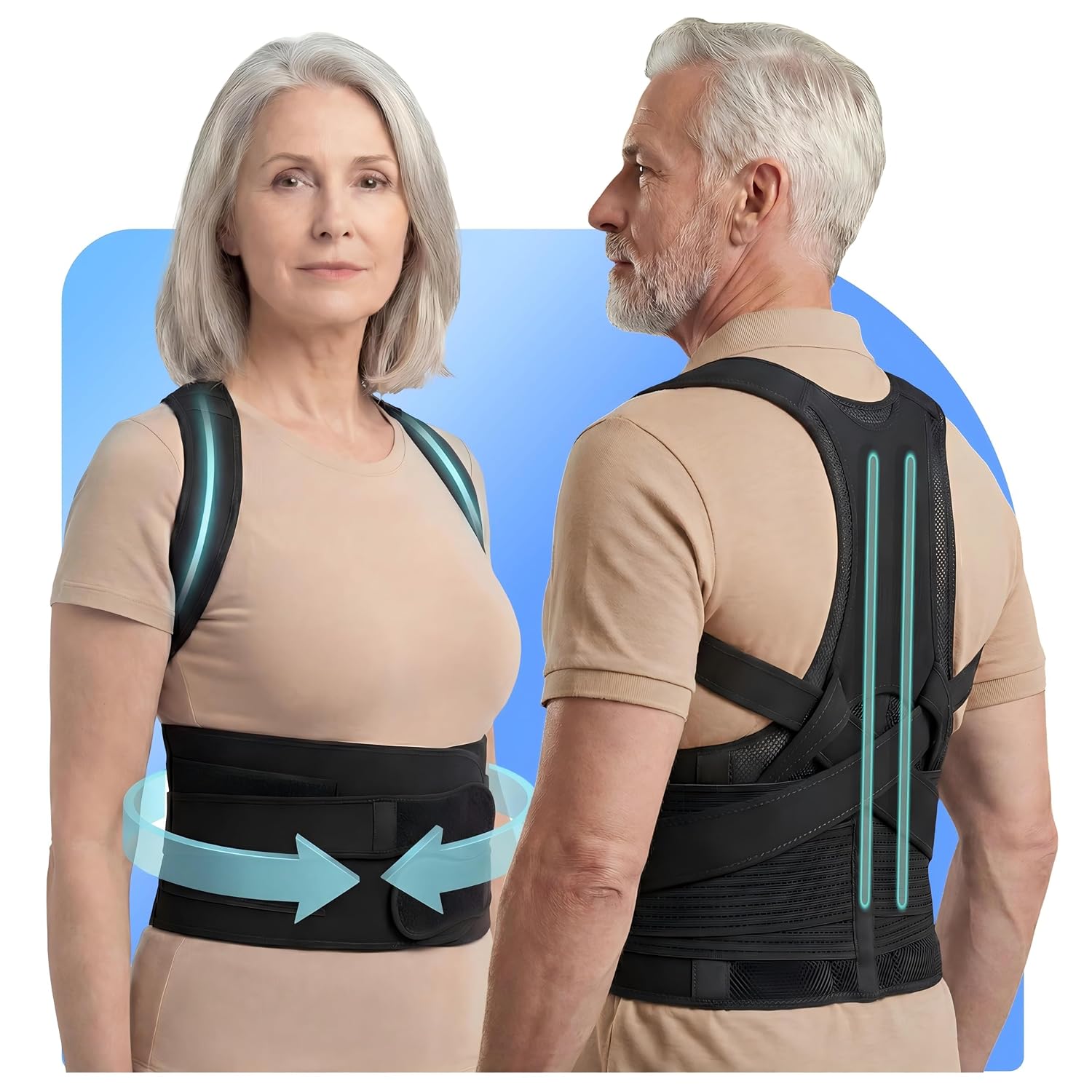
Our pick: Posture Corrector for Men/Women, Full Back Brace, Lumbar Support
 Visit on Amazon →
This is a full back brace with lumbar support, sized for men and women, and it earns its place in the routine for one reason: it gives your nervous system a reference point. When you have spent a decade hunched over a laptop, "sit up straight" is an instruction your body cannot follow, because it has no idea what straight feels like anymore. A brace gives it fifteen minutes of feedback. That feedback is the entire value.
What it is not is a permanent fixture. Wear it for twenty to thirty minutes while you do a task that pulls you forward, then take it off and do the work of holding yourself up. The muscles you are trying to wake up will happily go back to sleep if the brace does the job for them all day. Sizing matters more than anything else here, so measure your chest and waist rather than guessing, and check the fit before you wear it through a workday.
Flaws but not dealbreakers: A brace that is even slightly too tight will make you brace your abs against it, which is a different bad habit. If you can feel it digging into your ribs after ten minutes, it is too small or too snug.
Desk workers who cannot seem to stop collapsing forward by 2 p.m. will get the most out of this, especially in the first two weeks of the routine.
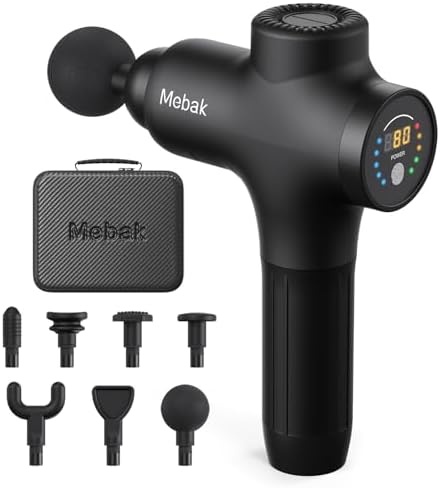
Upgrade pick: Mebak 3 Massage Gun Deep Tissue, Muscle Massager for Athletes Pain Relief
 Visit on Amazon →
This is a percussion massager aimed at athletes and at general muscle soreness, and percussion is the right tool for one specific job in this routine: reaching muscle bellies that a brace cannot touch and that you cannot comfortably roll, like the glutes and the mid-back beside the spine.
Two rules come with it, and I do not bend on either. First, muscles only. Not your neck, not your spine, not your kneecap, not your shin bone. I have seen what a percussion gun does to a neck, and it is not a story with a happy ending. Second, keep the speed moderate and the time short, roughly thirty to sixty seconds per area, moving slowly rather than parking on one spot. If you are gritting your teeth, you are not recovering, you are just tolerating.
Flaws but not dealbreakers: Any percussion device encourages overuse in the first week, because it feels productive. Set a timer for the session. Ten minutes total is a generous dose for a whole body.
Anyone whose legs and glutes are the tight spot, and who has no intention of rolling on a floor for twenty minutes, will use this more than they expect.
The routine, step by step
This is the part you came for. Do it in this order. Order matters less than consistency, but it matters.
Step one: Pick two targets, not eight. The most common failure mode is trying to treat everything. Choose the two areas that bother you most, usually the glutes and the mid-back for desk workers, and leave the rest alone for now. Two targets, twelve minutes, done.
Step two: Two minutes of easy movement first. Walk the hallway, do ten slow bodyweight squats, roll your shoulders. You are not warming up for a workout, you are waking up the tissue so that pressure does not feel like an ambush. Cold muscle plus firm pressure is how people decide that recovery hurts.
Step three: Percussion on the muscle bellies. Thirty to sixty seconds per area, moderate speed, over clothing is fine. Glutes, quads, calves, and the meat beside your shoulder blade, never on the spine itself. Move the head slowly across the muscle rather than holding still. If you find a spot that refers pain somewhere else, that is a trigger point, and the correct response is less pressure and more patience, not more pressure and fewer tears.
Step four: Roll if you have a roller, and skip it if you do not. This routine does not require one. If you do roll, two minutes per muscle group is a protocol, not a suggestion. Slow passes, breathing normally. The "it hurts so it is working" crowd is welcome to keep rolling hard, and welcome to keep coming back to my clinic.
Step five: Brace for the task. Put the brace on for twenty to thirty minutes while you do the thing that wrecks your posture, usually typing or driving. When the timer goes off, it comes off. The point is to feel what neutral actually is, then practice it without help.
Step six: Five minutes of the opposite position. Stand up, walk, open your chest, and let your hips move through their full range. Recovery is not the pressure you apply. It is the position you return to afterward, and if you go straight from the brace back to the chair, you have skipped the part that matters.
Step seven: Do it daily for two weeks, then reassess. Daily is fine. Twice a day is fine if the second session is short. What is not fine is a heroic ninety-minute session on Sunday followed by six days of nothing. Frequency beats intensity here, every single time.
The mistakes I see most
Wearing the brace all day. Covered above, but it is the number one error. The brace is a teacher, and teachers do not move in.
Using the gun on the neck or spine. I will keep saying this until it stops happening. Muscles only.
Chasing pain. Discomfort while rolling or using a gun is normal. Pain that makes you hold your breath, sweat, or cry is not a sign of progress, it is a sign you have exceeded the tissue's tolerance. Back off.
Recovering only after workouts. Rolling before activity and rolling after activity are different jobs. Before preps and primes. After calms things down. They are not interchangeable, and doing one does not replace the other.
Buying the tool before the routine. The tool is the cheap part. The twelve minutes is the expensive part, and it is the only part that compounds.
What I would skip, and why
Skip vibrating rollers if you are buying your first tool. The vibration helps, but a good firm roller gets you most of the way there, and the price difference is not small.
Skip inflatable rollers. They are a pop risk with a soft surface, and neither of those qualities is what you want under load.
Skip anything described as "deep tissue" that you can press flat with one thumb. That is a marketing word on a soft surface, and the hamstring will not be fooled.
Skip massage guns with one speed, where the single setting feels like a small earthquake. Percussion is a dose, and a tool with one dose is a tool you will use badly.
Skip textured rollers with aggressive knobs if you are new to this. They have a real job for stubborn quads, but they are not a starting point, and they are not a beginner tool.
What this all costs
The routine uses two purchases: the brace and the gun. Prices move constantly, so check the current Amazon price on both rather than trusting a number you read in a review, including this one.
The more honest accounting is time. Twelve minutes a day, six days a week, is about seventy minutes a month. Over a year that is roughly fourteen hours, which is less time than most people spend reading about recovery gear in a single month.
And the alternative is not free. The version of this that costs money is the one where the back pain wins, and you spend it on imaging, injections, and copays instead of on a brace and a timer.
The short version
Pick two targets. Two minutes of easy movement. One minute of percussion on the muscle bellies, never the neck or spine. Two minutes of rolling if you have a roller. Twenty minutes in the brace while you work, then off. Five minutes of moving in the opposite direction. Repeat tomorrow.
That is the whole posture recovery routine. It is not dramatic, it does not hurt, and it does not require a closet full of equipment. It requires that you show up tomorrow, which is the only part of recovery that has ever really been hard.