Most people who want forward head posture correction start in the wrong place. They buy a brace, crank it tight, wear it to the office, and three weeks later their neck hurts more than it did before. Then the brace goes in a drawer and the problem stays.
I get it. The neck is a bad place to guess. It is small, it is loaded all day by screens, and it complains loudly when you get the dose wrong. The fix is not complicated, though. It is two tools used in a specific order, for a specific amount of time, alongside movement that actually builds the muscles that hold your head where it belongs.
Here is how I set that up with patients, and the two pieces of gear I use to do it.
Why you should trust me
I have been a physical therapist for 12 years, and about half of that was spent in a clinic where people came in with backs that "just hurt" and legs that would not loosen up. The neck cases were always the ones where somebody had already tried something. A brace from a late-night search. A traction device a friend handed down. A massage gun aimed at the base of the skull, which is a story for another article.
I prescribe rolling and posture work the way I would prescribe anything else: a target, a dose, and a reason. If you cannot tell me which structure you are trying to load and how long you are loading it, you are not rehabbing, you are guessing. I keep a pressure gauge in my treatment room for the "it hurts so it must be working" crowd, because that belief is how people turn a two-week problem into a two-month one.
What I will not do is sell you a cure. Neither of the tools below fixes forward head posture on its own. They buy you the window in which the actual work happens.
How I judge posture gear
Every device I recommend gets run through the same four questions, and if it fails any one of them it does not make the list.
First, does it match a real clinical need? A brace and a traction unit do different jobs. One is a reminder, one is a decompression position. If a product tries to be both, it usually does neither well.
Second, can a normal person use it without hurting themselves? This is where most neck gadgets fail. Anything that lets you crank force into your cervical spine with no feedback is a problem, not a product.
Third, will it survive six months of real use? Straps that stretch out, foam that flattens, plastic that cracks. Those are the usual endings for cheap recovery tools.
Fourth, would I actually hand it to a patient? That is the test that matters. I do not recommend things I would not put in someone's hands on a Tuesday morning.
Both products below passed. They are also both affordable enough that you are not making a bet on them, which is more than I can say for a lot of the recovery aisle.
The gear, and what each one is actually for
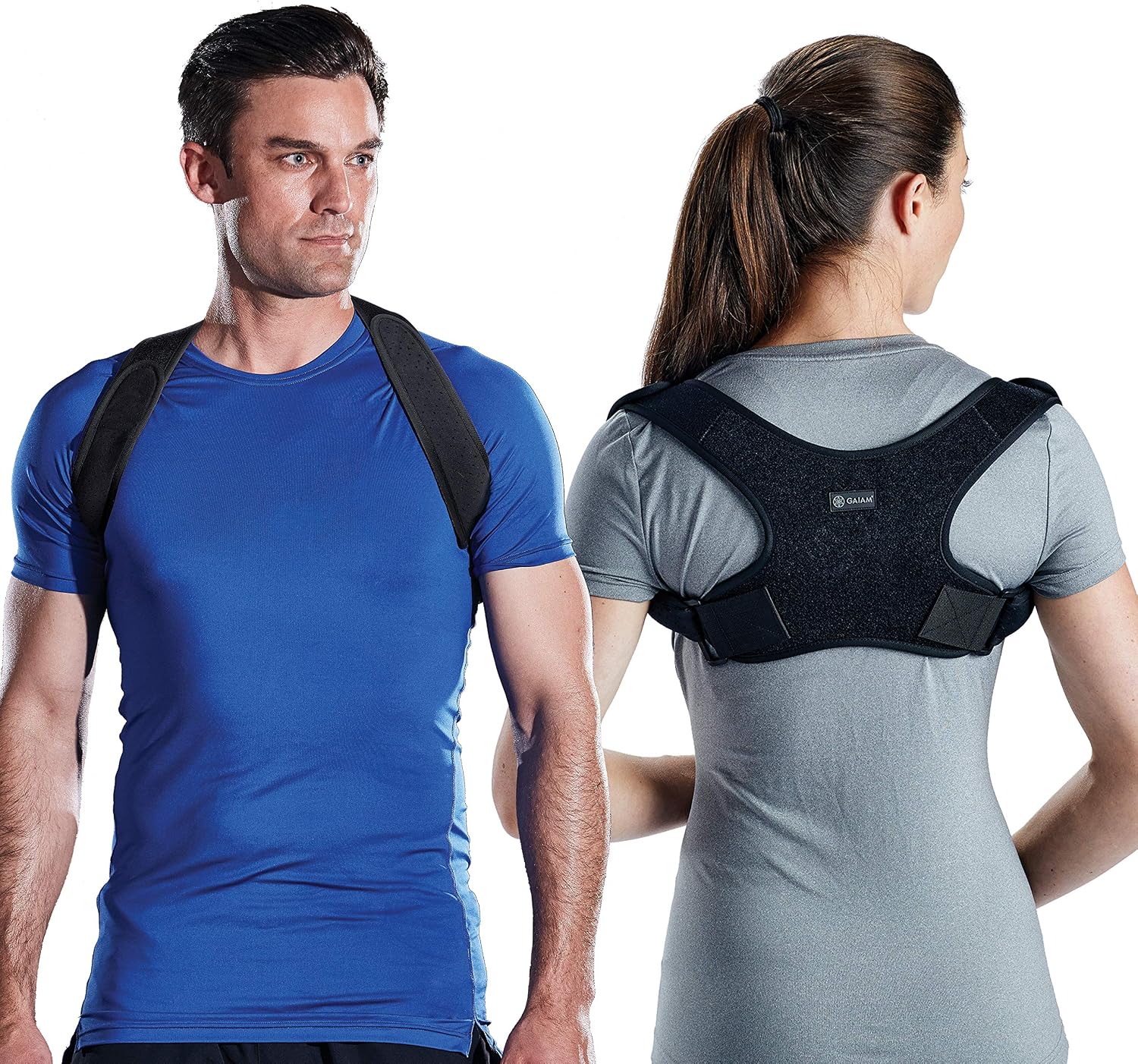
The brace: Gaiam Restore Posture Corrector for Women & Men - Back Straightener Adjustable Straps Compact Brace Support for Clavicle, Neck, Shoulder, Invisible Pain Relief
 Visit on Amazon →
This is the reminder tool. Adjustable straps run over the shoulders and across the upper back, and when you start to round forward, the pull is what tells you to stop. That is the whole mechanism, and it is a good one. Most people with forward head posture have lost the sense of where neutral is. The brace hands that sense back to you for the minutes you are wearing it.
Notice I said minutes. The mistake everybody makes with a corrector is treating it like a cast. It is not. You wear it while you do a task that usually wrecks your posture, you notice the pull, you correct, and then you take it off and keep the correction. Fifteen to thirty minutes at a time is plenty. If you need it all day to sit up straight, the brace is doing the work your upper back muscles should be doing, and those muscles will get weaker, not stronger.
Flaws but not dealbreakers: It is a compact, low-profile design, which makes it easy to wear under a shirt, but that also means it will not force you into position the way a rigid medical brace would. That is a feature for home use and a limitation if you were hoping for something structural. The adjustment matters more than people expect, too. Tighten it so you cannot breathe into your ribs and you have turned a reminder into a restriction.
Anyone who sits at a desk, drives a lot, or looks down at a phone for a living will get the most out of this one. If you have a diagnosed spinal condition, talk to your clinician before you strap anything to your shoulders.
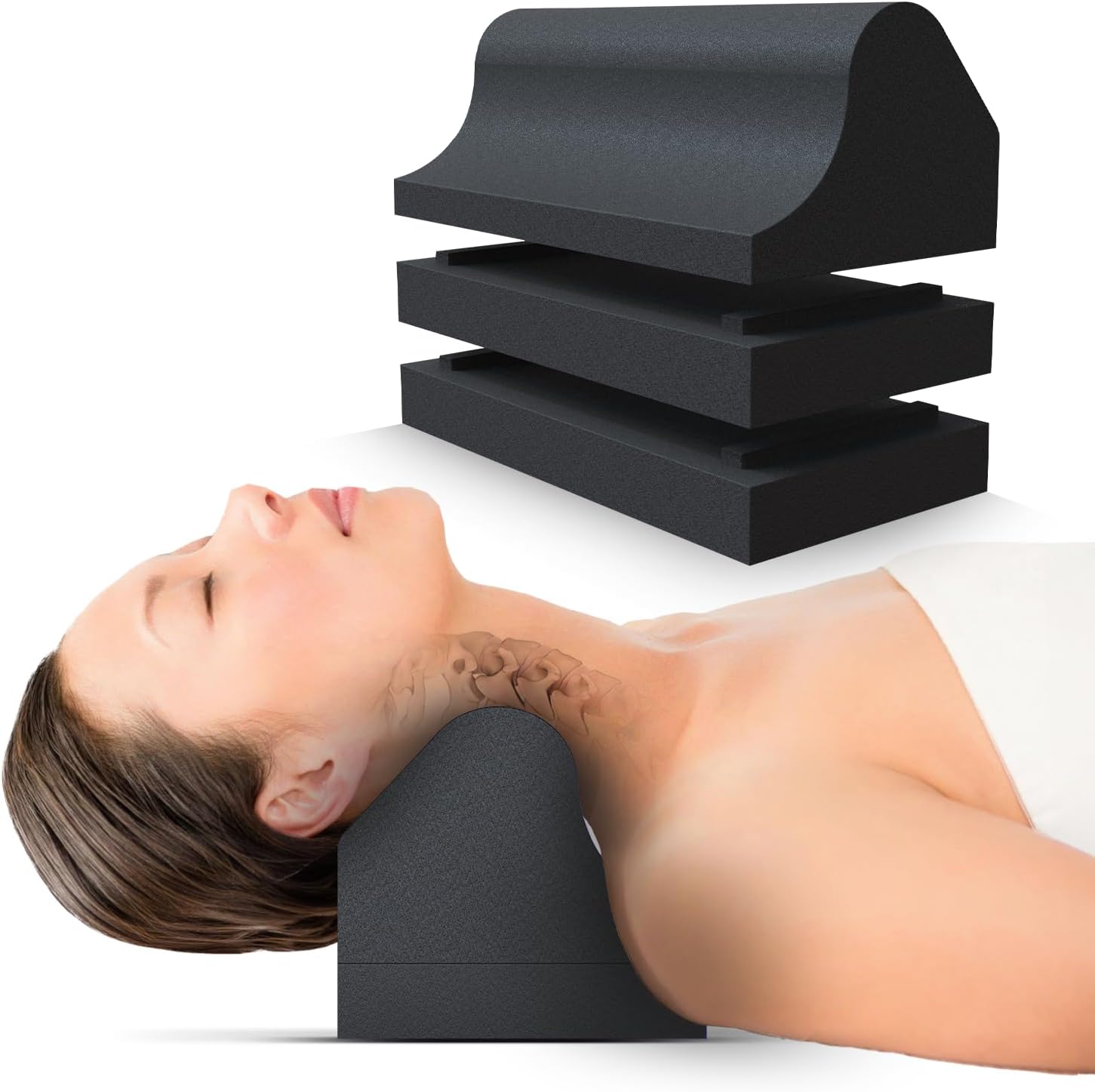
The traction tool: Cervical Traction Orthotic Chiropractic Neck Alignment Device for Spinal Curve Tension Stretching Forward Head Posture Pain Relief and Physical Therapy (Black)
 Visit on Amazon →
This is the other half of the pair, and it does the job the brace cannot. Traction is a position, not a stretch you push through. You lie down, you let the device support the curve of your neck, and you give the muscles at the base of your skull a few minutes where they are not holding your head up against gravity.
That is why I like it as a home tool. It is passive by design. There is no crank, no strap you pull tighter, no way to muscle your way into it. You set a timer, you lie there, you get up. For the patient who has been clenching through neck stretches for months, that passivity is the treatment.
The caveats here are real, so read them. Start short. A few minutes, not twenty. If you have a disc issue, a recent whiplash injury, spinal instability, or anything a doctor has already flagged, this is a conversation with your clinician before it is a purchase. Traction is not appropriate for every neck, and no product page can tell you whether it is appropriate for yours. Do not fall asleep on it. Do not use it as a pillow. Do not add force by pushing your head into it.
Flaws but not dealbreakers: It is a single-purpose device. It takes up floor space, and it only earns that space if you actually lie down for the five to ten minutes a day it asks for. People who want a tool they can use while watching television will use this one for a week and then forget it exists. That is a routine problem rather than a product problem, but be honest with yourself about it before you order.
Anyone whose neck feels better after a few minutes of supported lying down, and who has a clear green light from a clinician, will get real use out of it.
The protocol: how to use both tools in one session
The order matters more than the gear. Here is the sequence I hand to patients.
Step one: find your baseline. Stand with your heels, butt, and upper back against a wall. Can the back of your head touch the wall without you lifting your chin? If you have to strain, you have found the gap you are trying to close. Note how it feels. Do not force it.
Step two: move before you treat. Five minutes of easy motion first. Chin tucks, slow and small, ten of them. A doorway chest stretch, thirty seconds a side. Some gentle extension over the back of a chair. You are waking tissue and the nervous system up, not stretching for a personal record.
Step three: traction, short dose. Lie down with the cervical traction device for a few minutes. Build slowly over the first two weeks. If symptoms move down the arm, or you get dizzy, or the neck feels worse rather than looser, stop and call a clinician. That is not a push-through signal.
Step four: the brace as a training cue. Put the corrector on for fifteen to thirty minutes during whatever task destroys your posture, usually laptop work or driving. When you feel the pull, correct and keep going. Take it off when that block of work is done.
Step five: load the muscles that hold the position. This is the part people skip, and it is the part that actually changes the posture. Rows with a band or a dumbbell. Band pull-aparts. Face pulls if you have a cable. Two or three sets, two or three times a week. The brace reminds you where neutral is. The rows are what let you live there.
Step six: recheck once a week. Same wall test, same wall. You are looking for a trend over weeks, not a change over days.
Mistakes that undo the work
Wearing the brace all day is the big one. A corrector that never comes off turns your upper back into a passenger.
Cranking traction past the point of comfort is the second. Traction works in a relaxed position. If you are grimacing, you are contracting the exact muscles you are trying to quiet.
Rolling your neck on a foam roller is the third. I prescribe foam rolling constantly, and I still do not want a roller under your cervical spine. The neck is not a hamstring. You cannot roll it into submission, and the structures back there are not built for it.
Using a massage gun on the base of your skull or along the spine is the fourth. Massage guns are for muscles. Not bones, not joints, and not the neck. I have seen the injuries, and they are not worth ten seconds of relief.
The fifth: expecting either tool to work while you spend nine hours a day with your head two feet forward. Posture is a training load. You cannot out-device a position you hold all day.
The tools that are not in this guide
Foam rollers are the backbone of what I do, and they are not in this article for a reason. A roller is the right tool for quads, calves, lats, and upper back tissue. It is the wrong tool for a cervical curve problem, and every time someone tells me they rolled their neck to fix their posture, I wince.
Massage guns belong in the same conversation. Great on a stubborn quad. Not on your neck, ever.
The posture apps, the vibrating gadgets, and the "alignment" pillows that show up in the same search results all sit in one category: they are not wrong, they are just not the two things that matter here. Movement, then a reminder, then load.
What this all costs
Both tools sit in the range of a single clinic visit, and both are the kind of purchase you make once and use for years, if you keep them where you can see them. That is the honest math. A brace in a drawer costs more per use than a brace hanging on the back of your desk chair.
The traction device asks for floor space and a few minutes of doing nothing, which is a genuine cost for some people. Be honest about which of those two you are actually going to use, and buy that one first. You do not need both on day one. You need one of them, plus a band, plus the willingness to do rows twice a week.
Check current Amazon price before you commit, and remember that the price is the smallest part of the decision. The routine is the expensive part, and it costs you fifteen minutes a day.
That is the job. Your neck was built to hold your head up. Give it the tools and the dose, and let it.