Most posture problems are not structural. They are habitual, and that is genuinely good news, because a forward head posture routine that fits into a normal Tuesday will beat a perfect program you abandon by week two. I have been a physical therapist for twelve years, and the patients who improve are almost never the ones who bought the most equipment. They are the ones who did four boring things every day and stopped treating the neck like a separate machine from the ribcage.
The average adult head weighs about as much as a bowling ball, and every inch it drifts forward multiplies the load your neck extensors have to hold. That is why the ache shows up at 3 p.m. and not at 8 a.m. Muscles that hold a position all day get tired, tired muscles get sore, and a sore neck makes you shift into the next bad position.
You do not need a clinic to change this. You need twelve minutes, a floor, and a couple of supports that carry the hours you are not exercising.
Why you should trust me
I spent twelve years treating necks and backs, half of that in a clinic where the most common sentence I heard was some version of "it just hurts." I prescribe rolling and posture work the way I would prescribe anything else: specific, dosed, and with a reason attached.
I keep a pressure gauge in my treatment room for the patients who arrive convinced that recovery has to hurt, and I use it to show them that the pressure that helps is almost always lighter than the pressure they were using. I have no interest in selling you a device that ends up under the bed. The test I apply to any recovery tool is simple: does the design match a real clinical need, can a normal person use it without hurting themselves, and will it survive six months of real life.
What a forward head posture routine actually needs
Every routine that works has three parts, and skipping any one of them is why most people plateau.
Mobility. Your mid back has to be able to extend, and the front of your chest has to be able to lengthen. If the thoracic spine is stiff, the head goes forward to make up the difference. This is the part people skip.
Strength. The deep muscles at the front of the neck and the lower traps between your shoulder blades are the ones that hold your head over your shoulders. They are weak in almost everyone who sits for a living.
Awareness. You cannot correct a position you do not notice. This is where a support or a reminder helps, and it is the only honest reason to buy gear.
Dosing rules, since this is where people go wrong: two minutes per area, pressure that is uncomfortable but not painful, once a day, for six to eight weeks before you judge it. If you are crying, you are not recovering.
One caveat before anything else. If you have numbness or tingling into an arm, weakness in a hand, dizziness, or pain that wakes you at night, see a clinician before you start a home routine. Posture work is not the right first move for a nerve that is already irritated.
The gear that earns a spot in the routine
Two pieces of equipment come up again and again when patients ask what to buy. Neither one fixes posture on its own. Both make the routine easier to keep, and keeping it is the only thing that changes anything. Everything below is something you wear or lie on for a few minutes. None of it does the work for you.
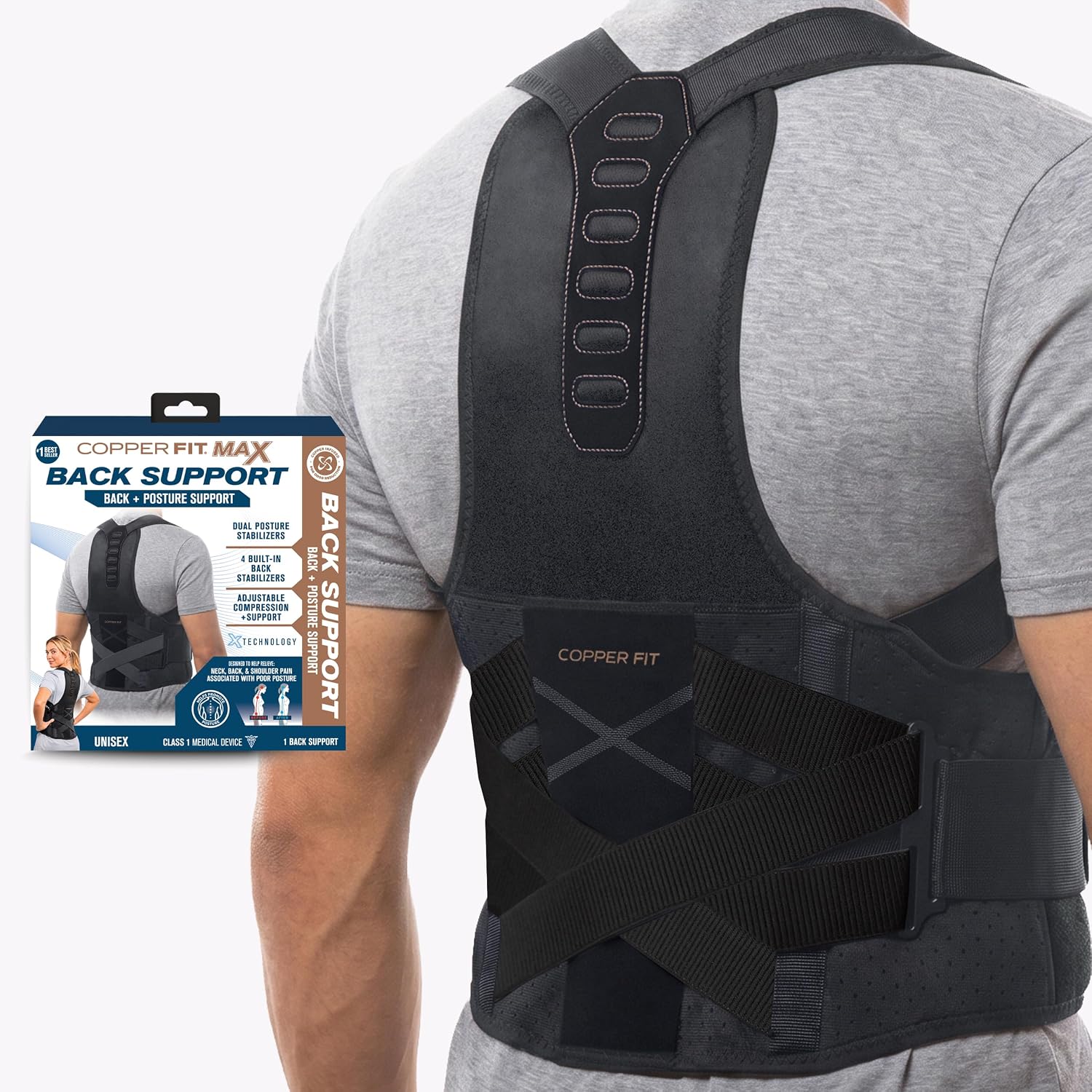
Daytime support: Copper Fit Max Posture and Back Support (Small/Medium)
 Visit on Amazon →
A posture support works the way a sticky note works. It does not strengthen anything. It gives your nervous system a physical reminder that your shoulders have drifted, and for a lot of people that reminder is the difference between noticing at 3 p.m. and noticing at 9 p.m. when the tension has already set in.
The way I suggest using a brace like this one: wear it in blocks, not all day. Pick the two hours when you are most likely to collapse, usually late afternoon at a desk or during a long drive. Then take it off and do the routine. If you wear it from breakfast to dinner, the muscles that should be doing the work get to retire, and you have traded one problem for another.
Sizing matters more than people expect. This listing is Small/Medium, so measure your ribcage before you order. A brace that rides up into the armpits or digs into the ribs gets abandoned within a week.
Flaws but not dealbreakers: It is a reminder, not a correction. No brace on the market holds your head in place for you, and any product claiming otherwise is selling you a feeling, not a result. It is also not for sleeping and not for training.
Anyone who spends six or more hours a day at a desk or in a car will get the most out of it.
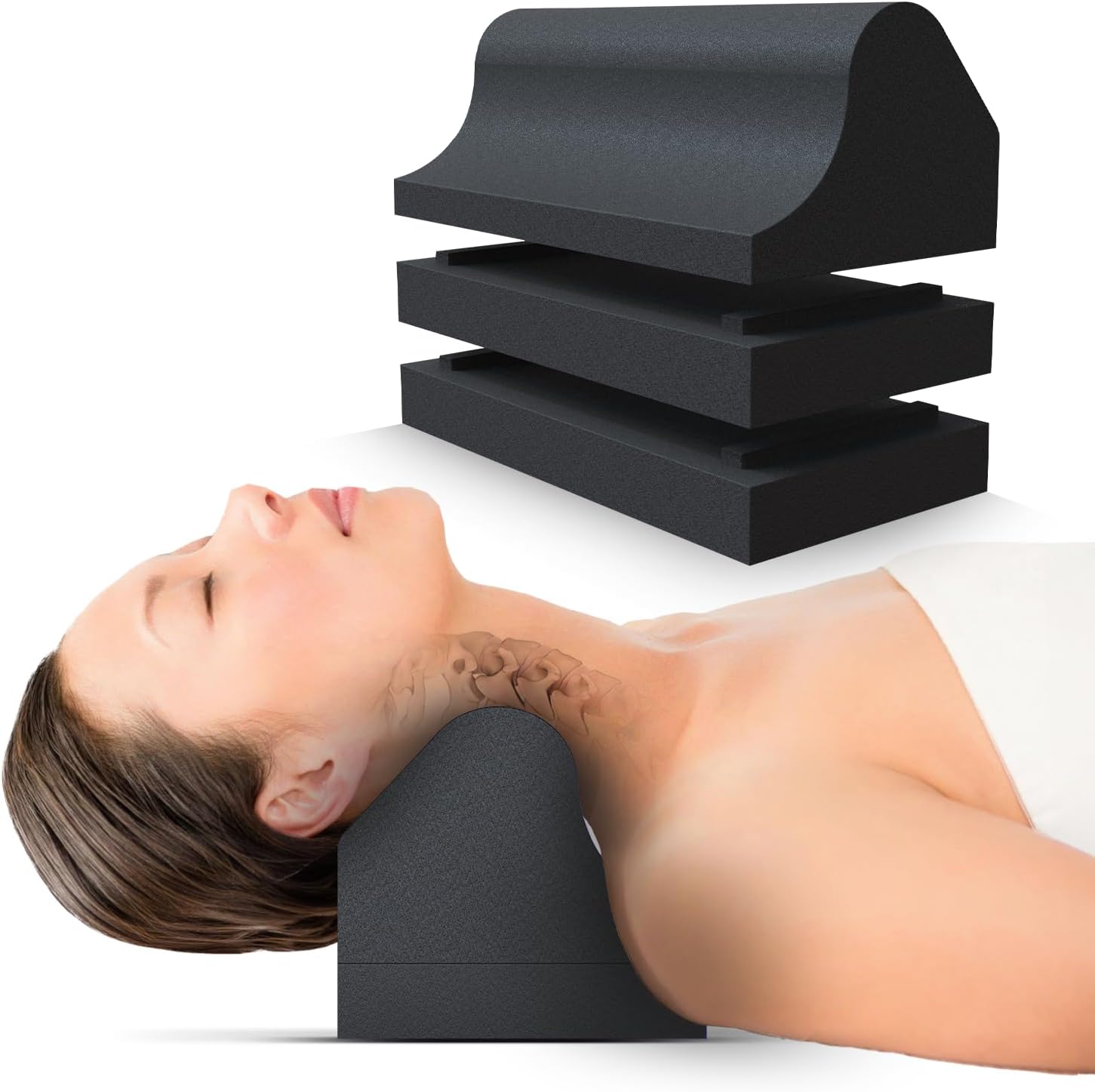
Evening decompression: Cervical Traction Orthotic Chiropractic Neck Alignment Device for Spinal Curve Tension Stretching Forward Head Posture Pain Relief and Physical Therapy (Black)
 Visit on Amazon →
Devices in this style work by cradling the curve of the neck while gravity gently lengthens the tissue along the back of the cervical spine. Used for five to ten minutes at the end of the day, that can take the edge off the tension that builds from hours of looking down at a laptop or a phone.
The rules I give patients are short. Start at the lowest comfortable setting. Keep sessions under ten minutes. Stop immediately if you feel dizzy or lightheaded, or if anything tingles or goes numb in your arms. Do not use it after a recent injury, and do not use it as a self treatment for radiating symptoms. It is a comfort tool and a mobility aid, not a cure for a disc problem.
It will feel strange the first few times, and that is normal. The long product name is doing a lot of work, but the function is simple: support the curve, let the tissue relax, get up.
Flaws but not dealbreakers: It is passive. Ten minutes of decompression does not replace the chin tucks and the rows below, and anyone who uses it as a substitute for strengthening will be back where they started in a month.
Anyone whose neck is stiff and achy at the end of a desk day is the right candidate. Anyone with arm symptoms should be talking to a clinician instead.
The routine, step by step
Twelve minutes, seven steps, once a day. Morning works for some people. Evening works for most.
Step one: chin tucks, two sets of ten. Sit or stand tall and pull your chin straight back, as if you were making a double chin, without tipping your head down. Hold each for three seconds. This is the single most important movement for forward head posture, because it trains the deep muscles at the front of the neck that hold your head over your shoulders.
Step two: thoracic extension over a roller, two minutes. Put a medium-density foam roller across your mid back and support your head with your hands. Extend gently over it, moving up one segment at a time. Do not roll your neck. A stiff mid back pushes the head forward, and this is the step that unlocks it.
Step three: doorway pec stretch, one minute per side. Forearm on the doorframe, elbow at shoulder height, step through until you feel a stretch across the front of your chest. Breathe and hold. Do not push into pain.
Step four: wall slides, two sets of ten. Back against the wall, arms in a goalpost shape, slide them up and down while keeping your ribs down and your lower back from arching. If your shoulders cannot stay on the wall, lower the arms. That is not failure. That is your current range, and it improves.
Step five: prone Y raises, two sets of eight. Lie face down, arms overhead in a Y shape, lift the arms an inch and hold for two seconds. This works the lower traps, which is what actually pulls the shoulders back and down.
Step six: cervical traction, five to ten minutes. Lie on the device described above, on the lowest comfortable setting. Keep it short and keep it boring.
Step seven: the two-minute desk reset. Once in the middle of the day, do a chin tuck, roll your shoulders back and down, and stand up. This is the step that makes the other six hold, and it is the one people drop first.
How often? Daily. How long before it works? Most people notice less end-of-day tension in two to three weeks. Visible change in resting head position takes six to eight weeks, because you are retraining a habit, not stretching a tight muscle.
What does not belong in this routine
Massage guns on the neck: no. The cervical spine packs bones, nerves, and arteries into a small space, and percussion does not belong there. Use a gun on your upper traps and mid back if you like it. Never on the neck.
Foam rolling the neck directly: also no. It is a good way to make a sensitive neck worse. Roll the thoracic spine, stretch the chest, strengthen the front of the neck.
Inversion tables and traction gadgets promising to undo years of posture: the marketing outruns the evidence. Traction can reduce symptoms for some people. It does not change structure.
Vibrating rollers: nice if you already own one, not necessary. A good firm roller gets you most of the way. And skip anything labeled "deep tissue" that squishes when you press it with a thumb. A soft roller has a job, but that job is a ribcage, not a mid back.
Any brace worn all day: covered above. It is a reminder, not a treatment.
What this routine costs you
The money part is small. Both items above are inexpensive, and I would rather you check current Amazon price on each listing than trust a number I quote today. The real cost is the twelve minutes, which adds up to about 73 hours a year. That sounds like a lot until you compare it to the hours you already spend in the position that caused the problem.
Broken down, the first six weeks of this routine is a little over eight hours of actual work. That is less time than most people spend choosing a mattress.
The short version
Chin tucks, thoracic extension, a chest stretch, wall slides, Y raises, a few minutes of decompression, and one reset at your desk. Twelve minutes. Daily. Six weeks before you decide whether it worked.
Posture is not a pose you hold for a photo. It is a habit your muscles are strong enough to keep, and habits respond to repetition, not to gear. Buy the support that fits your day, use it as a reminder, and spend the twelve minutes.
That is the whole job. Your neck was built to do this. Let it.