Most people who come to me chasing neck and shoulder tension relief have already tried the aggressive route. They have dug a lacrosse ball into their upper traps until they saw stars. They have parked a massage gun on their neck at full speed because a video told them to. They have bought a roller, used it twice, and left it behind the couch.
Then they sit at a desk for nine hours, sleep on a pillow that folds their head forward, and wonder why Monday's relief lasted until Tuesday lunch.
The problem is almost never effort. It is dosage and target. Neck and shoulder tension is a load problem: the upper trapezius and the levator scapulae spend all day holding up a head that has drifted forward, and the front of your chest has quietly shortened to make that position feel normal. You do not beat that with intensity. You beat it with a short, boring routine done most days, plus two inexpensive tools that make the routine easier to repeat.
That is the whole guide. Below is the routine I hand out in the clinic, the mistakes I see most often, and the two pieces of gear I actually recommend for home use.
Why you should trust me
I have been a physical therapist for twelve years, and about half of that was spent in a clinic where the referral reason was usually some version of "it just hurts." I prescribe foam rolling and self release the way I would prescribe a medication: specific tissue, specific dose, specific reason. I keep a pressure gauge in my treatment room because "it hurts so it is working" is the most expensive sentence in recovery. I also own far too many rollers and massage guns, which is how I learned that the marketing usually outruns the engineering.
One boundary up front. I do not use percussion on the neck or the spine, and neither should you. This article stays on muscles you can safely load and stretch, and it stays away from anything boney.
What is actually tight, and what is not
Two muscles do most of the complaining. The upper trapezius runs from the base of your skull and neck out to your shoulder. The levator scapulae runs from the top corner of your shoulder blade up into the side of your neck. When your head sits forward of your shoulders, both of them work overtime to hold it up, all day, without a real break.
What you feel as a knot is usually a patch of guarded, overworked tissue, not a physical knot you can crush. Stretching and self release help because they change blood flow and calm the nervous system down. They do not break up scar tissue, and anyone selling you that story is selling you something. That distinction matters, because it changes what "good" is supposed to feel like during a session: uncomfortable but controlled, never sharp, never something you have to breathe through while your eyes water.
The front of your body matters just as much. A tight pec minor and a stiff thoracic spine keep the shoulders rolled forward, which keeps the neck working. If you only ever treat the back of the neck, you are treating the symptom and leaving the cause in place.
Before you start: three things to rule out
This is general information, not a diagnosis. Three situations mean you should see a clinician before you stretch or traction anything.
Numbness, tingling, or weakness in an arm or hand. That is a nerve conversation, not a muscle one, and stretching it can make things worse.
Dizziness, visual changes, or nausea with neck movement. Stop and get assessed. That is not a tight muscle.
A history of neck surgery, fracture, or osteoporosis. Traction devices and strong end range stretching need clearance first. This is the one place where a cheap tool and a confident YouTube video can genuinely hurt you.
If none of those apply, you are clear to start, and you should start small.
The routine, step by step
This takes about eight minutes. Do it once a day, ideally in the late afternoon when the tension has already built up, or after work if your job is physical.
Step one: give the shoulders a place to sit. Sit or stand tall and gently draw your shoulder blades down and back, as if you were putting them in your back pockets. Do not shrug. Hold for five seconds, relax completely, and repeat ten times. This gives the upper traps a break because the mid back takes over the job.
Step two: lengthen the levator scapulae. Turn your head about forty five degrees, as if you were looking toward your armpit, then look down. Let the weight of your head do the work. Rest a hand on the back of your skull only if you want a little more, and use almost no pressure. Hold thirty seconds, three times per side. If you feel a sharp pull near the shoulder blade, you went too far.
Step three: open the front. Stand in a doorway with your elbow at shoulder height and your forearm on the frame. Step through gently until you feel a stretch across your chest, not a pinch in the front of the shoulder. Thirty seconds, three times per side. Then spend sixty seconds extending your upper back over a firm roller or a rolled towel on the floor. This is the step people skip, and it is the step that makes the neck work last.
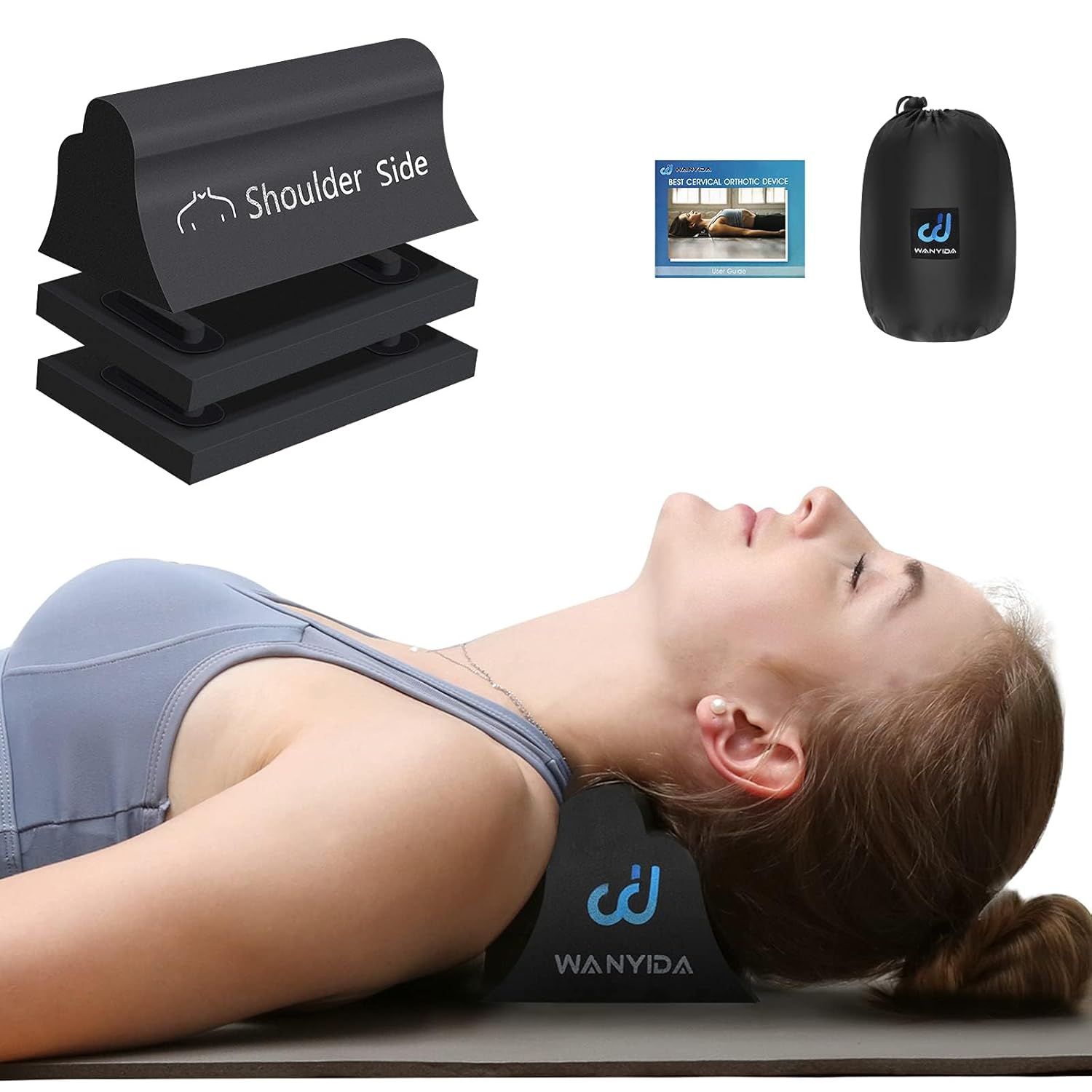
Step four: dosed traction. Lie back on a cervical traction device and let the curve of the tool support the base of your skull. Start with three to five minutes. Build toward ten to fifteen minutes at most, and stop there. More is not better here. The sensation should be a slow, spreading stretch at the back of the neck, never a sharp pull or a pinch.
Step five: reset during the day. Every forty five minutes, stand up, roll your shoulders back ten times, and do five slow chin tucks, pulling your head straight back over your shoulders without tilting. The eight minute routine is what loosens you up. The daytime resets are what keep you loose.
Step six, optional but smart: build some capacity. Ten band pull aparts and a set of rows twice a week will do more for your posture over six months than any passive tool on this page. Stretching buys you range. Strength is what holds it.
Tools that make the routine repeatable
You do not need gear to do steps one, two, three, five, and six. You do need something for step four, and a reminder helps more than most people admit for step five. These are the two I recommend, and both are inexpensive.
For dosed traction: WANYIDA Neck and Shoulder Relaxer, Neck Stretcher Chiropractic Pillows for Pain Relief, Cervical Traction Device for Cervical Spine Alignment,FSA HSA Eligible
 Visit on Amazon →
This is the tool I point people toward for step four, and the reason is the shape. The curved channel cradles the base of the skull and lets gravity do the traction instead of your hands, which means you can actually relax while it works. That matters more than the marketing language on the listing. Traction only helps when your neck muscles stop guarding, and you cannot stop guarding while you are actively pulling on your own head.
The dosing rules from step four apply here without exception. Three to five minutes to start. Ten to fifteen at the ceiling, no longer. If you feel tingling in your fingers, numbness, or any dizziness, get up and stop, because that is a signal, not a stretch. Use it on the floor, not on a soft bed, since a mattress will let your spine sag and change the angle. And this is not a sleep pillow. People who fall asleep on it for two hours wake up worse, not better.
One practical note: it is eligible for FSA and HSA funds, which is worth checking if you have a balance sitting there. Check current Amazon price on the listing, since it moves.
Flaws but not dealbreakers: It is a single purpose tool. It does one job, it does that job well, and it will sit in a closet if you do not build the four minute habit around it. The curve is also fairly firm, so if you are very sensitive at the base of the skull, start with two minutes and a folded towel under the ends.
Anyone with a forward head position and no nerve symptoms who wants a hands free way to decompress at the end of the workday is the right buyer for this.
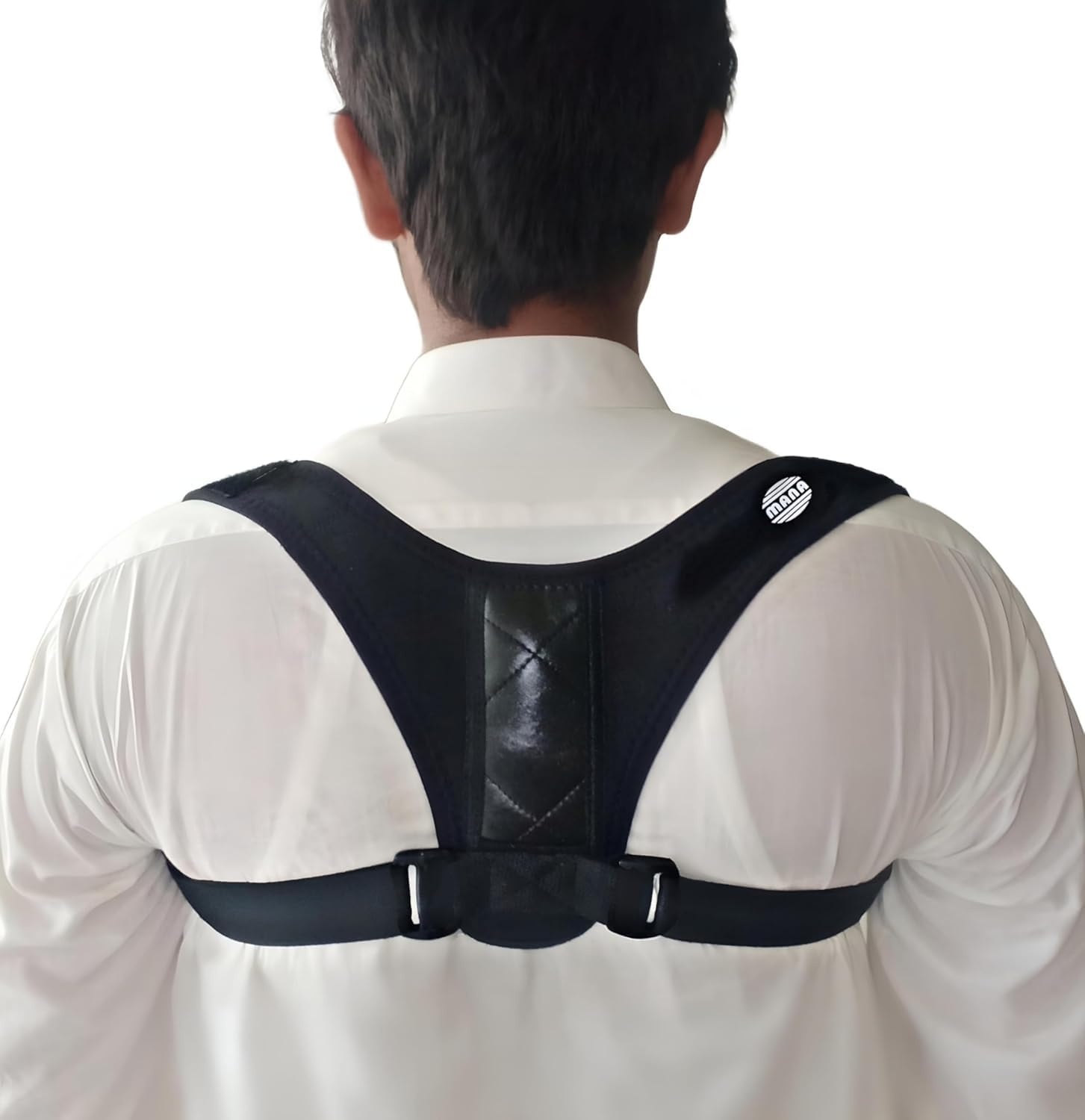
For daytime cuing: Posture Corrector for Men & Women
 Visit on Amazon →
I am careful about this category, because most posture correctors are sold as a fix and they are not one. A brace cannot strengthen your mid back. What it can do is act as a reminder while you are doing something that normally wrecks your position, like a long drive, a stack of paperwork, or two hours of video calls. That is the only job I assign it, and it is a job worth having.
Wear it for twenty to thirty minutes during a specific task, not all day. Take it off when the task ends. Do not sleep in it, do not wear it under a tight shirt to the gym, and do not let it replace step six. If you find yourself needing it every waking hour to feel upright, that is a sign your strength work is behind, not a sign you need a tighter strap.
The fit is adjustable for a wide range of frames, and the design is meant to be low profile enough to wear under a shirt without broadcasting itself to the room. Check current Amazon price before you decide, since this category has a huge spread between near identical products.
Flaws but not dealbreakers: Any brace in this category gets warm and gets itchy after an hour, which is exactly why I cap the wear time at thirty minutes. The straps also tend to loosen slightly with movement, so expect to reset them once per session.
Anyone who spends long stretches in one fixed position and wants a physical reminder to reset should look at this. Anyone hoping it will replace the routine in the previous section should skip it and save the money.
How long until it works
You will usually notice a difference in how your neck feels within the first three or four days of doing the routine daily. That is the easy part, and it is mostly blood flow and a nervous system that has stopped bracing.
Visible posture change is a slower project. Expect six to eight weeks of consistent work before your default resting position starts to shift without you thinking about it. That timeline is why I keep pushing the boring version: eight minutes most days beats forty five minutes once a week, every single time.
If nothing changes after two weeks of daily practice, or if anything is getting worse, that is your cue to get evaluated in person. Self treatment has a ceiling, and it is lower than most people want to believe.
Mistakes that undo the work
Rolling your neck on a foam roller. I see this constantly. You cannot safely load the cervical spine that way, and the muscles you are trying to reach are better served by the steps above.
Percussion on the neck. No. Muscles only, and not these. The neck is a bad place to experiment.
Chasing pain. If you are bracing, sweating, or holding your breath, you are training your nervous system to guard harder. Back off to a pressure you could hold for a full minute.
Stretching cold and hard first thing in the morning. Two minutes of shoulder rolls and walking first, then stretch.
Buying your way out of it. A shelf of tools does not replace eight minutes a day. I own three rollers and I still have to do the work.
What this all costs
The routine itself is free. That is the part that does the heavy lifting, and it is also the part with no return policy.
The two tools are both in the inexpensive tier as recovery gear goes, and I am not going to quote numbers here because they move constantly and vary by listing. Check current Amazon price on each one. Neither is a medical device you need a prescription for, and both are things I would happily hand to a patient who has already ruled out the nerve and joint issues above.
Compare that to the alternative, which is a weekly adjustment or a massage habit at real money per visit, and the math is not close. The tools are cheap. The consistency is what you are actually buying, and that part is on you.
The short version
If you only remember one thing, remember the order: unload the shoulders, lengthen the neck, open the chest, traction briefly, then reset all day. Add a little strength work twice a week and you have a plan that holds up.
Your neck is not fragile, and it is not broken. It is tired, it is doing a job your mid back should be sharing, and it responds to small doses far better than it responds to heroics. Give it eight minutes a day and a reason to stop guarding, and it will meet you halfway.