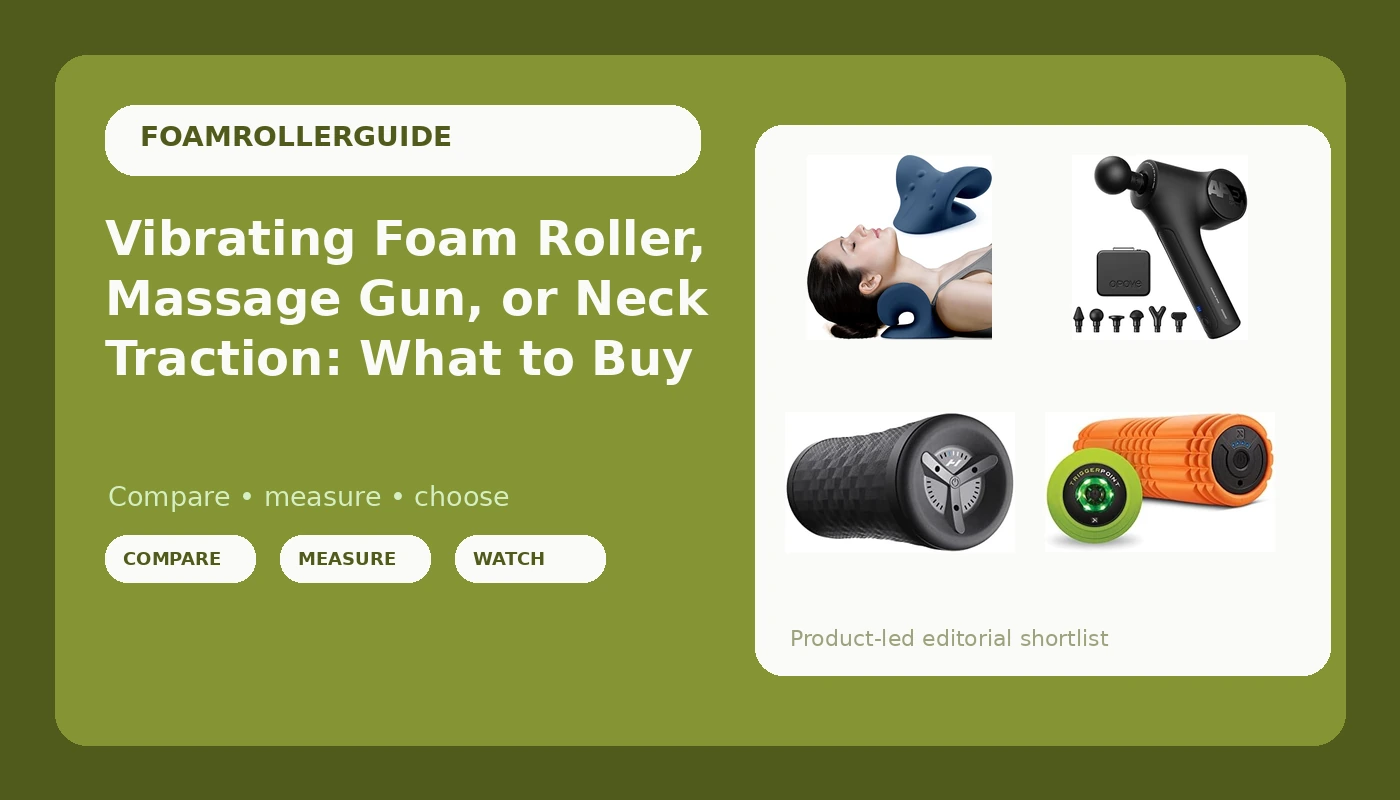
Recovery gear has a sorting problem. Walk down the aisle of any fitness store and you will see a vibrating foam roller, a percussion massage gun, a plastic neck cradle, and a textured roller set all sold with the same three words: deep tissue relief. They are not the same tool and they do not do the same job. One is for a large muscle group you can wrap both hands around. One is for a knot you can point to with one finger. One is for a neck that has been folded over a laptop since Tuesday. Buy the wrong one and you will not get hurt, but you also will not use it, and a recovery tool that lives in the closet helps nobody. This is a breakdown of four devices, what each one is actually for, and how to decide which one belongs in your routine.
Related: Foam Rolling Before or After a Workout: How to Sequence Recovery →
Quick answer
Match the tool to the tissue. The RESTCLOUD Neck and Shoulder Relaxer is a cervical traction device, so it belongs under a neck, not under a quad. The Opove Apex Massage Gun delivers percussion, which suits large muscle bellies you can isolate. The Hyperice Vyper 3 is a vibrating roller built for broad, full-length work. The TriggerPoint GRID Vibe Plus pairs a vibrating roller with a vibrating ball for spot treatment. If you want one purchase that covers the most surface area, a roller does that. If your problem is a specific knot in a calf, glute, or foot, a ball or a percussion head reaches it. Do not put a massage gun on your neck or spine.
Four useful options
| Model | Best fit | What stands out |
|---|---|---|
| RESTCLOUD Neck and Shoulder Relaxer | Neck and upper-shoulder tension | Shaped for cervical traction rather than rolling |
| Opove Apex Massage Gun | Large muscle bellies that need targeted percussion | Handheld percussion device with a listed 14.5 mm amplitude |
| Hyperice Vyper 3 Vibrating Foam Roller | Full-length rolling with added vibration | Vibration built into a full-size roller for myofascial release work |
| TriggerPoint GRID Vibe Plus | Roller work plus spot treatment | Vibrating roller bundled with a vibrating massage ball |
Neck and shoulder relief: RESTCLOUD Neck and Shoulder Relaxer
The neck is the one area where I want people using a shape, not a cylinder. You cannot safely roll your cervical spine with body weight, and a massage gun near the neck is a bad idea no matter how good the marketing is. A traction-style cradle works differently: you lie down, the curve of the device supports the head, and gravity does the work while the muscles around the neck get a chance to stop guarding. Sessions are short, usually a few minutes at a time, and the position should feel like a gentle stretch, never like a stretch you are enduring. If you feel dizziness, tingling, or numbness into the arm, come off it. This is also the least athletic of the four products, and that is exactly the point. It serves desk workers and anyone whose upper traps have been clenched since breakfast.
Percussion: Opove Apex Massage Gun
A massage gun is a convenience tool, and convenience is a real clinical variable. Rolling a calf properly takes floor space, a mat, and a few minutes of awkward positioning. A handheld percussion device takes ten seconds and can be used standing in a kitchen. The trade-off is precision of a different kind: you control the pressure with your own hand, which means it is easy to press too hard on a tender spot and call it progress. The rules I give people are simple. Muscle bellies only, never bone, joint, or spine. Keep the head moving instead of parking it on one spot. Thirty to sixty seconds per area is plenty, and if the area is bruised or swollen, skip it entirely. A gun is also not a warm-up substitute for actually moving, and it will not fix a strength problem that keeps the same knot coming back.
Full-length vibration: Hyperice Vyper 3 Vibrating Foam Roller
Vibration is the feature people ask me about most, and my honest answer is that it is a nice addition rather than a transformation. The pressure and the rolling motion do the main work. What vibration appears to add is sensory input that can make a tight area feel less guarded, which is why some people tolerate a vibrating roller better than a plain one at the same firmness. If you already roll consistently, a vibrating roller is an upgrade you will notice in comfort, not a new capability. If you do not roll consistently, buy a plain firm roller first and save the money. This is also the heaviest and least portable of the four options, so if your routine happens at a gym rather than a living room floor, think about whether you want to carry it.
Roller and ball combo: TriggerPoint GRID Vibe Plus
The ball is the underrated half of this set. A roller cannot get into a glute the way a ball can, and it cannot work the arch of a foot at all. The ball can, and it can do it against a wall, which matters for anyone who cannot comfortably get down on the floor. The textured roller surface is a preference, not a requirement: some people like the extra grip, some find it irritating on bare skin, and neither reaction means the tool is working or failing. If you are choosing between this set and a single vibrating roller, the deciding question is whether your problem areas are long muscles or small ones. Long muscles favor the roller. Small, stubborn spots favor the ball, and this bundle gives you both.
Prices and availability may change. Product images, names, and retailer links are matched to verified listings. No current price, rating, stock status, or measured result is stated here without current evidence.
Density, vibration, and percussion are three different jobs
Density is how firm a roller is, and it is the single most misunderstood spec in this category. A soft roller is correct for a ribcage, a sensitive low back, or a first-time user who tenses up the moment they touch the floor. A firm roller is correct for a quad or a hamstring, where a soft surface simply compresses and does nothing. The common mistake is buying one density for the whole body. That is like owning one screwdriver.
Vibration is a comfort and sensory feature layered on top of density. It does not replace pressure, and it does not change the tissue under your skin. Rolling does not break up scar tissue, and any product page that promises that is selling you a story. What rolling appears to do is load tissue, increase local blood flow, and give the nervous system a strong, non-threatening input that can reduce the sensation of tightness. That is a real benefit. It is just not the benefit the packaging claims.
Percussion is a different mechanism again. The gun hammers a muscle belly at a high rate, which people describe as loosening and which may be more about nervous system input than mechanical change. It is excellent for reaching a calf or a glute without floor work and terrible for anything with bone under thin skin. Traction, the fourth job, is passive: it positions the neck so that gravity can create a gentle stretch while the surrounding muscles stop working.
None of these tools build strength. If a knot returns every week, the answer is usually load management, mobility, or strength work, not a firmer roller.
How to choose in five steps
- Name the body part first. Neck, feet, and glutes point toward a cradle or a ball. Quads, hamstrings, and back point toward a roller.
- Name the timing. Before a workout, you want a short, light pass to prep. After a workout, you want slower work at a pressure you can breathe through. These are different sessions, not interchangeable ones.
- Match the format to your space. If you have no floor space, a percussion gun or a ball against a wall beats a roller you never unroll.
- Set the dose before you start. Two minutes per muscle group, pressure around a four to six out of ten, is a protocol. Twenty minutes of gritting your teeth is not.
- Check the six-month test. Would you still use this in February? If the honest answer is no, buy the simpler, cheaper version of the same idea.
Five rules I give patients
- Never roll your neck or your lumbar spine directly with a hard tool.
- Never use a percussion gun on bone, joints, the spine, or the neck.
- Keep pressure uncomfortable but not painful. If you are holding your breath, you are too deep.
- Roll before training to prep, after training to recover, and treat them as different doses.
- Give any new tool two consistent weeks before you decide it does not work.
Which option should you choose?
Choose the RESTCLOUD Neck and Shoulder Relaxer when your tension lives in the neck and upper shoulders and you want a passive tool you can use while lying down. Choose the Opove Apex Massage Gun when you want targeted percussion on large muscle bellies and value being able to do it standing up. Choose the Hyperice Vyper 3 Vibrating Foam Roller when you already roll regularly and want the comfort of vibration in a full-size roller. Choose the Triggerpoint Grid Vibe Plus Massaging Foam Roller + MB Vibe Massage Ball when you need both broad rolling and spot treatment and would rather buy one set than two tools.
There is no single tool here that covers every job, and no evidence that any of them replaces movement, sleep, or progressive strength work. The vibration and percussion categories in particular have modest research behind them, so treat the comfort and consistency benefits as the honest reason to buy rather than a clinical guarantee.
The bottom line
The best recovery tool is the one that fits the body part you actually have a problem with and the routine you actually keep. A neck cradle, a percussion gun, a vibrating roller, and a roller-and-ball set are four answers to four different questions, and buying the wrong one is why so many of these devices end up behind a couch. Start with the target tissue, choose the format that reaches it, and set a dose you can repeat. Consistency at a sensible pressure does more for you than any single feature on a spec sheet, and if a tool hurts, that is information, not a workout.