Recovery tools for sore muscles do not all do the same job, even when they sit on the same shelf and get described with the same three words: deep tissue, relief, trigger points. That overlap is what makes the decision feel harder than it is. The useful question is not which tool is the most powerful. It is which tool matches the tissue you are trying to reach, the position your body is in when you use it, and the amount of time you will honestly give it on a Tuesday night.
That last part gets ignored in most buying advice. A tool that requires you to lie on the floor at 6 a.m. competes with sleep. A tool that lives in a gym bag gets used on the road. A brace you wear at a desk gets used every workday, which is a completely different kind of consistency than a rolling session. Consistency is the variable that actually produces results, and it is set by the format, not by the marketing.
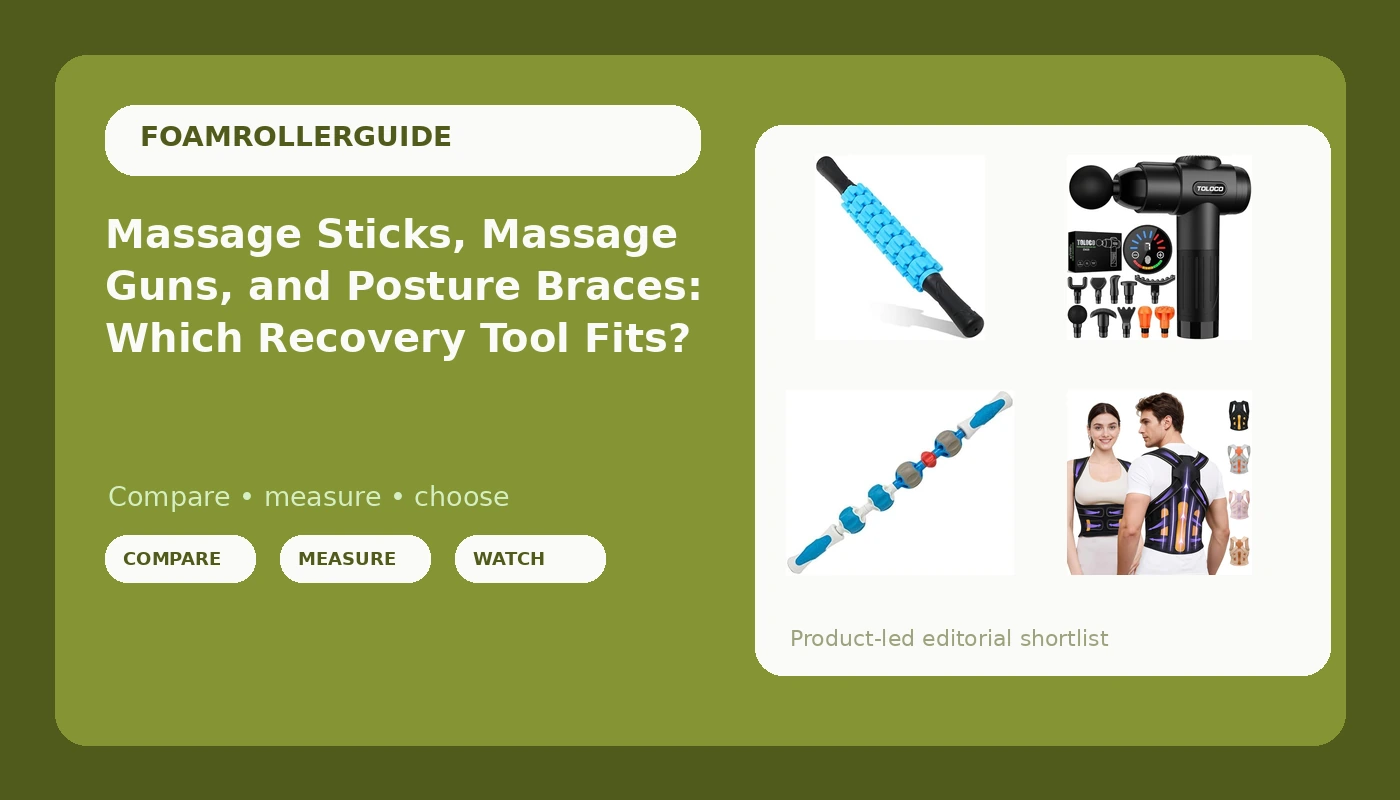
This guide covers four options in that space: two hand-held massage sticks, the ZanLLW Massage Roller and the ProStretch Pro Roller, a percussion massager, the TOLOCO Massage Gun, and a posture brace with five support rods. Each is built around a different job, and none of them replaces the others.
Related: How to Foam Roll Your Quads Without Wincing →
Quick answer
Match the format to the tissue first, then to your routine. Hand-held sticks give you the most control over pressure and work well on legs, calves, and thighs, plus any spot you want to press precisely. A percussion massager covers larger muscle groups with less effort from you, but it belongs on muscle bellies only, never on the neck, spine, or joints. A posture brace is a wearable cue for desk hours, not a strength program. If you are buying only one thing, buy the format you will actually pick up: a stick you keep next to the couch beats a gun that stays in its case.
4 useful options
| Model | Best fit | What stands out |
|---|---|---|
| ZanLLW Massage Roller | Legs, calves, and thighs you can reach while seated | Stick format with handles, listed for legs, calves, thighs, and trigger points |
| ProStretch Pro Roller | Precise pressure on one sore spot at a time | Compact massage stick listed for muscle soreness and trigger points |
| TOLOCO Massage Gun | Larger muscle groups where you want coverage | Ten interchangeable heads and a brushless motor the listing describes as silent |
| Posture Corrector for Women and Men | A wearable posture cue during desk work | Five support rods, adjustable shoulder straps, FSA and HSA eligible |
Percussion for big muscle groups: TOLOCO Massage Gun
The appeal of percussion is coverage. A gun can reach the middle of a back or the top of a hamstring without you contorting yourself, and ten heads let you swap between a broad pad and a narrow tip depending on the area. The trade-off is control: the device sets the rhythm, and a fast setting on a small muscle is easy to overdo. Keep the head moving, stay on muscle bellies, and skip the neck, the spine, and any bony point. A short pass at a moderate setting is a recovery tool. Five minutes at full speed on one spot is a bruise.
A stick for legs and calves: ZanLLW Massage Roller
A stick solves a positioning problem that a floor roller cannot. You can work a calf while sitting on the couch, and you can carry it in a bag. Handles on either end let you dial pressure with your grip, which matters for anyone whose tolerance changes from day to day. The format is at its best on limbs and on the outer thigh, where you can wrap the stick around the tissue and lean in. It is a poor choice for the middle of your back, where you cannot generate much force or reach, and it will not substitute for a broad roller on large areas.
Pinpoint pressure: ProStretch Pro Roller
Two sticks in one article can sound redundant, but they are not identical purchases. A compact stick is easier to control for pinpoint work: you press a small contact area into one spot, hold, and breathe, rather than sweeping the whole muscle. That is the right approach for a stubborn spot in a quad or a calf. The limitation is the same as any hand-held tool. Precision takes time, and if you want to cover both legs after a long run, a small stick means more passes and more patience.
A wearable cue for desk hours: Posture Corrector for Women and Men
A brace with support rods works differently from everything else here. It does not roll or percuss anything. It pulls your shoulders into a position and reminds you, through tension, to hold it. Used for defined blocks of desk hours, that reminder can be genuinely useful, especially in the first weeks of building a posture habit. Used as a substitute for strength work, it becomes a crutch: the muscles that hold your shoulders back still need to be trained, and a brace does not train them. Fit and wear time matter, so check the sizing guidance before ordering, and build up the hours gradually.
Prices and availability may change. Product names, images, and retailer links here are matched to the listings shown. Check current Amazon price and availability on the retailer page before you buy, and do not rely on a product page in place of advice about a diagnosed condition.
Rolling, percussion, and bracing are three different jobs
Myofascial release is the popular name for what a roller or a stick does, and the honest version of the science is less dramatic than the packaging suggests. Rolling does not break up scar tissue or permanently lengthen a muscle. What it appears to do is increase blood flow to the area, feed the nervous system a strong sensory input, and produce a short-term increase in how much range of motion you have. That temporary window is useful: it is why rolling before a workout and rolling after a workout are different sessions with different goals.
Density is the variable that matters most in a roller, and it applies to sticks too. A soft surface is correct for a ribcage or a tender area. A firm surface is correct for a hamstring or a quad that needs real pressure. The mismatch to avoid is a soft tool on a tissue that needs firm input, which is why a roller described as deep tissue but built soft tends to end up in a closet.
Percussion is a separate mechanism. A massage gun delivers rapid, repeated pressure impulses into muscle tissue. That can feel good and can help with a tight area, but the impulse does not know the difference between a muscle belly and a vertebra. That distinction is on you, which is why the neck, the spine, and joints are off limits.
A posture brace is not a recovery tool in the same sense at all. It changes position and provides an external cue. It can support a posture habit; it cannot build the endurance that holds a position on its own. Treat it as one input among several, and it earns its place.
How to choose in five steps
Start with the tissue, then work outward to the format, the pressure, and the routine. The steps below are the same ones worth running through before any recovery purchase.
- Name the body part you actually need to work on most often, not the one you feel guilty about.
- Decide where you will use the tool: floor, couch, gym bag, or desk chair. That location eliminates formats quickly.
- Match the format to the job: a stick for limbs and precise spots, a percussion gun for broad coverage of large muscles, a brace for posture cueing during desk hours.
- Look at adjustability and pressure range rather than the words on the box. Handles, interchangeable heads, and adjustable straps are the features that change how a tool behaves.
- Set a realistic dose before you buy. A few minutes per muscle group at a pressure that is uncomfortable but not painful is a protocol. An hour of suffering is not.
How to use any of these without making things worse
- Roll before a workout to prepare and after a workout to recover. They are not interchangeable, and the dose is different for each.
- Keep pressure at uncomfortable but not painful. If you are holding your breath or bracing against the tool, back off.
- Start with about two minutes per muscle group and add time only if the tissue still feels like it needs it.
- Never run a percussion massager over the neck, the spine, or a joint. Muscle bellies only.
- Wear a posture brace in defined blocks of time, pair it with strengthening work, and take it off when the block ends.
- Keep the tool where you will see it. Visibility beats willpower.
Which option should you choose?
Choose the ZanLLW Massage Roller when your soreness lives in your legs, calves, or thighs and you want to work those areas while sitting down or away from home. Choose the ProStretch Pro Roller when you want precise pressure on a specific sore spot or trigger point rather than broad coverage. Choose the TOLOCO Massage Gun when you want to reach large muscle groups with less physical effort from your own hands and arms. Choose the Posture Corrector for Women and Men when the problem you are actually trying to solve is a posture habit during long desk hours, and you want a physical reminder to hold your shoulders back.
These are different jobs, and buying two of them is not redundant if your routine has two problems. The combination that covers the most ground for most people is one hand-held stick for limbs and one posture cue for desk hours, with a percussion massager added only if you want powered coverage of larger areas.
None of these listings includes clinical testing on your specific injury, and a product page cannot tell you whether rolling or percussion is appropriate for a diagnosed condition. Sharp pain, radiating pain, numbness, or symptoms that are getting worse are a conversation with a clinician, not a purchase.
The bottom line
Pick the format that matches the tissue and the room you will use it in, then judge the tool by whether it survives six months of real use. A hand-held stick gives you the most control for legs, calves, and precise spots, and it travels well. A percussion massager buys you coverage of larger muscles at the cost of some control, and it comes with hard limits around the neck, spine, and joints. A posture brace is a wearable cue for desk hours that works alongside strength work rather than instead of it. The most expensive option is the one that stays in the closet, so choose the tool that fits the routine you already have.