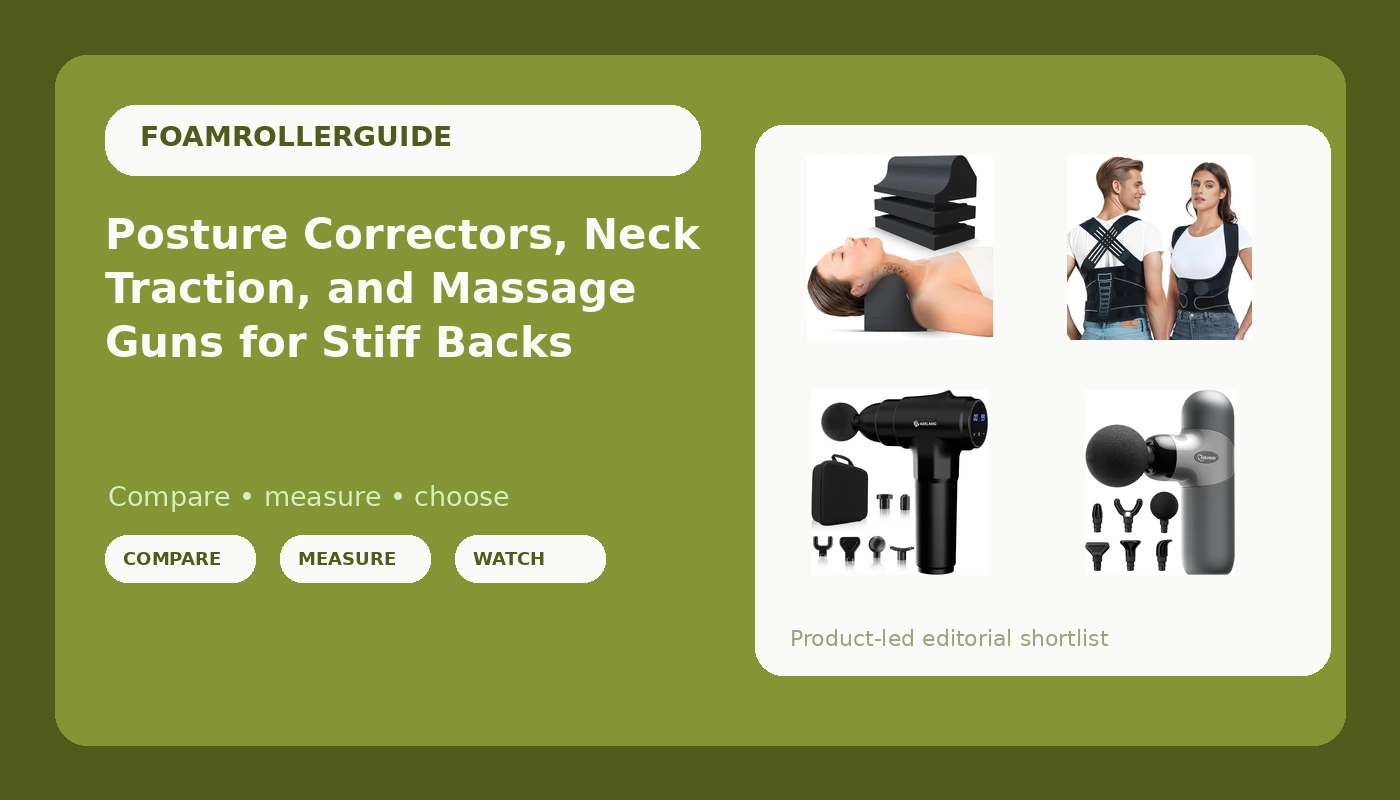
If your upper back aches by mid-afternoon and your neck feels like it is being pulled forward on a string, you have probably already typed posture correctors and massage guns into a search bar. The trouble is that this category mashes three different jobs together. A brace cues a position. A traction device unloads and lengthens. A percussion gun changes muscle tone after effort. Those are not interchangeable, and buying the wrong one for your problem is how a tool ends up in a closet by February. I have spent twelve years treating backs and necks in a clinic, and the questions I ask before recommending anything are simple: what is the target, how long will you actually use it, and what else are you doing about it? Here is how four tools divide the work.
Related: Foam Rolling vs Massage Gun: Which Recovery Tool Fits Your Routine →
Quick answer
There is no single tool that fixes posture, because posture is a behavior, not a body part. If neck tension and a forward head position are the complaint, a cervical traction device is the more direct fit. If your lower back needs support and a reminder to stay tall, a posture brace with a vertical alignment system addresses that job. If the issue is muscle tightness after training or a long day, a percussion massager belongs in the rotation, and a compact mini model covers travel and small spaces. Most people get further by picking one tool that matches their main complaint and pairing it with daily movement than by buying all four.
Four useful options
| Model | Best fit | What stands out |
|---|---|---|
| Cervical Traction Orthotic Chiropractic Neck Alignment Device (Black) | Forward head posture and neck tension | Built for cervical traction and spinal curve stretching |
| Back Brace Posture Corrector with Spine Vertical Alignment System (Black, Medium) | Lower back support and posture cuing | Spine vertical alignment system, sized by waist measurement |
| Massage Gun Back Massager Deep Tissue for Athletes | Post-training work on large muscle groups | Full-size deep tissue percussion format |
| cotsoco Mini Massage Gun | Travel and small-space recovery | Compact handheld with six heads and four speeds |
Featured option: Back Brace Posture Corrector with Spine Vertical Alignment System
Here is the honest version of how braces work. A brace gives your nervous system a reference point: when you slouch, you feel the pull and you correct. That feedback is useful, especially in the first weeks of changing a habit, and it is why I still hand them out. What a brace does not do is build endurance in the muscles that hold you upright. Wear it for a couple of hours at a desk, then take it off and do the work: rows, dead bugs, a daily walk. Worn all day, every day, it trains you to lean on it. Sizing matters more than anything here, which is why the waist measurement in the listing is worth checking with a tape measure before you order.
For neck tension: Cervical Traction Orthotic Chiropractic Neck Alignment Device
Traction is the tool I get the most questions about, and the one that is most oversold. Done gently, it can feel like a long exhale for a neck that has been held forward over a laptop. Done aggressively, it is a reliable way to irritate a joint. Start with short sessions measured in a couple of minutes, at a level that feels like lengthening rather than pulling, and stop if you feel tingling, numbness, or dizziness. Traction is also passive, which means it buys you a window of ease. Use that window to move: chin tucks, shoulder blade squeezes, a screen raised to eye level. With a history of disc issues, stenosis, or recent injury, get cleared before trying traction at home.
For muscle work: Massage Gun Back Massager Deep Tissue for Athletes
Percussion is the most misused recovery tool I see. People run a gun up and down the spine and across the neck, then wonder why they have a headache. The rule is simple: muscle bellies only. Calves, quads, glutes, lats, upper traps. Two minutes per group is a working dose, and you do not need ten. Pressure should be uncomfortable but not painful, and you should be able to breathe normally the whole time. If a spot is genuinely tender, a slower pass with less pressure does more than hammering at it. A full-size gun like this one covers big areas efficiently, which makes it a reasonable fit for someone training hard several days a week.
For travel: cotsoco Mini Massage Gun
A mini gun lives in a bag, which is the entire point. The one you have with you beats the powerful one at home, and for small muscle groups the smaller amplitude is not much of a loss. Where it falls short is dense tissue: a big quad or a tight glute usually wants more reach and more amplitude than a palm-sized tool can deliver. If your recovery routine happens at a gym with equipment around, a larger gun makes more sense. If it happens in a hotel room at six in the morning before a meeting, this is the category that actually gets used.
Prices and availability may change. Product images, names, and retailer links are matched to verified listings. No current price, rating, stock status, or measured result is stated here without current evidence.
What each type of tool actually does
Passive tools get a bad reputation in rehab circles, mostly for good reason: they are easy to lean on and hard to keep honest. But each category here does something specific.
A posture brace changes input. It gives your trunk constant feedback about where tall is, which can be genuinely useful while you build the endurance to hold that position yourself.
Cervical traction changes load. By applying a gentle pull along the neck, it temporarily reduces compression and lets irritated tissue settle. That is a window, not a cure.
A percussion massager changes tone. Rapid pressure appears to influence how a muscle feels and how much blood is moving through it, which is why it fits so well after training. What it does not do is lengthen tissue or break anything up, and anyone telling you otherwise is selling something.
None of these replace movement. The research on posture and back pain keeps pointing the same direction: how often you move matters more than how perfect any single position is. A tool that helps you move more comfortably is worth owning. A tool that becomes an excuse to move less is not.
Dosing: how long, how hard, how often
This is where most home recovery goes wrong, in both directions. People either use a tool once, feel nothing dramatic, and quit, or they use it hard every day and irritate something.
A workable frame: wear a brace for one to two hours at a time during the task that wrecks your posture, then take it off, and never sleep in it. Start traction at a couple of minutes once a day and build slowly, with a gentle pull and no tingling. Keep percussion to about two minutes per muscle group at moderate pressure, moving rather than parked on one spot. Daily use is fine for gentle tools, so raise intensity slowly rather than duration.
Two weeks is a fair trial. If your main complaint has not shifted at all, the tool is probably mismatched to the problem, and it is worth reassessing with a clinician rather than buying a fourth gadget. If you are deciding between these four, work through this in order:
- Name the target: neck and upper back, lower back, or muscle tightness after effort. Different targets, different tools.
- Check for red flags. Radiating pain, numbness, weakness, or a recent injury means a clinician first and a tool second.
- Pick the mechanism you need: positional feedback, unloading, or a change in muscle tone.
- Match the tool to your environment. The best-designed tool you leave at home is furniture.
- Set a dose and a review date: two weeks, a specific number of sessions, then decide whether to keep going.
Putting these tools into a week that works
- Wear a posture brace in short, purposeful blocks during the activity that pulls you into a slump, not from morning to night.
- Keep percussion on muscle bellies. Neck, spine, and joints are off limits, with no exceptions.
- Treat traction as gentle lengthening, not a stretch you push through.
- Store the tool where the habit happens: brace at the desk, mini gun in the travel bag, full-size gun by the gym bag.
- Pair every passive session with two minutes of active work, like chin tucks, rows, or a walk around the block.
Which option should you choose?
Choose the Back Brace Posture Corrector with Spine Vertical Alignment System when your main complaint is lower back support and you want a reminder to stay tall during desk work or long drives, and when a waist measurement between 32 and 40 inches puts you in the Medium. Choose the Cervical Traction Orthotic Chiropractic Neck Alignment Device when your tension sits in the neck and upper back and you want a lying-down stretch and unload session at the end of the day. Choose the Massage Gun Back Massager Deep Tissue for Athletes when you train hard and want a full-size percussion tool for large muscle groups afterward. Choose the cotsoco Mini Massage Gun when portability decides whether you use it at all, and when your target areas are small enough for a palm-sized tool.
One caveat on the marketing. Listings in this category promise pain relief and instant correction, and those words describe intent, not guaranteed outcomes. A brace cannot straighten a spine, traction cannot undo years of desk posture in a week, and a massage gun cannot fix a joint. Fit and sizing matter for the brace, and anyone with a diagnosed spinal condition, a recent injury, or nerve symptoms should treat these as adjuncts to a plan from a clinician rather than a substitute for one.
The bottom line
The right purchase here is the one that matches your complaint and survives your routine. If your neck is the problem, traction. If your lower back and desk posture are the problem, a properly sized brace. If tight muscles after training are the problem, a percussion gun, full size for the gym and mini for the road. Buy one, use it at a set dose for two weeks, and judge it on whether you moved better, not on whether it felt dramatic. Check current Amazon price on the option that fits, and put what you save by not buying all four toward a pair of shoes you will actually walk in.