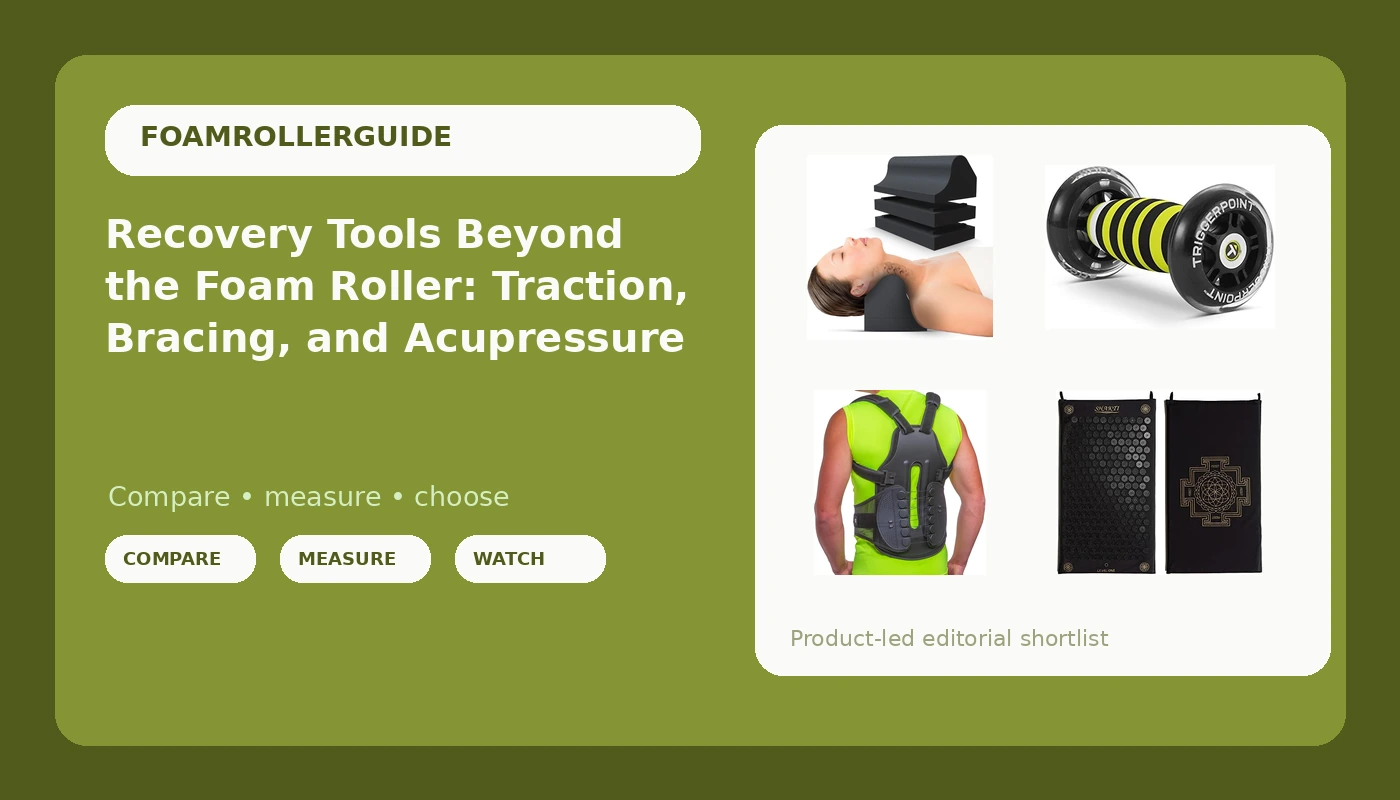
Most people who own a foam roller eventually hit the same wall. The big muscles feel better, but the things that actually bother them, a stiff arch in the morning, a neck that aches after a laptop day, a mid-back that will not straighten out, do not respond to a cylinder on the floor. That is where the wider category of posture recovery tools comes in. A foot roller, an acupressure mat, a cervical traction device, and a rigid back brace all do different jobs, and none of them replaces the others. This explainer walks through what each one is for, who it fits, and how to tell whether it belongs in your routine at all.
Related: Foam Rolling for Posture: Where to Start →
Quick answer
The right pick depends on the body part and the goal, not on which product sounds most intense. A foot roller handles arches and plantar tension. An acupressure mat is a lying-down tool for tension release and relaxation. A cervical traction device is targeted neck work that deserves guidance before you start. A rigid TLSO brace is a clinical device worn as part of a treatment plan, not a home-fitness upgrade. None of these replaces a foam roller, and a foam roller does not replace any of them.
Four useful options
| Model | Best fit | What stands out |
|---|---|---|
| TRIGGERPOINT Performance Nano LTE Foot Roller Massage Roller | Feet, arches, and plantar tension | A roller sized and shaped for the foot rather than the whole body |
| ShaktiMat Acupressure Mat for Tension Release & Relaxation, Level 1 | Wind-down and general tension release | Acupressure surface used lying down; Level 1 intensity |
| Cervical Traction Orthotic Chiropractic Neck Alignment Device | Forward head posture and neck stretching, with clinical guidance | Traction-based device aimed at spinal curve tension |
| BraceAbility TLSO Full-Body Back Brace Support | Prescribed rigid support for thoracic and lumbar posture | Hard turtle shell jacket design, listed for postural correction and post-surgical recovery |
For the feet and arches: TRIGGERPOINT Performance Nano LTE Foot Roller Massage Roller
The foot is the body part people most often skip, and it is usually the one complaining first. A full-size roller is the wrong tool for an arch: it is too wide, too long, and it forces you into a standing position that loads the very tissue you are trying to calm. A foot roller lets you work seated, rolling from heel to ball with steady pressure and no need to balance. The trade-off is narrow scope. It will not do anything for your quads, and it will not fix a foot problem that comes from training load, footwear, or a sudden jump in mileage. It is a local tool for a local complaint, and it works best as a few minutes of daily maintenance rather than a heroic session once a month.
For wind-down and general tension: ShaktiMat Acupressure Mat for Tension Release & Relaxation, Level 1
Acupressure mats and foam rollers get lumped together because both involve lying on something uncomfortable, but they are doing different work. A roller applies moving, mechanical pressure to a muscle. A mat applies thousands of static points across a broad area, and the effect most people notice is a shift in how wound up they feel rather than a change in tissue length. That makes it a good fit for the end of the day, for people who cannot tolerate much pressure, and for anyone whose recovery problem is really a sleep-and-stress problem. Be realistic about the trade-off: relaxation is not the same as strengthening, and a mat will not correct forward head posture on its own. If you have a skin condition, reduced sensation, or a bleeding disorder, ask a clinician before using one.
For the neck and forward head posture: Cervical Traction Orthotic Chiropractic Neck Alignment Device
The neck is the one region where I want a clinician in the conversation before a device shows up at the door. Traction can be genuinely useful for some cervical complaints and completely inappropriate for others, including instability, recent injury, or certain disc and nerve problems. That is not a reason to avoid it; it is a reason to get assessed first and to use short, gentle sessions rather than long ones. Stop immediately if you feel numbness, tingling, dizziness, or a headache that builds. And to be clear about a related habit: percussion guns do not belong on the neck, ever. A device designed for traction is a different tool with a different risk profile, and it still needs a plan behind it.
For prescribed structural support: BraceAbility TLSO Full-Body Back Brace Support (Large)
A rigid brace is not a posture gadget, and treating it like one is how people end up worse off. It limits motion on purpose. It is worn for a defined period, for a defined reason, usually under a physician's or orthotist's direction, and it is often paired with a plan for what happens when it comes off, because long-term reliance can leave supporting muscles underworked. Fit matters enormously: a shell that sits wrong will be painful and ineffective at the same time. If you are considering this category, the ordering decision comes after the clinical decision, not before it.
Prices and availability may change. Product images, names, and retailer links are matched to verified listings. No current price, rating, stock status, or measured result is stated here without current evidence.
Why a foam roller is not the whole answer
Rolling does a few things well. It creates movement and blood flow in tissue, it gives the nervous system a strong sensory input that can change how tight a muscle feels, and it is an easy way to get the thoracic spine moving before you train. What it does not do is restructure a spine. I say this plainly because the marketing does not: you are not breaking up scar tissue, and you are not lengthening a muscle permanently. You are temporarily changing tone and sensation, which is useful, but temporary.
Posture, meanwhile, is driven by strength, endurance, habit, and sometimes structure. If your head sits forward because your deep neck flexors fatigue in twenty minutes, no amount of rolling your upper back will fix that. If your mid-back is stiff, rolling can help you get the extension you need to train the muscles that hold you upright. If your spine has a structural curve or you are recovering from surgery, you are in a different conversation entirely, one where a rigid orthosis may be part of the answer.
That is the reason these four products do not compete. They sit in three different buckets: muscle tools, nervous-system tools, and structural support. Confusing the buckets is how people buy the wrong thing and conclude that recovery gear does not work.
Matching intensity to the tissue you are targeting
Density is not a measure of quality. It is a measure of match. A soft surface over a ribcage is correct, because the tissue underneath is not designed to take a hard load. A soft roller on a hamstring is a waste of time, because the muscle will barely register it. The same logic applies to the tools here: a Level 1 acupressure mat is the sensible starting intensity, a foot roller concentrates pressure in a small area, and a rigid brace applies support rather than pressure.
The dose rules are boring and effective. Roughly two minutes per area, pressure that is uncomfortable but not painful, and steady breathing throughout. If you are grimacing or holding your breath, you are past the useful range, and the tissue you are working on is tensing against you rather than releasing.
- Name the body part and the symptom in plain language before you shop.
- Decide whether the problem is muscle tone, nervous-system arousal, or structural support.
- Pick the intensity you can actually tolerate today, not the one you imagine tolerating in a month.
- Rule out reasons to get assessed first, especially for the neck, the spine, and anything post-surgical.
- Choose the tool that fits where you will genuinely use it, because the one in the closet helps nobody.
How to fit these into a real week
- Use the foot roller seated while you work or watch something, a few minutes per foot, rather than as a separate event you have to schedule.
- Keep the acupressure mat for the last thirty minutes of the day, when the goal is downshifting rather than fixing.
- Treat neck traction as a short, deliberate session, never something you do while distracted, and stop at the first odd sensation.
- If a brace has been prescribed, follow the wearing schedule you were given instead of improvising based on how your back feels that morning.
- Reassess every few weeks. A tool that stopped helping is either the wrong tool or a sign the problem changed.
Which option should you choose?
Choose the TRIGGERPOINT Performance Nano LTE Foot Roller Massage Roller when the complaint is in the arch, heel, or plantar surface and you want a seated, low-effort way to work it daily. Choose the ShaktiMat Acupressure Mat for Tension Release & Relaxation, Level 1 when your recovery problem is really about winding down and you want a passive session that does not demand much tolerance for pressure. Choose the Cervical Traction Orthotic Chiropractic Neck Alignment Device when forward head posture and neck tension are the target and you have talked through traction with a clinician who knows your history. Choose the BraceAbility TLSO Full-Body Back Brace Support when rigid support has been prescribed for a structural or post-surgical issue and you need the correct size.
A caveat worth repeating: none of this is diagnostic. Devices do not know what is causing your symptoms, and a listing that names a condition is not the same as a clinician confirming you have it. If you have neurological symptoms, unrelenting pain, or a recent injury or surgery, the ordering decision waits.
The bottom line
Foam rolling earns its place, but it only addresses one of the three jobs recovery gear has to do. Muscle tools like a foot roller handle local tissue. Nervous-system tools like an acupressure mat handle the wind-down side that most people neglect. Structural support like a rigid TLSO belongs to a clinical plan and should stay there. Buy the tool that matches the body part and the job, use a dose you can tolerate, and let the boring consistency do the work.